


How to Use Consumer Data from Tracking Surveys
When diving into data analysis for your business, the sheer volume of data can be overwhelming. Having a better understanding of your data so you can identify how to target your consumer is essential. There are many tools available for market insights: consumer tracking data, government data, internal sales data, industry association data, POS. In this article, we’ll focus on how tracking surveys can give you a wealth of information about customers and give you a competitive advantage in pursuing potential customers to help move your business forward (for more on the others, click here). By using tracking surveys like OpenBrand, you are able to track, monitor, and compare behavior and market trends to create significant value for your company.

Tracking and Monitoring
An important component to understanding your customer is to recognize your customers’ purchasing behavior. Every company should be tracking and monitoring their customers’ purchasing behavior over time to identify movements and market share trends. When looking at the changes in market share for you and your competitors, you can identify if particular competitors are gaining or losing ground. Consistency over time provides great insight in comparing price levels and market share trends. Here are some key measures that you can track over time:
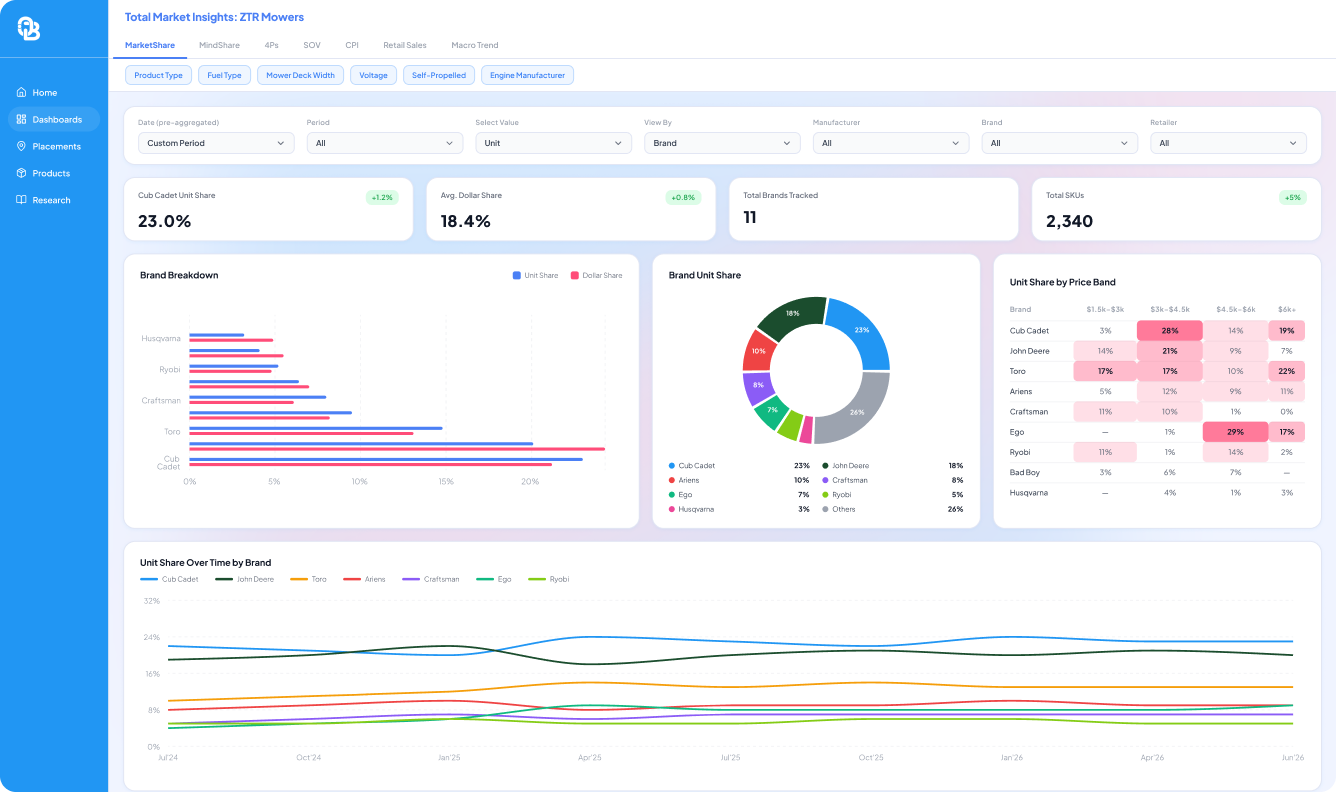
Market Share – Every brand and retailer can look at comp sales. But while it may be great to see that you’ve grown your sales volumes by 15% vs. last year, if the market grew by 20%, you may be in trouble. Market share takes into account market growth as well as your growth and provides a scorecard for performance. As an added, and possibly more important, bonus, not only can you track your performance, but also your competitors as well. Add in the ability to track up-and coming brands and this metric is indispensable.
Pricing trends – a quick look at unit shares and dollar shares will often reveal a disparity between each. A higher unit share compared to dollar shares highlights lower than average industry pricing. This insight can help you understand positioning of competitors, retailers, or brands – giving you valuable knowledge about what gaps might exist for your products.
Online performance and mix – Amazon isn’t the only retailer selling online. Recently announced, Microsoft and Walmart are teaming up to grow online sales. Best Buy, Lowe’s, Sears, even manufacturers are selling online. Monitoring this trend and the changes will help you ensure your online strategy is working against others in the industry. For example, if online sales are cutting into the market, you can redirect your strategy focus more on online advertising and e-commerce applications.
Draw (Consideration) Rate – Obviously, if consumers don’t shop your store, they’ll never be able to buy your products. Draw rate provides hard data on what percentage of buyers for a category are shopping your brand/store. Measuring over time allows you to measure the long-term impact of promotions, store additions, and strategic changes for you and your competition.
Close Rate – What happens to the consumer once they’re in your store? Hopefully you close the sale. Close rate measures the % of your shoppers who end up purchasing. Use this metric to quantify the impact of in-stocks, salespersons, pricing, and strategic changes.
Brand penetration – having insight into what percentage of a retailer’s sales is devoted to each brand can be a critical component in determining where a potential brand or feature might fit into the product lineup. When looking at this penetration over time, retailers and manufacturers alike can identify shifts in brand alliances, thus proactively implementing measures to ensure your store or brand has just the right mix.
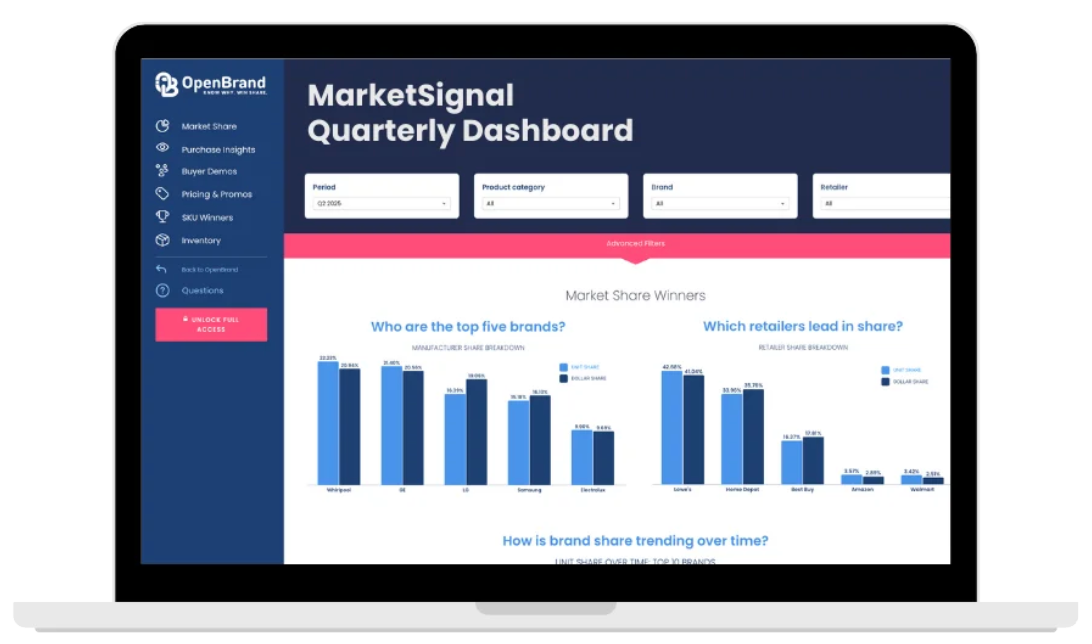
Incidentally, OpenBrand's quarterly reporting covers all of these key measurements and more. If you'd like to learn more about the data OpenBrand can provide, check out our Deliverables page.
More about online: Analyzing Shoppers' Online Behaviors
Beyond measuring share and trends for online mix, understanding online shopping behaviors can further lend to understanding and address your brand positioning. When you have a buyer persona established for your ideal customer, determining where and how often those shoppers are shopping online can help you determine how to increase your market share. Are you losing ground to online consumers? If so, figuring out where and why they are shopping online can help your marketing strategy.
This kind of analysis should look beyond raw numbers to give context to the reasons consumers provide for shopping online. Are they merely browsing online or are they purchasing online? The distinction between your draw and close rates becomes vital to understanding these reports. Analyzing prices paid, units sold, and their effect on your pricing and marketing models is essential for you to understand the degree to which online retailers represent genuine competition to your business.
Analyzing Market Conditions
Looking at the stability of the market and your customer base is critical to understanding the level to which you need to manage your business. Repeat customers can help identify brand strength. Looking at data of your own customers can determine whether or not you need to do more to retain customer loyalty to your business. But a tracking survey can identify whether customers shopping around more or purchasing less of your products or services relative to your competition? If so, you may need to refocus your strategy based on data about how consumer segments are buying.
In a broader sense, looking at the data on market changes is beneficial to your business. For example, if a competitor (or one of your retail partners) has gone out of business, you may have an opportunity to target their former customers. Understanding who these customers are, why consumers shop at other stores, and what brands are sold there can provide critical insights into what retailers stand to gain share from another retailer’s loss. Looking at the overall market condition gives you a chance to prepare for the future and identify any potential problems.

Identifying Market Opportunities
Of course, market conditions do not just speak to defensive needs. If you identify gaps in the market, you can turn those into offensive opportunities for your company. These can include an underperforming category or an opening for a product or service at a particular price point. Either way, if you identify a market opportunity that is underserved, you can move in and direct your marketing to help bolster your market share and general positioning.
Beyond looking at markets in which you already serve customers, you may benefit from looking at additional market opportunities. Are there areas in which competitors have found immediate success or lasting failure? Either of these can speak to the benefits of you expanding into those areas. Looking at opportunities in the market can inspire you to not only fill out your own market opportunity but to grow into others that may not even hold a direct competition for you.
Keep Moving Forward
Analyzing data is an important step in learning more about your customers and how to target their purchase process. Identifying your customers’ purchase behaviors will help you have a better understanding of your market and be able to shape your marketing strategy to be more effective and cost-efficient. The more you can implement data analysis – specifically tracking survey data like OpenBrand - into your marketing approach, the stronger you will grow in the long run.

5 Major Ways Consumer Durables Studies Differ From CPG Studies
If you’re coming from the world of research on consumer-packaged goods (also known as CPG—things like potato chips, diapers, or soap) into the world of consumer durables (things like refrigerators or mattresses), or vice-versa, it’s easy to assume you know what to expect. CPG and consumer durables may be fundamentally different things, but research is research, right? However, the differences between these categories of goods are vast enough that you’ll sometimes need to take a different tack to get to the information you want. There are some big implications for how research can be done and how much it will cost for each product category. It may seem obvious, but it can be easy to overlook things like the purchase cycle, purchase impact, and other important factors. Here are a few key differences to consider:
Longer Product Purchase Cycle:
CPG are bought frequently- often weekly or monthly (perhaps even more often). Consumer durables, on the other hand, may only be purchased every few years. If you’re planning a study that requires consumers who made a purchase recently, it’s far easier to find CPG customers than it is Consumer Durables customers. Finding those more difficult-to-reach durables customers that fit the criteria, might mean your study will spend longer in the field, and drive up the cost. Despite the increased difficulty, don’t cut corners – you’ll want to keep your research focused on recent or likely purchasers, regardless of the length of the purchase cycle.
Different Customer Path to Purchase:
Whereas a consumer might grab a bag of potato chips off the shelves of the grocery store in a hangry moment, odds are good that their choice in refrigerator or lawn mower is a little less impulsive. This adds different nuances to the kinds of questions you might ask a consumer about his or her purchases. For example, it makes sense to drill deep into the purchase process for their new lawnmower, but not for that bag of chips. On the other hand, for that bag of chips, you might need additional questions about what’s eye-catching to ensure it stands out in a grocery aisle.
More Involved Methodology:
Two of the more common tests for new products are in-home tests and central location tests. When testing CPG, it’s not difficult to send something like a new razor or a soft-drink to someone’s home for them to test. Putting a test mattress or clothes washer into someone’s home is more challenging, to put it lightly. Beyond access to the materials needing to be tested, there’s the matter of time. A quick taste test (like Pepsi’s famous Pepsi Challenge) to form a consumer’s opinion is easily done with CPG. It’s unreasonable—if not impossible—for consumers to form an opinion on something like how comfortable a mattress is in just a few minutes. Ideally, a consumer would need to sleep on a mattress the whole night, or even several nights. Central location tests help consumers form opinions on certain aspects of large, hard-to-evaluate products, where they can be hands-on with the product without having the product in their own home. But this still has some limitations. While testers can judge things like aesthetics, it’s hard to weigh in on a major appliance’s performance if testers can’t run a test load of laundry or put their own groceries into a fridge. If an evaluation of product interaction is essential and in-home testing is simply not a feasible option, the experience can be re-created at a central location. A refrigerator or clothes washer can be set up and consumers can be recruited to come and unload bags of groceries or do a load of laundry.
Longer Lead Times for Testing:
Depending on the complexity of the project, there can be significant lead-times on consumer durables projects. New prototypes must often be custom built, as there’s no manufacturer with an assembly line producing what’s needed. Lead time requirements for CPG are a bit different. While more time might be spent formulating new ideas, it typically doesn’t require a whole new assembly line to be built just to add a new flavor to chips. This allows for a more flexible timetable for CPG testing. There’s less time between when an idea is brainstormed to when a testable product can be put into a consumer’s hand. You’ll find it beneficial to plan our consumer durables research well in advance, working closely with engineering and design.
Logistic Considerations for Products:
As we mentioned previously, it can be difficult to get bulky consumer durables to people for hands-on testing. Due to the size of things like mattresses or refrigerators, there’s an added layer of logistical considerations that CPG doesn’t face. Large consumer durables take time and money to ship to the appropriate place, whether that location is a consumer’s home or a central testing facility. If a central location is being used, it must have adequate space to accommodate multiple large prototypes.
Many standard focus group facilities may not have rooms large enough and other types of locations (i.e. hotel conference rooms) may need to be considered. Once on site, final delivery of the prototypes also will likely require extra time (it’s not easy moving 6 refrigerators) and special arrangements. For example, you’ll need to consider:
- Does delivery need to be after hours?
- If needed, what elevator is available? (The main one may not be suitable)
- Is there a place to park the delivery truck? (Not a given in large metropolitan areas.)
Next, there are additional time considerations to account for when it comes to set-up. Additionally, it’s usually a good idea to have someone on call who can help with any troubleshooting needs that might arise as consumers interact with prototypes.
All these considerations can be handled by a well-prepared research team. We’ve discussed how to choose research providers that fit your needs, as well as how to have open lines of communication with your research providers before. Finding a research provider who’s familiar with the kinds of product testing you need will help you avoid potential pitfalls as you progress. Some teams, like the one assembled by The Stevenson Company, have experience with both CPG and Consumer Durables, and can help you test everything from the box of frozen pizza to the oven where that pizza will be cooked and the kitchen table where it will be eaten.

Understanding the Design and Function of Competitive Intelligence
Competitive intelligence is an ongoing process that identifies competitors and their actions to allow you to look at current and future market activities and respond accordingly. In a broad sense, competitive intelligence encompasses every aspect of what a business does. Within your business, this can include gathering the following information about you and your competitors:
-
- Analyzing financial data
- Addressing production and distribution capabilities
- Assessing the corporate structure and the performance of the people filling each role
- Evaluating marketing and competitive threats
Each of these elements benefits from different kinds of expertise. For our purposes, we will look at how to gather and apply competitive intelligence to direct marketing and strategic efforts. The process relies on collecting information and data to better understand the strengths and weaknesses of competitors. This includes understanding the similarities and differences among what other companies do in the market. Following the collection and analysis of competitive intelligence, you can create your action plan to capitalize on your knowledge of marketplace conditions.

This article will focus on the first half of the marketing and competitive threat equation: how to identify, gather, and utilize market intelligence. Strategic analyses and decisions should stem from this intelligence, but compiling and understanding the right data comes first. In particular, we will focus on the following areas:
I. How to gather competitive intelligence
II. How to asses the competitive market
III. How to organize competitive intelligence
IV. How data points yield insights into market trends
V. Avoiding Analysis Paralysis
VI. How to move forward on competitive intelligence
How To Gather Competitive Intelligence
Gathering this competitive intelligence requires an understanding of the tools that are used to collect it. Companies gather competitive intelligence through both quantitative and qualitative methods. Qualitative methods are frequently used before quantitative and are often used to determine attitudes and feelings about a product, service, or industry. Quantitative intelligence is based on collecting enough data to draw statistically significant observations about the market. Analyzing market volume trends, sales trends, or market shares are examples of quantitative intelligence. On the other hand, qualitative intelligence relies less on collecting vast quantities of information and more on observations and descriptions. Naturally, both are valuable – providing insights upon which organizations can act on in different ways.
Qualitative Intelligence Gathering
As mentioned above, qualitative intelligence typically involves understanding the behaviors, usages, and attitudes of the target market. Therefore, more probing and in-depth research methods are used. Since the results are used to help guide the direction of quantitative intelligence, qualitative information is typically gathered before quantitative research. Some of the ways to gather qualitative competitive intelligence include the following:
-
- Focus groups (In-person or Online)
- Dyads and triads
- In-depth individual interviews
- Observational research
- Online communities
In all of these, the data come from descriptive and observational information with a skilled moderator or administrator and a relatively small number of respondents. Due to the dynamic and in-depth nature of this information, collecting massive amounts of qualitative data is unreasonable. You will use it to focus on grouping and organizing the data into a coherent narrative. For example: Interviewing potential customers about previous shopping experiences provides individual stories and observations; grouping the information gleaned from dozens of these interviews can build a compelling story to apply to future marketing efforts.
Quantitative Intelligence Gathering
Some common examples of quantitative consumer research include the following:
-
- Segmentation
- Performance driver assessment
- Mystery shopping
- Attitude, awareness, and usage (AAU)
- Equity assessment
- In-market tracking
- Positioning
- Pricing impact
- Concept testing
- New product evaluation
- Barriers research
- Product optimization
- Communications/Advertisement development and evaluation
- Package testing
Each of the above examples has its own time and purpose for using it. How you utilize these methods depends on your depth of knowledge about your product or service and your market position. The way you apply quantitative data will determine your success. Selecting the correct research method means identifying the challenge and matching the quantitative method to that challenge. Targeted selection and use remain key to building an effective competitive intelligence strategy.
To get the best results, gathering both quantitative and qualitative data goes hand in hand. It should almost never be an either/or approach to looking at the market. Instead, using the tools available in different ways can create a robust, holistic approach to understanding the competitive market.
How To Assess The Competitive Markets
Self-Assessment
Before you can identify your competitors, you need to be clear on the following question: In what industry do you operate? This is a stage of self-assessment that helps define the scope of a competent, competitive intelligence effort. Questions such as the following set the stage for self-assessment:
-
- What is the broad industry in which you operate?
- Is your focus on products, services, or both?
- What are your core functions?
- What might be missing from your core function
- Who will your product/service serve?
While identifying the industry represents the initial step in building out a competitive profile – understanding the industry focus must follow as a second step. A company focused on automotive service, for example, is in the same general industry as a company that sells automotive parts. But the two serve different customer bases; the former sells to those looking for someone to perform vehicle repairs and maintenance, while the latter sells to people who want to complete repairs themselves. While they may ultimately serve the same end customer (i.e. someone whose car needs maintenance), they will seldom compete directly.
Market Assessment
Once a self-assessment is complete, you should begin your market assessment. To start that process, identify your addressable market. If the available market means all customers for a particular good or service, the addressable market is the subset of that market that a company can realistically reach. Every company faces limits of some kind, whether tied to geographical reach, size, scale, available resources, time, etc. The types of customers also limit the scope of whom a company can reach; some customers maintain loyalty to particular brands or stores, while others focus on price points or features available. An auto parts store may have an available market of all drivers, but its addressable market will be those with the combination of vehicle knowledge and available time to perform their own repairs and maintenance.
Importantly, the addressable market is not a fixed target. As you implement your corporate strategy, it may grow and expand its reach over time, it may gain the capability to introduce a new product or service, or the demographics and overall population in an area could change. Part of the continuous process of assessing competitive intelligence involves flexibility and recalibration of the scope and definition of the field of play, not only for you, but also for the market in which you compete.
Identifying Direct Competitors
The ongoing process of self-assessment and market assessment will allow you to reach a realistic sense of who your actual competitors are: those organizations that seek to sell similar products or services to the same set of customers. Market competition is not a zero-sum game; market differentiation allows companies to both find individual niches within a market and expand their market. Still, companies will always compete for individual customers, and those that contend most efficiently will thrive where other businesses fail. Identifying the relevant market competitors thus becomes critical to success.
How To Organize Competitive Intelligence
When you identify your addressable market and the relevant competitors within it, you can use this information to best address the areas that matter. An in-depth understanding of the market requires looking at multiple layers of what the market provides, as well as gaps in the market. The more you build out your competitive intelligence, the more effectively and thoroughly you can respond to their findings. Previously, we examined the steps necessary to build a thorough competitive analysis. More broadly, however, you can begin your competitive analyses with these avenues of investigation:
1) Start Big
For many, a starting point for gathering competitive intelligence is at the industry-wide level. While this goes beyond the aforementioned addressable market, it may give a more complete picture of what other companies are doing. Starting industry-wide can create value by identifying activities and trends that may not have reached a particular segment, but with which companies should expect to contend later. Identifying effective advertising or an appetite for other products in the broader category can lead to insights even without a direct correlation to the end product or service you provide. Casting a wide net can give you a head start by helping identify the seeds of potential future trends. For example, by looking at early adopters, companies can understand the purchase drivers, use cases, and possibly even demographics of a group of consumers that will ultimately buy a product – even if that product has yet to reach the mainstream.
2) Geography
Understanding trends in a geographical area provides immediate insight into how the market is likely to behave within that area. In a brick and mortar environment, prices tend to vary by geographic location, and understanding those metrics allows companies to balance profitability with competitiveness. Using trends of similar demographics across your other target markets can help you understand how consumers might behave in a new geographical area. Further, if you have the resources such as PRIZM, Mosaic, or VALS, metropolitan regions can be sub-divided into neighborhood-level demographics, attitudes, and trends, rather than providing uniform geographic blocks to study as a whole. Successful selling in the right place depends on multiple factors and understanding how attitudes and beliefs differ across an area can make a tremendous difference. Marketing approaches that work well in one neighborhood can fall flat in another. Geographic competitive intelligence allows you to see where other businesses succeed and falter and provides actionable information to guide their own efforts.
3) Demographic
Demographic differences can also provide critical information. Consumers of particular generations, ethnicities, or genders respond differently to competitor products or services. This may lead to gaps your company can fill, or may help narrow the target market for your products or services. Your company can glean information from these differences to build a marketing strategy. Understanding who is purchasing which products/features and each demographic’s purchase drivers can lead to impactful messaging to target groups. Competitive intelligence that focuses on the not only the “who” of a market’s demographics, but also the “why” of each segment can serve as a meaningful driver for your efforts. You can use their research data to segment your customers into your best demographic groups.
4) Core Offerings
Finally, competitive intelligence that looks into the differences among products and services available in the market allows for direct comparisons between your core offerings and those available elsewhere. This can focus on customer satisfaction, product or service effectiveness, or a host of other kinds of information. This analysis of competitive features is addressed in depth in Element 3 in our article: Competitor Analysis: 5 Elements To Unraveling Your Competitor’s Strategy. Of course, the better you understand what the competition offers to the market, the better you can analyze and assess your own offerings.
Data available in the competitive intelligence arena can get as granular as you want to go. Each of these broader categories provides for layers of information that in turn break into hundreds of smaller areas of study. The key, as always, is to stay focused and collect relevant data that you have the resources to analyze and use to help further your business goals.
How Data Points Yield Insights into Market Trends
There are some common problems companies have when collecting data in different areas:
-
- The sheer quantity of information might be overwhelming
- The information may no longer be relevant by the time you start to analyze it
- It may be an anomaly that does not represent the actual market conditions
These changes need not relate solely to the particular product, service, or geographical area in which you operate. Similar trends in other segments can inform the understanding of present circumstances. As with any comparison or effort to understand the future based on the past, this process will not be perfect. Still, taking the time to gather an appropriate amount of information and track its changes over time yields information about patterns that successful businesses effectively use for their own strategic planning.
Avoiding Analysis Paralysis
Today’s wealth of data expands daily and can make gathering competitive intelligence a full-time pursuit. Indeed, the process is never-ending, with market conditions changing all the time and competitors entering and exiting different markets. Successful companies must know when to collect additional information and when to act on the information at hand. There is a real danger of getting stuck in a rut.
Still, the value of in-depth analysis is just as real. Collecting the information above will help you you move beyond obvious information to more fully understand the market. This will help you gain an advantage over your competitors—so long as you use the insights you’ve uncovered. This requires a dual approach.
How To Move Forward on Competitive Intelligence
Identifying and analyzing the right competitive intelligence isn’t a cookie-cutter process. Begin by looking within: define the company’s needs and wants, look at the market that currently exists, and determine what data will connect those needs to the market. The process and the information gathered must fit the organization’s specific needs. And this process itself can change over time; as a company grows or evolves, its needs change.
Once you begin the process, it should be a continual effort. To be effective, competitive intelligence can never be a one-shot proposition. Gather information over time and recalibrate as needed to ensure the information remains connected to what matters. And as the data develops, it can create a set of strategies to respond to the evolving picture that data trends create.
Contact OpenBrand | Market Research and Consumer Insight
If you are looking for market research partners skilled in competitive intelligence, contact the experts at OpenBrand. Our professionals have the tools, experience, and knowledge needed to keep your business ahead using competitive intelligence.
Contact our experts today to learn more about how we can help you succeed within your market.
Good, Fast, & Cheap Market Research Services - Pick Two
You’ve begun to narrow down your options for research providers, and now it’s time to make some real decisions on how to proceed with your market research project. Ideally, you want a comprehensive project done quickly and that is kept under budget. However, these three qualities, Good, Fast, and Cheap, are a little like that saying about college: “Study, Sleep, Social Life- you get to pick two”.
The three factors will almost always work against one another so it’s impossible for any project to hit that trifecta. Unfortunately, that means you might have to compromise, but you can still reach your goals if you’re willing to give up something from one of those three. Your options? “Good and Fast”, “Good and Cheap”, and “Fast and Cheap”. Let’s break down the pros and cons of each of these options to help guide you to the option that will work best for your situation.

Good and Fast Research Providers:

If getting comprehensive insights quickly is your goal, it will likely not be cheap. Skipping or skimping on key steps, such as testing a survey before its launch, or quality assurance steps to ensure you’re getting responses you can use (i.e. monitoring responses during data collection or comprehensive data cleaning at the end) could help. However, this can result in too many cut corners, or questionable data. Those skipped steps are safeguards that ensure you receive quality data.
How to Speed Up the Research Process
However, if you’ve got a project that absolutely needs an accelerated timeline and high-quality data, there are options to help move things along.
- Much of the time spent on a project is time spent in the field, so one option is to give large incentives to motivate a higher percentage of potential respondents to participate, thus cutting back on the length of time spent looking for the right respondents.
- You may choose to pay more for your research partner to spend extra analyst time and labor hours to quickly produce quality data.
- Timelines can be compressed. If you’re conducting a field study in multiple markets, instead of shipping your prototypes from Market A to Market B, you may wish to develop two of the same prototypes and run your study concurrently. Note this is likely to utilize an additional project manager and supplier resources, but your timing can be significantly reduced.
While some research suppliers have different definitions of “fast”, it’s important to keep in mind that accommodations can be made when “fast” isn’t fast enough. When you’ve got a “crash and burn” schedule, your research partner may be able to accommodate you, but you should expect to pay a premium—anywhere from 10-20%, depending on the particular situation. That will help make sure nothing slips through the cracks while keeping to an abridged schedule. Keep in mind, your research partner should always bend over backwards to make sure your project goes according to your specifications, but extra person-hours result in additional costs for everyone involved.
When Good and Fast is appropriate: You have an accelerated timeline and you have the additional budget to make the tradeoffs your research partner needs to dedicate additional resources to your project.
Good and Cheap Market Research:
Just as it’s not ideal to have a research project that cuts corners to save time, cutting corners to save money can also have an impact on how much comprehensive data you receive. However, you may have an opportunity to save money if you’ve got a project that is not time-sensitive. If that’s the case, make sure you let your research partner know upfront. That way they can work with you to find options to keep the costs of the project down.
Keeping Research Costs Down

If a project is not time-sensitive, there are other options for keeping the costs down. For example:
- Re-use your product prototypes by going to different markets sequentially rather than conducting research concurrently in multiple markets. Depending on your product, developing prototypes for market research can be very costly.
- Explore finding respondents via social media.
- Conduct your study with respondents who do not require incentives.
- Provide your own list of customers as a respondent pool, rather than paying for a supplier panel.
Note, each of these latter three could cause a lower response rate to your survey. In order to have enough responses to draw statistically sound conclusions, the survey will have to remain in the field longer, which slows down the turnaround time for data you can use. It is also critical that you do not sacrifice respondent quality for cost.
While you may feel that you can save significant money by writing your survey and analyzing the results on your own, many quality full-service research partners urge caution. These partners have staff that dedicates every hour of every day to exactly these tasks and you’ll find that they are exceptional at doing them. your cost-saving efforts instead of planning your research well in advance, as part of your product planning cycle and you will find that you can better meet your research budget.
When Good and Cheap is appropriate: You have a project that isn’t time-sensitive, and you can work with your research partner to adjust some project specs.
Fast and Cheap Research Services:

Given that we strive to make every research project “excellent”, we would never condone research that isn’t at the very least “good”. It is never worth it to give up usable and actionable results for speed and cost. So in this case, we’ll use the term “good” as a proxy for “comprehensive”. With this in mind, we understand that there are times where you’ve got neither the time nor the budget to get data that goes as deep as you’d like. That doesn’t mean that the data you get is suspect, but it does mean you may not be able to do as much with it. Providing a customizable marketplace simulation or conducting methodologies like a maxdiff or conjoint could add valuable context to your data but are costly and take more time.
For a simple survey, fast and cheap is certainly a viable option. However, anything more comprehensive in nature cannot be done both quickly and cheaply. You may have saved by using online resources (such as Survey Monkey, or other online survey hosts), but that won’t always allow for complex survey designs or multiple approaches to the available data. You’ll also miss out on utilizing the high powered specialized resources of your research partner. For example, The Stevenson Company has a Ph.D. statistician and 2 Ph.D. Economists on staff for complex statistics and modeling.

When fast and cheap is appropriate: You need information to make a quick decision. But it doesn’t have to be comprehensive – you have a few quick questions to ask and you need those answers yesterday!
OpenBrand Market Insight and Research Services
Good, Fast, and Cheap- the good news is that you don’t have to pick just one…the bad news: it’s tough to have all three! As you begin to structure your research project, identify your key objectives. By planning ahead, at least two of the three criteria will be easily met, and you’ll have found a happy medium with the third. For example, you may be able to execute on Good and Cheap, and Fast will become “reasonable”.
By examining all the options available to you, and by weighing the pros and cons, you’ll be able to design the best project for your needs based on your resources and limitations. Despite the challenges, you’ll be aware of any limitations in your project and able to find creative solutions to keep everything on schedule, on budget, and actionable.
Are you ready to partner with an advanced research provider that can meet all of your needs? OpenBrand is here for you. Our experts work with a variety of industries and client types. Stay ahead of the competition with insight into the latest consumer behavior and market trends. Contact OpenBrand today to get started!

The Ultimate Checklist for Choosing A Research Supplier
Do a Google search on “Market Research Suppliers,” and you come up with a list of thousands of results. Why? Because just about anyone can write a survey and administer it on Survey Monkey or any other survey site. But a great market research supplier, the kind you want to partner with, can do more than just type up a survey. From eliminating bias when writing questions to reporting results, there are dozens of considerations that make some suppliers better than others. Taking the plunge and selecting a research supplier can feel overwhelming, but you can mitigate the risk by following our quick checklist for how to choose a research supplier.
Most of the time you’ll start by sending an RFP (request for Proposal) which outlines the details of your study. However, sometimes it makes sense just to call and talk through your study with a researcher. Here are some key questions to ask yourself whether you’ve identified potential suppliers or are still searching:
1. Do they ask (the right) questions?

They should. The kinds of questions that a research provider asks you will help you differentiate between an average provider and one that will best fit your needs. The more they know about the project, the more appropriate the proposal and the more accurate the costs. Some questions a good research provider might ask include:
-
- what your long and short-term objectives are
- how you will use the results
- who will see the results
- where this research fits in with your strategy
- what past learnings exist and how it impacts your strategy
Beyond these questions, they may also ask more tactical questions, such as incidence numbers for the population you want to interview. The provider may also ask you for a budget number, give them a range and don’t be scared of this question! Often times it’s simply to make sure your expectations are in line with what it costs to do a study. If your budget is $300 for a three-market central location test, don’t be surprised if you get some push-back from your supplier.
2. Do they speak your language?
A good research partner can speak many languages – marketing, insights, engineering, C-Suite. That’s why it’s important to ask specific questions about your audience for the research. If your researcher can only answer questions with “research” jargon, you may run into a problem. If they can’t speak in a language that you and your organization can understand, it may be wise to keep your distance. After all, why spend valuable research dollars on a result that’s incomprehensible? You want to work with smart people, but if they do not effectively communicate with you that will be a problem.
3. Are they working out of their mom’s basement?
While we support helping mom pay the rent, we think this might be a bad sign for a research supplier. A one-researcher show can provide a certain level of personalization – of course they want to win your business – but this type of operation can cause bottlenecks. Your supplier should be staffed enough to be able to handle not only your project, but other projects as well. Finding the right balance between personal and capable should be a prime consideration.
4. Do they have senior staff and will they be involved?

Typically a senior member of the firm is involved up front during the proposal development phase. However, once a project is awarded it is often passed on to a more junior project manager for implementation. While this is very standard, do you still have interaction with the senior person or are they now out or the picture? Having the experience of a senior researcher can prove valuable, so you still want that senior-level involvement at all project stages.
5. Are they “Yes Men”?
Working with a research supplier should mean that you’re getting expertise, not just a project executor. With that, look for a supplier that adds value to your ideas, not just takes every idea you have and implements it. Don’t be afraid to ask their opinion on your ideas – you may be surprised at how good (or bad) their own perspective is on your particular situation.
6. Are expectations clear on each side?
In any proposal there should be details about who is responsible for what and the associated timing for the project as a whole. (Yes, the client has responsibilities too – more about that in a future blog.) Projects can easily go off track, particularly with respect to timing, when expectations are not clear from the start.
7. Does the supplier understand your industry?
There are two components to understanding your industry.
-
- Do they have an understanding of the nuances of distribution, pricing, challenges, and competitive pressures that can translate from one category to another (e.g. Appliance market similarities with HVAC)? This is an important piece of the puzzle. Without this understanding, your supplier may target the wrong respondent, ask awkward questions, or waste valuable resources coming up to speed.
- The second component is more “nice to have”: has the supplier worked specifically in your category (e.g. specifically in home improvement)? If they have, it’s a nice bonus. The more they already know about your category, the less you have to teach them. That said, if you feel that they strongly check off the other boxes, this may be less critical. Suppliers who have less experience in your specific category may bring new ways of thinking to the table.
8. Are you (or they) overly focused on price?
Price is always important, but it is not the only aspect to consider. The old saying “you get what you pay for” can be true, so be careful of low-ball bids. If you have bids that are markedly different, try and understand why. Are methodologies, specifications, or other assumptions different between other supplier’ proposals? Just be certain you know what you are getting with any low-ball bid, or any bid for that matter.
9. Do they seem likeable?
There are a lot of research suppliers out there. It’s ultimately a service industry and there is an element of relationship development to working with one of them. You don’t have to be best friends, but a little chemistry is nice. Connecting with a supplier on a personal level will make the experience more positive and will likely help encourage the supplier to go the extra mile for you when needed. Have a conversation about your project with any potential supplier and trust your gut.
OpenBrand Market Research Experts
Now that you know what to look for in a research provider, you’ll be more prepared to choose a supplier who can turn into a real partner. Remember, this checklist is designed to help you select a research provider. Later, we’ll explore how to maximize your relationship with your provider, explaining the responsibilities that clients have as well as how to work effectively with your provider.
For a research supplier with everything that you need to find success, contact the experts at OpenBrand today.

How Consumers Decide When To Shop & When To Stop
This article was originally published on April 12, 2017. It has been updated to reflect data through the end of 2017.
It is a truth universally acknowledged that consumers want to get the best deals available when they’re shopping. One time-honored tradition in getting that best deal is shopping around at multiple stores.
What drives consumers to take a look at that second or third store? In almost all cases price is the deciding factor, but product selection and store familiarity are also considerations.
What Leads to More Stores Shopped? Price and selection
Price Conscious Buyers Shop Multiple Stores
As one might expect, price is the #1 decision driver across all categories. Those shoppers for whom price is most important are more likely to shop around. Conversely, those consumers for whom price is less important are less likely to shop around. The Hand and Power Tools market provides a good example: for those shoppers who shopped only one store, 49% indicated that price was one of the top two reasons why they bought at the store. However, for those that shopped 4 stores, 59% indicated that price was one of the top two reasons. Finding the best price is clearly is a major reason consumers shop multiple stores. For retailers who want to be the LAST store shopped (and thus bought), this means understanding the shopping habits of your category, price matching, and a strong sales force can make the difference.
Higher Average Price = More Stores Shopped
Within each category, we find that a higher average price paid yields more stores shopped. So consumers who are buying a $1000 refrigerator are shopping more stores than those buying a $500 refrigerator.
For those brands and retailers selling items on the high end of your category price curve, you can expect cross-shopping and address this with strong POP and the right pricing strategy.
Product Selection: Meeting Consumer Preferences
While price will always be important to most shoppers, it obviously isn’t the only important factor. Just as higher-priced products lead to more stores shopped, consumers who find product selection to be an important factor tend to shop more stores.
What does this mean for retailers? Having the right mix of products for the category should help keep people in the store. Giving consumers a complete omnichannel experience, with the products, reviews, and specs available on your website will help shoppers to see the breadth of products available for sale.
What leads to fewer stores shopped?
Previous Experience, Convenient Location
Reasons for purchase don’t always increase as the number of stores shopped increases. Two of the most important reasons people purchase overall (previous experience and convenient location) have an inverse relationship to the number of shores shopped. The more stores shopped, the less important these two reasons become to consumers. This is particularly important given the fact that most categories on average only have two stores shopped or fewer. For retailers, it means that the three most important factors in brick and mortar might still hold true: location, location, location.
Shopping around reduces your ability to close the sale by increasing the likelihood that your shoppers will buy elsewhere. Most retailers want to be the one -and only- store shopped. Providing a quality shopping experience for the customer is an important factor in closing the sale with those shoppers. In some categories, a shopper’s previous experience with the store can have an impact when multiple stores are shopped. More consumers indicate “previous experience with the store” was a major influence for one-store shoppers (40%) vs. four-store shoppers (28%).
Conclusion: How To Reach Consumers Online and In-Store
Keep in mind that shoppers generally shop an average of fewer than two stores. While worrying about what to do when consumers shop around is important, it may not be as important as providing your customers with good information on your website and at the point of purchase.
However, when consumers do shop around, there’s more than one consideration at play:
- Bringing them into the store with a strong web presence.
- Providing a quality shopping experience for the customer is an important factor in closing the sale with those shoppers.
- For retailers, location is still of critical importance in your brick and mortar operations.
- Having the right mix of products for the category and giving consumers a complete omnichannel experience.
- For those brands and retailers selling items on the high end of your category price curve, you can expect cross-shopping and address this with strong POP.
- Do your research and understanding the shopping habits of your category, focus on price matching, and a competent sales force.
Additionally, established retailers can bolster their close rates by keeping pricing competitive, while new arrivals can shore up their reputations with excellent selections in their stores.
OpenBrand: Reliable Market Insight and Category Expertise
Get information about what brands and price points have higher levels of cross-shopping by using a consumer behavior tool like OpenBrand or conducting quality quantitative research. Our market research experts are here and ready to help you keep consumers engaged in your products. Using up-to-date insights and statistics, OpenBrand stays ahead of the latest trends, allowing you to surpass competitors in consumer engagement. Contact the market research experts at OpenBrand today to get started!
HEAD TO HEAD (TO HEAD)- HOW WALMART, AMAZON, AND BEST BUY COMPARE
It’s time for a good, old-fashioned show-down! We’re going to take a look at how Walmart, Amazon, and Best Buy compare with one another in three categories: Consumer Electronics, Small Kitchen Appliances, and Cell Phones. We’ll look at both total and online-only sales within each category.
Consumer Electronics:
Encompassing everything from laptops and e-readers to video game systems and wi-fi routers, American consumers spent an average of $275 per product in the 4 quarters ending December 2017. Here, we break down how consumers shopped at these three retailers:
The Winner: In unit share, Walmart and Best Buy are neck-and-neck, with 26% of the unit share in 2017. However, Walmart has seen significant growth for the last two years. Amazon is just behind them with 10% of the unit share. In terms of dollars, however, Best Buy is the clear winner. They take home 33% of consumer dollars, as compared to Walmart’s 21% and Amazon’s 9%.

The Online Winner: Once brick and mortar purchases are filtered out, Amazon is victorious. In 2017, the Everything Store took home 35% of the unit share, compared to Best Buy’s 17% and Walmart’s 15%. However, Amazon’s unit share has been falling, while both Best Buy’s and Walmart’s shares have increased significantly over last year.
Small Kitchen Appliances:
In the four quarters ending December 2017, consumers spent an average of $60 for small appliances like coffee makers, blenders, toaster ovens, etc. Here’s how Amazon, Best Buy, and Walmart stack up when consumers go shopping for small kitchen appliances:

The Winner: With just over 1/3 of the small kitchen appliance unit share, Walmart is the runaway winner. But with seven consecutive quarters of significant growth, Amazon is catching up. 2017, Amazon wins almost 14% of unit share. Best Buy trails behind the other two retailers, winning just under 2% of unit share. In terms of dollar share, Walmart is still leading the way, with Amazon and Best Buy behind.
The Online Winner: Amazon dominates online sales of small kitchen appliances. Last year, the e-commerce behemoth took home 49% of the online unit sales of small kitchen appliances. Walmart comes in a distant second with just over 10% of online unit sales share. Best Buy’s online only shares are comparable to its overall unit shares, with almost 2% of unit share. This same pattern holds true in dollar shares.
Cell Phones:
The majority of American consumers purchase their cell phones directly from mobile carriers, rather than from other outlets. That being said, Walmart, Best Buy, and Amazon all crack the top 10 outlets for cell phone purchases in the United States:
The Winner: In terms of unit share, Walmart edges out the competition with just over 8% in 2017. Best Buy comes in a few places behind, with a little over 6% of the unit share. Amazon trails a bit behind, getting almost 4% of the unit share. In dollar share, Best Buy brings home over 7% of consumer dollars, while Walmart and Amazon trail behind with 4% and 3% dollar share respectively.
The Online Winner: Once brick & mortar sales for Walmart and Best Buy are filtered out, Amazon becomes the clear winner between the three, taking home 15% of the unit share online, and 12% of the dollar share. Walmart and Best Buy trail behind, taking home almost 5% and 4% of the online unit share respectively.
The Champion(s):

In the three categories we’ve looked at here, Walmart takes home the prize in terms of unit shares. However, Best Buy gives Walmart a good run for its money, and frequently outdoes its rival in terms of dollar share. While a different category mix might tell a different story, it’s clear that each retailer has its strength
Online, it’s still Amazon’s game. The e-tailer is dominant in all three categories. However, as more retailers turn to omni-channel solutions, there will be increased competition. We can already see a little of that in the gains that Best Buy and Walmart have made for consumer electronics sales.
4K TV Sales: Underdog brands against Samsung & LG this Super Bowl
February 4, 2018 marks the 52nd Super Bowl. Hundreds of thousands of fans will crowd the stadium to cheer on the Philadelphia Eagles and the New England Patriots. Millions more will be watching on televisions around the world. For Americans, the Super Bowl is not only one of the greatest sporting events of the year, but with deals that are sometimes better than black Friday, it is also one of the best times of the year to buy a new big-screen television.

Saving for the Super Bowl
The timing of the Super Bowl drives this phenomenon; The Consumer Electronics Show in Las Vegas has recently ended, and many television manufacturers have just announced the most high-tech, newest televisions available. New models are primed and ready to hit the market. In order to make room for the latest and greatest models, last year’s televisions are offered at a deep discount.
It just so happens that this coincides with the Super Bowl- which last year drew an audience of 111.9 million. With so many eyes glued to television screens, it’s no wonder that retailers jumped at the opportunity to discount last year’s television models.
Which TVs are Consumers buying?
For the most part, consumers are buying the big-name brands that you expect. The majority of consumers gravitate towards Samsung, LG, or Vizio. When it comes to unit shares, Samsung currently leads the way with a share that is nearly double that of its nearest competitor, despite significant year-over-year losses. Consumers tend to gravitate towards Samsung televisions due to the value they place on Samsung’s brand name and the quality of their products.
Holding steady at number two is Vizio, also coming off of significant losses. Some of those losses could be due to the outcry that followed after it was revealed that Vizio was collecting information on television owners without their knowledge or consent. Despite this, Vizio’s competitive pricing and appealing features keep consumers interested.

On the other hand, LG is gaining ground. The brand has seen year over year gains for each of the last four quarters. Both LG and Samsung are frequently at the forefront of television technology advancements, adding screen technology like QLED and OLED, experimenting with TV form factors, and so on. This draws attention, as 27% of consumers choose television brands based on features. As a result, brand names like LG & Samsung tend to be top of mind for consumers, which adds to the appeal when making a higher-priced investment like a television. 26% of OpenBrand respondents revealed that Good Brand Name was a key factor in their decision to purchase televisions.
What’s the deal with 4K Televisions?
The unit shares for 4K televisions are increasing at a significant rate. The category has seen significant year over year increases in unit and dollar shares. While 1080p/1080i combine for the largest single share of screen resolutions, approximately 1/3 of all televisions currently purchased fall into the 4K/Ultra High Definition category of televisions.
Smaller TV Brands Gain Share
While it may seem that the top 4K televisions would belong to the big-name television brands, that isn’t exactly the case. True, the top brands are Samsung and LG, with Sony and Vizio not far behind. However, there have been rumblings from the bottom of the pack.

Like any great underdog story, we’re beginning to see significant year over year growth in brands such as TCL, Philips, and Hisense. TCL, in particular, has seen consistent growth for the past five quarters. In fact, TCL’s 4K televisions make up 2.4% of the sales mix in the R4Q ending September 2017, up more 1.8% over the previous R4Q. Similarly, Philips 4K televisions significantly increased their share of the market mix by 2% year-over-year.
As prices for 4K televisions continue to fall and the cost of the technology drops, there will be greater opportunities for lesser-known brands to increase their unit shares. As additional features continue to trickle down into affordable price ranges, these more budget-friendly brands can attract consumers who just need the perfect television for the big game, not the fanciest, most advanced television on the block.
OpenBrand Market Insights
You can stay ahead of the wavering market with consumer insights from OpenBrand. When you know the latest in industry trends, you can keep your company working ahead of the curve. Get the insight you need to drive your company forward with data. Contact the market research experts at OpenBrand today!
Academy & Dick's Sporting Goods Gaining Fitness Equipment Share
“New Year, New You!”—Sound familiar? Every January, people make their New Year’s resolutions and embark on a journey to become a better version of themselves. In fact, according to Statistic Brain, 21% of Americans made a New Year’s resolution involving weight loss, and a further 5% made a resolution to start exercising more back in 2017. For many, this type of resolution involves joining a gym. For others, it involves investing in their own fitness equipment. According to OpenBrand’s own data, 34% of people purchase fitness equipment in order to lose weight (Q3 2017).
Stationary Bikes Growing in Market Popularity
When it comes to large fitness equipment, consumers’ enduring favorites are the Treadmill, the Stationary Bike, and the Elliptical. But over the years, we’ve seen a shift away from treadmills and ellipticals – moving towards the stationary bike.
While the popularity of treadmills peaks during the first quarter of every year (routinely making up approximately 25% of fitness equipment purchased that quarter, per OpenBrand), sales are relatively flat overall. However, in the last couple of years, the mix of unit sales of treadmills have started to fall slightly. In the four quarters that ended September 2016, Treadmills made up 24% of fitness equipment sales, but that fell to 23% in the four quarters ending September 2017.
Ellipticals have also been trending down for the last few years. In R4Q September 2016, ellipticals made up 13% of the sales mix of fitness equipment. In R4Q September 2017, that fell significantly to 11%. Unlike treadmills, ellipticals do not see that first-quarter spike in sales; they are a bit more variable in when their sales peak for the year.
On the other hand, the Stationary Bike is gaining ground. Sales mix increased significantly between the four quarters ending September 2016 and the four quarters ending September 2017 (17.7% to 19.2%). Some of the increase in stationary bikes’ popularity could be due to the increasing popularity of spin classes and the availability of connected devices, such as Peloton’s spin bike, that allows users to stream spin classes from home—for a monthly fee.
Popular Fitness Equipment Brands – Does Brand Name Matter?
Just like the nebulous “lose weight” resolution, consumers don’t have an overwhelmingly favorite choice when it comes to fitness equipment brands. Despite being #1 for most popular brands, Nordic Track only makes up about 7% of fitness equipment sales- almost half of all sales of fitness equipment come from a myriad of other, smaller brands. Additionally, despite the high cost of Fitness equipment, 15-20% of consumers don’t know the brand they purchased. Once the data is broken down to look at popular types of equipment, some patterns become more apparent.
For example, Nordic Track tops both Treadmill and Elliptical sales, making up 17% and 14% of sales respectively for the four quarters ending September 2017. For other equipment such as stationary bike, incline trainer, and rowing machine, Nordic Track has a much smaller share.
Additionally, the Proform brand makes the top 5 lists for treadmills, ellipticals, and stationary bikes.
Interestingly, almost all of the top 5 brands for treadmills, ellipticals, and stationary bikes make all three products. However, they may only be known for one particular type of equipment.
Overall, the brand name on fitness equipment isn’t a major draw for consumers. Features, price, and quality are all more important factors, with only 17% of consumers saying that brand was an influence in their purchase decision (OpenBrand R4Q ending September 2017).
The lack of any one clear “winner” in fitness equipment brands indicates that there is an opportunity to be had for new brands to establish themselves.
Popular Outlets – Where Consumers Buy Workout Equipment
While there’s no “one easy stop” for consumers who’ve made a weight-loss related resolution, less-specialized, National outlets are their top choice for making home gym equipment purchases. Amazon, Walmart, and Sears are the top outlets for fitness equipment, and they maintain their top statuses within treadmills, ellipticals, and stationary bikes. Amazon, in particular, has grown significantly over the past year. Currently, 20% of fitness equipment is purchased on Amazon.
But don’t count specialty sporting goods stores out entirely just yet. As they continue to add stores nationally, Academy Sports + Outdoors has demonstrated directional growth from R4Q September 2016 to R4Q September 2017, and Dick’s Sporting Goods had significant growth between those same time periods.
Why Consumers Buy – Home Fitness Equipment
While competitive pricing is the largest influence on consumers’ decisions on where to shop, it’s not the only factor that consumers consider. Having a good selection of products is important to almost 1/3 of all consumers when they select an outlet to purchase from. For retailers looking to gain an edge, having not only a good selection, as well as opportunities for consumers to try out those selections, could help gain an additional edge over online retailers.
Consumers who are hoping to make healthier choices in the coming year routinely turn to home gym equipment such as treadmills, ellipticals, and stationary bikes. Brands like Proform and Nordic Track have made their impression on the market at retailers such as Amazon and Walmart, but there’s still ample opportunity for brands and outlets alike to draw consumers’ eyes as they set out to make good on their new year’s resolutions.
OpenBrand Fitness Equipment Market Insight
Are there other products you see receive an uptick in sales as consumers start the new year? Let us know by tweeting us @OpenBrand, or dropping a message at LinkedIn. If you are looking for an easy, effective way to reach your target market, OpenBrand is here for you! With insight into a wide variety of industries, our market research experts can help your company stay ahead of emerging trends. Contact our OpenBrand experts today to get started!
Sorry, But Power Tools Are Just Better In Person
Every day, new stories emerge that claim Amazon is taking over the retail world. Amazon and its online competitors take a bigger slice of the retail pie each year. But some industries appear to resist the march to online sales more than others. Power tools continue to maintain the majority of their sales through traditional home improvement locations. This trend occurs even with a stratified market for brands and holds steady across the generational lines that often indicate future growth for Amazon and other online-only retailers.
What the best merchandisers provide — and what Amazon lacks–is the tactile experience that tools on display provide. Home improvement stores offer all the top brands across multiple price points and lay them out in a way that allows customers to both visualize and feel how they fit into home improvement projects. The line will not hold forever, but traditional venues and marketing remain the focus of the immediate future for power tools.
Power Tools Sales and Store Loyalty
For many kinds of products, loyalty creates barriers to entry for new brands but provides little impediment to online delivery channels. For power tools, though, brand loyalty lies not at the product level, but rather at the store level. Home improvement chains have used retailing experience and prowess to build and expand their customer bases, regardless of the type or brand of tool those customers seek to buy.
Based on OpenBrand’s research, three traditional home improvement stores dominate the landscape for sales of power tools: Home Depot, Lowe’s, and Sears. The three combine for over 57% of sales for both Millennials and Generation X, and over 53% among Baby Boomers. Amazon sales, in contrast, hover at between 7% and 8% for all three groups. In a world where Amazon has pushed further into almost every product group for increased sales, it continues to lag in the power tools arena.
Hands-On Experience Matters
In analyzing these pieces of data, one immediate aspect that jumps out is the importance of a hands-on retail experience. Online shopping works well for many kinds of products, and that list continues to expand every year. But power tools represent hard, manual labor, and the ability to work with one’s hands. Whether this means drilling, sawing, or any other workbench or garage kind of task, seeing and feeling the product before buying continues to matter.
The products lend themselves to a shopping experience that is as much tactile as it is visual. Generations both young and old purchase their power tools in brick and mortar stores more frequently than online.
Further, outlets such as Home Depot and Lowe’s offer a clear advantage over their competitors by providing a one-stop shopping experience for home improvement. A consumer can go to either of these stores and find all the tools required for a job, as well as other equipment and supplies, organized and displayed to provide what consumers need. With an array of brands to fit every budget on hand, the store retailing experience reduces the need to comparison shop on that front after the ideas take hold.
Looking Beyond Brand Loyalty
Indeed, one of the interesting aspects the OpenBrand research notes is the limited extent to which brand loyalty for individual tools seems to matter. DeWalt tools enjoy significant market share, but not so much that the many other available brands fall by the wayside. Retailers can focus on placing products in the best environments to succeed, with an interactive display to allow a hands-on experience.
Online availability will still matter. When over 7% of power tool purchases come from Amazon, the outlet should receive some attention. But home improvement stores dominate well beyond the extent to which the power tools’ brand names inspire loyalty. The ability to create a one-stop shopping environment seems much more efficient for power tools than for other categories of product. Stores simply provide ideas and options in a format that lets consumers get a real feel for solutions to home improvement problems they face.
Delivering on What Today’s Customers Want
Even with the strength of in-person, hands-on marketing, stores are finding ways to incorporate technology into their retailing. Unlike marketing for other products, power tools lend themselves to a less high-tech, more traditional kind of in-store marketing. The knee-jerk reaction to this may be that staying current courses should be the order of the day. Focus on the right brand, form factor, and product mix, build in-store displays and let the people come, so long as those products sell in big home improvement stores.
This is an oversimplification though. Other factors, such as how different generations shop for products, should be taken into consideration. Millennials have different expectations for shopping experiences than older generations. Rather than a simple display, a recent Forbes article notes that they look for personalization and a customer-centric experience when they shop. For the leading home improvement retailers, delivering on this expectation fits well with how they already do business. They give their customers the ability to see and feel many of the tools they are purchasing, efficiently providing a one-on-one experience with the products.
Further, the displays aren’t where the shopping experience ends. For example, Business Insider highlights how Home Depot has focused on developing its mobile app to enhance its in-store shopping experience. Rather than merely turn customers loose to wander in the giant warehouse-style store, Home Depot uses technology to make the shopping process more straightforward and help customers access additional ideas while shopping in a tactile-focused environment.
Driving Sales into the Future
The future of power tools sales should continue to focus on putting them in the right retail environments to succeed. The lack of generational differences in purchasing behavior points to stability in what customers want and expect. A hands-on shopping experience tweaked to maximize a customer focus through a combination of technology, and project-based display should deliver the most significant impact on retail power tool sales.