


Notebooks: 2025 Year-In-Review
Our Notebooks: 2025 Year-in-Review report recaps launches, placements, pricing and advertising and promotional activity captured throughout 2025. The report features data and insights from OpenBrand’s Notebooks category, which feature products sold through the US ecommerce and brick-and-mortar channels.
Read through all the 2025 pricing and promotions insights below or email the report to read later.
You can also check out our 2025 Year-in-Review reports for other Consumer Electronics categories.
Notebooks: 2025 Product Updates
For notebooks, 2025 began with high uncertainty as tariff threats loomed over a category deeply dependent on overseas manufacturing and complex supply chains. Brands scrambled to adjust pricing and SKU strategies in response, especially for high-end gaming and premium consumer laptops, where elasticity was weakest and Copilot+ SKUs were prevalent. While the most aggressive tariffs never fully materialized, the impact was clear: Best Buy saw visible shelf price hikes through the first half of the year, while retailers like Walmart and Amazon largely held the line.
At the same time, shifting consumer preferences drove increased momentum behind sub-14” form factors, with Acer, Asus, and Microsoft embracing smaller, lighter notebooks – even if pricing remains a barrier. Dell re-emerged as a key player in the value segment, embracing aggressive pricing at Walmart and refreshing Alienware with sharper positioning at Best Buy. And yet, the defining trend that didn’t quite land was AI: despite a flood of Copilot+ launches, AI performance failed to resonate with consumers in 2025, leaving the notebook market searching for its next true differentiator.
Tariffs Impacted the Channel Unevenly
The number one issue for the retail channel when entering 2025 was how tariffs would impact the US at a time when foreign production accounts for nearly every notebook and desktop sold domestically. Additionally, given the increased complexity of the former, relocating manufacturing was more challenging than that for the latter. In Q1, new RTX 50 gaming SKUs began receiving price adjustments, fueled by the one-two punch of tariff uncertainty and tight supply of RTX 50 GPUs. Asus was particularly noticeable in this regard, given its position as a traditional first-to-market brand for premium gaming, where demand was less elastic. By March, brands such as HP and Asus were also experiencing increased shelf prices for consumer notebooks, such as HP’s OmniBook Ultra line. Meanwhile, Asus was active in this trend due to a busy H1 2025 full of product launches featuring more expensive Copilot+ CPUs. Lenovo also followed in April with fewer, but at times more drastic, price hikes. Ultimately, by summer these price increases were partly being rolled back as the worst fears of tariffs on China and Southeast Asia didn’t come to fruition.
Amid these price changes, it was notable that Best Buy was the retailer most impacted. Costco and Walmart, on the other hand, managed to largely maintain prices during their 2025 resets. Additionally, Amazon and MFR.com became popular outlets where brands could better protect their margins.
Sub-14” Notebooks Continue Gaining Momentum
While thin-and-light ultrabooks experienced a boost in recent years, 2025 saw consumer notebooks increasingly gravitate toward smaller and lighter notebooks. Acer and Asus offered their thinnest and lightest products to date with the Acer Swift Air 16 and Zenbook A14, with both weighing in under a kilogram in certain configurations. Microsoft also got behind this trend, building off the success of its 14-inch Surface Laptop launch in 2024 with the addition of a 13-inch Surface Laptop over the summer. Challenges remain, however, as these smaller devices frequently come at a steep premium, and Microsoft’s 13-inch model seems like a product in search of a customer, given that the slightly bigger 14-inch model is a better value for only $100 or $200 more.
2026 could be a year that further adds fuel to the fire if reports of Apple launching a new smaller and lighter MacBook that would slot in under the MacBook Air. Under pressure to grow its PC shipments at a time when Apple’s hardware business is mature and potentially at a high water mark, conditions may be perfect for Mac to sell the broader consumer market on the merits of a sub-14” notebook. If Apple succeeds, this could open the door for more Windows notebooks in that size class.
Expanding Focuses for Dell
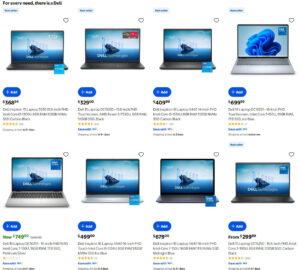
In response to increased pressure from HP and Lenovo in recent years and a tumultuous period of organizational changes, Dell’s strategy in 2025 noticeably changed for retail. While it continued to retain its focus on Dell.com and merchants like Best Buy, it started doing direct business with Walmart. Its laptops began popping up over the summer at Walmart.com, and even though they have yet to debut in stores, their impact was noticeable. Its portfolio of eight laptops ranging from $299 to $699 was aimed at Walmart’s value-oriented shoppers that would otherwise likely be buying HP, Asus or Lenovo notebooks. These were backed up with the substantial discounts needed to stand out at Walmart, indicating to the channel that Dell is focused on taking back volume it lost, even if it’s at the expense of ASPs and margins. These notebooks mirrored Dell’s desktop strategy of using older processors while retaining premium touches such as 2K displays (instead of the traditional FHD).
Dell’s new focus on competitive pricing was mirrored with Alienware. At Best Buy, its Alienware Aurora 16 and 16X notebooks were among the first to launch in-store, and surprisingly were among the lowest priced SKUs for RTX 5060. Impressively, in some cases this was done without dropping premium features such as 2.5K displays at a price where most brands top out at 2K. This strategy also affected Walmart, where Alienware’s $1,459 Aurora 16 has been heavily discounted to $899 during the holidays. If Dell continues investing in this strategy, it could emulate HP’s success in growing notebook volume with ultra-aggressive pricing during key periods at Walmart.
Consumers Remain Lukewarm on AI PCs
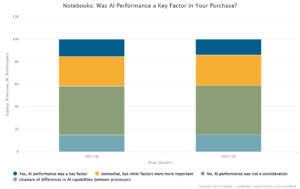
After a year and a half of Copilot+ PCs, and consumers remain at best lukewarm around the broader AI PC segment and processor differentiation. In Q3 2025, only 14% of notebook purchasers in OpenBrand’s MindShare consumer tracking survey cited AI performance as a key factor in their purchase. Almost triple (43%) did not consider AI performance at all. Perhaps more concerning, however, is that Q3’s results showed no improvement compared to Q2. There’s also relatively few easy converts, with only 15% of notebook buyers being unaware of differences in AI capabilities between processors. This could rapidly change if local AI applications find their killer app, but in the meantime AI PC processors are not driving consumer purchases.
New Form Factors
While every CES and every year has its unorthodox ideas and form factors, 2025 seemed to lean into this trend more than usual. Lenovo was the primary actor, with the launch of its ThinkBook Plus Gen 6 Rollable and ThinkBook VertiFlex Concept. The former is a $3,000+ commercial device that can expand its display vertically, while the latter was an IFA concept that allowed users to rotate the display between landscape and portrait. More interestingly, Lenovo appears far from done, with reports of a rollable gaming notebook potentially being revealed at CES 2026. Ultimately, the clamshell continues to reign supreme, but sooner or later alternative form factors may catch on, as the smartphone market has found with foldables.

Notebooks Market: 2026 Outlook
2026 will be a more challenging year than 2025.
The PC industry faces a memory shortage that has the potential to increase channel shelf prices even more than tariffs ultimately did in H1 2025, and the tailwind of Windows 10 EOL will peter out sooner or later. Bigger brands are best positioned to navigate this price increase due to their greater ability to leverage scale in negotiations, but smaller brands like Asus and Acer have increasingly been more willing to take risks with product design in recent cycles.
Zooming out, Windows itself will face a shifting landscape. Chrome OS will migrate toward Aluminium OS, and Apple seems all but set to launch a lower priced MacBook that is more affordable than the MacBook Air. With the latter, it could also upend the merchant landscape if it debuts at Walmart – where Apple has been testing demand for sub-$600 notebooks with a heavily discounted M1 MacBook Air – rather than solely Best Buy.
Get more information
Visit our Consumer Electronics industry page to learn more about the data we deliver for the Notebooks market – or reach out to our analyst below to ask questions about this report or get specific insights you need.
About the Author



Desktops: 2025 Year-In-Review
Our Desktops: 2025 Year-in-Review report recaps Desktop launches, placements, pricing and advertising and promotional activity captured throughout 2025. The report features data and insights from OpenBrand’s Desktop category, which feature products sold through the US ecommerce and brick-and-mortar channels.
Read through all the 2025 pricing and promotions insights below or email the report to read later.
You can also check out our 2025 Year-in-Review reports for other Consumer Electronics categories.
Desktops: 2025 Product Updates
The first half of 2025 was marked by volatility and uncertainty, with proposed tariffs casting a long shadow over the PC industry and disrupting pricing strategies across the board. While worst-case scenarios around component tariffs were largely avoided, the ripple effects of rising prices and portfolio adjustments defined the early part of the year. Layered on top of constrained supply for next-gen GPUs and a muted reception to new desktop processors, and the result was a lopsided market recovery in which gaming bore the brunt of pricing and availability shocks.
Yet amid the chaos, certain OEMs like MSI and Asus found room to grow, and channel shifts, particularly at Best Buy and Walmart, opened new paths for opportunistic players. As the year closed, tariff pressures eased but left behind a changed retail landscape, where brands leaned harder into marketplace models, mobile silicon crept into desktops, and AI PC hype continued to outpace actual consumer demand.
Tariffs Tossed a Wrench in H1
The first half of 2025 was dominated by macroeconomic uncertainty related to tariffs, and how merchants and brands responded. While the worst case scenarios – most of which involved high tariffs on PC components sourced from China or South East Asia – didn’t fully materialize, price increases and partial rollbacks of them were a consistent theme through the beginning of back-to-school. Coupled with a significant gap between overdue and less elastic demand for new GPUs and insufficient supply of RTX 50 through H1 2025, and unsurprisingly, gaming was the most significantly impacted segment.
Starting with system integrators, then followed by Asus and other OEMs, SKUs at Best Buy started receiving price increases in late Q1. These price hikes generally ranged from 5% to 10%, with particularly sharp increases on lower margin, budget-focused towers. If there was a winner among brands, it was OEMs who found themselves facing SI’s who couldn’t price as aggressively as they did in years past. MSI and Asus were particular winners, with the former gaining in-store placements at Costco at iBuyPower’s expense while the latter faced less competition than normal for its new ROG G700 SKUs. These were later followed by AIOs and consumer towers receiving similar price increases. Exiting 2025, AIOs remain the most vulnerable. While some price increases on consumer and gaming towers have been rolled back, AIOs have been less fortunate, likely due to the difficulty in reshoring production and assembly of devices with display panels. This may change in coming years, however, as Dell was able to shift production of some of its AIOs to Mexico, while HP has been able to pivot out of China to South East Asia in some instances.
Overall, 2025’s tariff rollercoaster could be summed up as “Could be better, could be worse.” Best Buy and to a lesser extent Costco experienced price increases, but these were often partly rolled back by the time BTS arrived. Walmart and Amazon were more able to successfully maintain prices, with the former often finding success in peeling off gaming shoppers from Best Buy and other traditional outlets for gamers.

Best Buy Marketplace
With the benefit of an overdue gaming refresh and the tumultuous post-tariff landscape, Skytech was able to grow its foothold at Best Buy. In-store, it built off of its initial RTX 4070 foothold last year to multiple SKUs, ranging up to an $1,879 King95 placement with an RTX 5070, bringing increased competition across most price bands. Online, Skytech eagerly jumped behind BestBuy.com’s marketplace launch after August and invested in dozens of 2P SKUs (shipped and sold by Skytech at BestBuy.com). By the end of 2025, Skytech’s assortment at BestBuy.com is approaching 200 desktops – larger than CyberPower and iBuyPower’s combined portfolio at BestBuy.com.
While it’s early days for Best Buy’s online marketplace, 2026 is shaping up to be an interesting year as brands follow Skytech’s example. With rising memory costs trending to impact retail shelf prices more than tariffs in 2025, CyberPower and iBuyPower have been reorienting their BestBuy.com portfolios to increasingly leverage 2P SKUs. These debuts are where OpenBrand has first tracked increased shelf prices for CyberPower and Skytech, with the former removing 1P SKUs and then reviving them as 2P placements with a higher price. It’s a logical reaction to protect margins, and one that other brands will likely emulate where possible. The question going forward will be how much volume marketplace SKUs can drive at these higher prices and if consumers are willing to forgo the benefits of 1P fulfillment.

Components: Everything Old Is New Again
2025 saw an uptick of mobile processors in gaming and consumer towers, the culmination of years of sluggish generational uplifts and advancements in desktop processors. After the 2021 launch of Intel’s 12th-generation Alder Lake processors and the venerable LG1700 socket and their favorable reception from the channel, Intel followed up with two fairly modest refreshes and then the underperforming Arrow Lake family in late 2024, which traded raw performance and value for a hard-to-sell boost to efficiency.
The response from brands and retailers has increasingly resulted in less momentum to update to the latest Intel processor. 14th-generation Intel processors and older Ryzen chips have become the de facto choice for entry-level, mainstream, and even premium $1,500+ shelf price gaming desktops. Examples include Walmart.com’s iBuyPower $1,699 SMA7N5701 ($1,399 after discounts) that pairs a Ryzen 7 8700F with an RTX 5070 or Best Buy’s $1,099 CyberPower GXi3200BSTV10 ($929 after discounts to start 2026) that pairs an i5 14400F and an RTX 5060. This response was also at times mirrored for non-gaming SKUs, with Intel 13th and 14th generation processors being popular choices for entry-level towers and Dell largely avoiding new processors for its AIOs and sticking with Core Ultra 100.
These trends have opened up the door to two specific chip segments in 2025: mobile processors for towers and AMD and its X3D chips. Asus and Acer both launched budget, reduced footprint gaming towers that used older Intel laptop processors. Both the former’s TUF T500 and the latter’s Nitro 20 (currently available in non-US markets) uses Intel’s i5 13420H and i7 13620H from 2023. While HP has yet to make any US market announcements, it recently began offering the Omen 16L in China with the Intel i7 14650HX. This trend was also seen to a lesser extent in consumer towers, where Asus’ V500 desktops also used Intel 13th generation mobile processors. AMD has also gained shelf share with key channel partners amid Intel’s stagnation, growing its foothold in mainstream gaming with its Ryzen 7000 and Ryzen 8000 processors particularly, while X3D SKUs continue to slowly grow in premium price bands. While the latter’s impact remains limited, momentum is growing as key OEMs like Lenovo adopt X3D SKUs at merchants like Best Buy.
For 2026, it’s unclear if these trends will strengthen. While it will be a quiet year for desktop processors, Intel also reported earlier this year that its older processes are at capacity due to demand from notebooks and desktops, which could force brands to allocate this limited supply toward notebooks. And for AMD, it figures to have a strong advantage for desktops given that Intel appears to be opting for only a minor Arrow Lake refresh in H1, with Nova Lake not expected to arrive in volume until 2027.
Dell Tries to Reinvent Channel Strategy
Dell’s consumer channel performance in recent quarters has been uneven as the overall company struggled to adapt to the post-Covid landscape and ever increasing commodification of PCs. In response, Dell has overhauled its retail channel strategy to be more price competitive and even going as far as to work directly with Walmart. This reversal of historical trends – Dell had not done business with Walmart directly since at least Covid, if not ever – could lay the foundations for a comeback in 2026. It started with a quartet of consumer desktops over the summer (two towers and two AIOs) that received aggressive discounts in Q3, to the point that it was at times matching or beating out HP’s competing SKUs in value. The company has also worked closely with Costco as part of the club store’s Costco Next program to steer additional traffic to Dell.com deals. Finally, Dell also leaned into the SMB refresh with the launch of its Dell essential PCs, which save costs on minor features (connectivity, for example) while maintaining core components.
For Walmart, this has coincided with increased ecommerce appeal for gaming desktops. Its offers frequently undercut similar deals at Best Buy and Costco, which are slowly shifting consumer perception of Walmart. Whereas it used to be a destination for $500 consumer desktops, it’s increasingly a retailer of interest for those seeking a $1,000+ gaming tower. If it can use its volume to force brands to keep costs down in 2026 as the industry grapples with exploding memory prices, Walmart will be well positioned to continue slowly and steadily gaining market share.
Consumers Remain Lukewarm on AI PCs
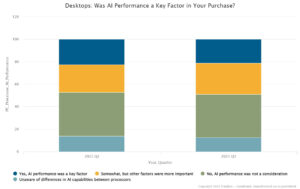
After a year and a half of Copilot+ PCs, and consumers remain at best lukewarm around the broader AI PC segment and processor differentiation. In Q3 2025, barely one-fifth of desktop purchasers in OpenBrand’s MindShare consumer tracking survey cited AI performance as a key factor in their purchase. Almost double (38%) did not consider AI performance at all. Perhaps more concerning, however, is that Q3’s results showed no improvement compared to Q2. This could rapidly change if local AI applications find their killer app, but in the meantime AI PC processors are not driving consumer purchases.
Desktops: 2026 Outlook
2026 is shaping up to be a particularly challenging year for desktops. Tight memory supply and skyrocketing component costs will likely impact channel pricing and assortments more than tariffs did in H1 2025. For gaming, this could offer OEMs with better supply infrastructure and supplier relationships a chance to catch up with leaner system integrators that will not be able to maintain their rock bottom pricing. For consumers, Dell’s arrival at Walmart in 2025 will likely be built upon, potentially putting pressure on AI, which has maintained a strong presence in AIOs and towers at the big box giant.
Get more information
Visit our Consumer Electronics industry page to learn more about the data we deliver for the Desktops market – or reach out to our analyst below to ask questions about this report or get specific insights you need.
About the Author
Navigating the Tariff Disruption: Strategic Insights for PC Brands and Retailers
In early 2025, gaming PCs and Copilot+ PCs became the first segments of the consumer PC channel to feel the impact of newly implemented tariffs. These changes have created a ripple effect across pricing strategies, product availability, and retailer positioning, especially for brands heavily exposed to Asia-based supply chains.
These are not minor adjustments. Gaming desktops and notebooks featuring Nvidia RTX 50 GPUs have been hit with price hikes, some models jumping over $300 almost instantly. The strategic ripple effect has forced companies to urgently revisit pricing models, rethink product availability, and adjust retailer positioning just as they navigate crucial launch windows.
But what’s truly behind these dramatic market shifts, and how can your brand stay ahead of the volatility? As OpenBrand’s category expert in computing, I took a deep dive into the causes behind this volatility and offer strategic recommendations to help brands and retailers successfully navigate the new market reality.
Have a question for our analysts?
Get the market data needed to support your business goals, trend data to guide strategic decisions, and more.
In this blog, we’ll explore:
- Strategic Shockwaves: Immediate Pricing and Inventory Adjustments
- Navigating Uncertainty: Rethinking Your Supply Chain Strategy
- Brand Spotlight: Who’s Adjusting Best, and Why
- Forecasting Tariff Impact in Computing Through 2025
This blog offers a high-level look into these areas. For the full deep dive, download my analyst report now.
Strategic Shockwaves: Immediate Pricing and Inventory Adjustments
Gaming PCs experienced immediate and significant price adjustments.
Halo desktop SKUs such as system integrator prebuilds with RTX 5080 and RTX 5090 GPUs began seeing price increases in excess of $300 in mid-February.


Borderline midrange systems featuring GPUs like RTX 5070 were frequently temporarily discontinued, only to return a couple of weeks later with a $100-$200 price increase in several instances.
This was quickly followed by the notebook retail channel, with adjustments on pre-orders from brands such as HP and Asus.
Navigating Uncertainty: Rethinking Your Supply Chain Strategy
These changes have created a ripple effect across pricing strategies, product availability, and retailer positioning, especially for brands heavily exposed to Asia-based supply chains.
While semiconductors remain exempt from tariffs, displays and other components sourced from Asia remain extremely vulnerable.
If tariff coverage expands, brands may face increased margin pressure or be forced to pass on additional costs to consumers. Brands should consider prioritizing cost-effective component sources, reassessing their global supply chain strategies, and preparing for ongoing volatility.
Brand Spotlight: Who’s Adjusting Best and Why
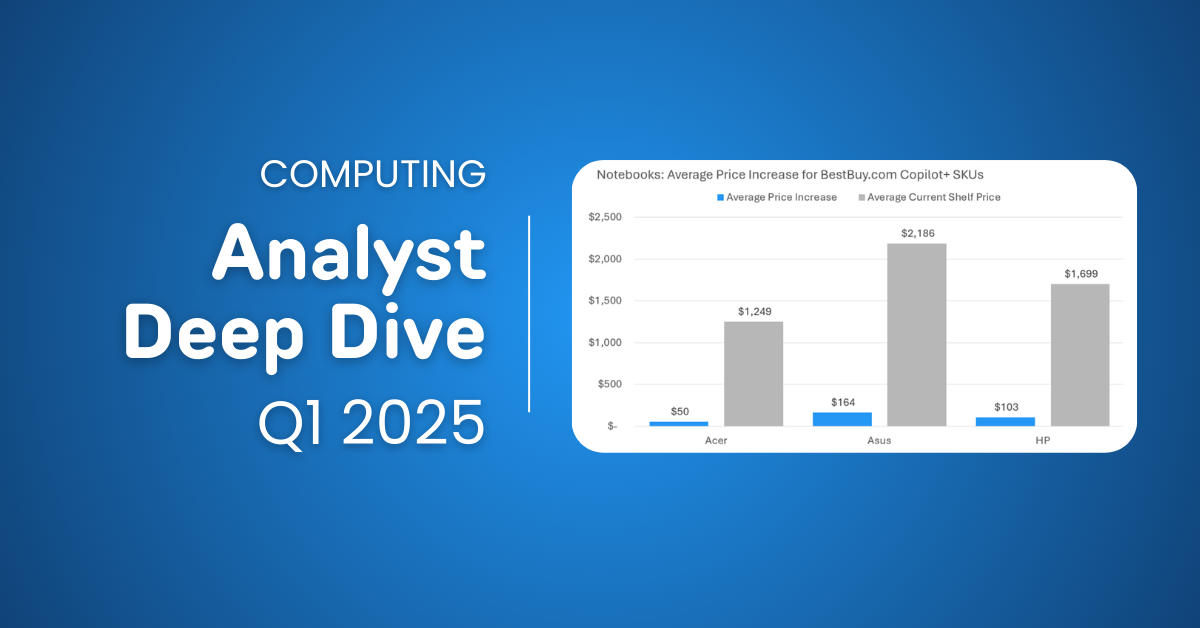
Asus has notably driven price adjustments in the emerging Copilot+ notebook segment, with around 23% of BestBuy.com’s Copilot+ SKUs seeing price hikes. ASUS accounted for all but four price increases. This is a combination of its particularly broad Copilot+ consumer and creator portfolio, coupled with the ongoing RTX 50 notebook launch including several AMD Ryzen AI 300 SKUs.
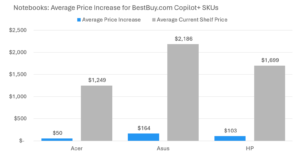
HP was the first brand to roll out broad price adjustments starting with the OmniBook Ultra Flip, $1,500+ SKUs that received roughly $100 price increases.
In contrast, HP has not increased prices on its original Snapdragon X-powered OmniBook X SKUs. This suggests that Qualcomm notebooks may be less impacted by tariffs.
Given the increasingly competitive landscape between Intel, AMD, and Qualcomm – and soon Nvidia and Mediatek – processor manufacturers willing to provide additional funding could reap massive gains in market share with price-conscious shoppers.
Looking Ahead: Tariff Impact Through 2025
With Back-to-School season only weeks away, the channel will have its first significant test of how shoppers – especially traditionally price conscious Chromebook customers – react to elevated prices and, should demand lessen, what these shoppers will do.
Potential scenarios include:
- Refurbished product purchases: Chromebooks already benefit from a longer-than-usual software support life (eight years from model launch), and merchants such as Best Buy have no shortage of open-box or refurbished products.
- Third-party sellers: With a lower barrier to entry (cost) compared to many Windows devices, price-conscious consumers could turn to 3P sellers able to win the buy box at Amazon or Walmart during key buying periods.
- Budget windows: Notebooks with Intel Core i3’s and AMD Ryzen 3’s have pushed into Chrome’s traditional customer base with aggressive pricing at merchants like Best Buy and Walmart. Consumers might end up opting for Windows if the price advantage for a Chromebook shrinks or altogether disappears.
Tariff impacts will increasingly pressure margins, potentially forcing broader price adjustments across consumer PC segments.
Ultimately, the true test of tariff impacts in the computing space may be if discounts are significantly diminished during Back-to-School.
Get the full report for more insight into tariff impact in computing
Overall, the first wave of tariff-driven price increases has exposed critical vulnerabilities across the gaming PC, Copilot+, and Chromebook segments, with brands and retailers already making tactical adjustments to pricing, assortments, and launch strategies.
For more strategic insights, including detailed breakdowns of specific SKU-level pricing shifts, deeper analysis of consumer reactions across segments like Copilot+ and Chromebooks, and more on upcoming tariff impacts through 2025, download the full analyst report below.
Access the report now
About the Analyst

Notebooks: 2024 Year-In-Review
2024 was an eventful and influential year in the notebooks market, full of major debuts and unexpected developments. Below are some of the most significant trends that impacted the notebook channel this year.
- Meteor Lake Discounts Set the Tone
- Copilot+ Finally Arrived
- Intel Gamer Days Grows But Remains a Work-in-Progress
- Walmart and Apple Shake Up Consumer
- New Names from Major Brands
- Key Promotional Events
- 2025 Outlook
Read through all the 2024 pricing and promotions insights below or email the report to read later.
Meteor Lake Discounts Set the Tone
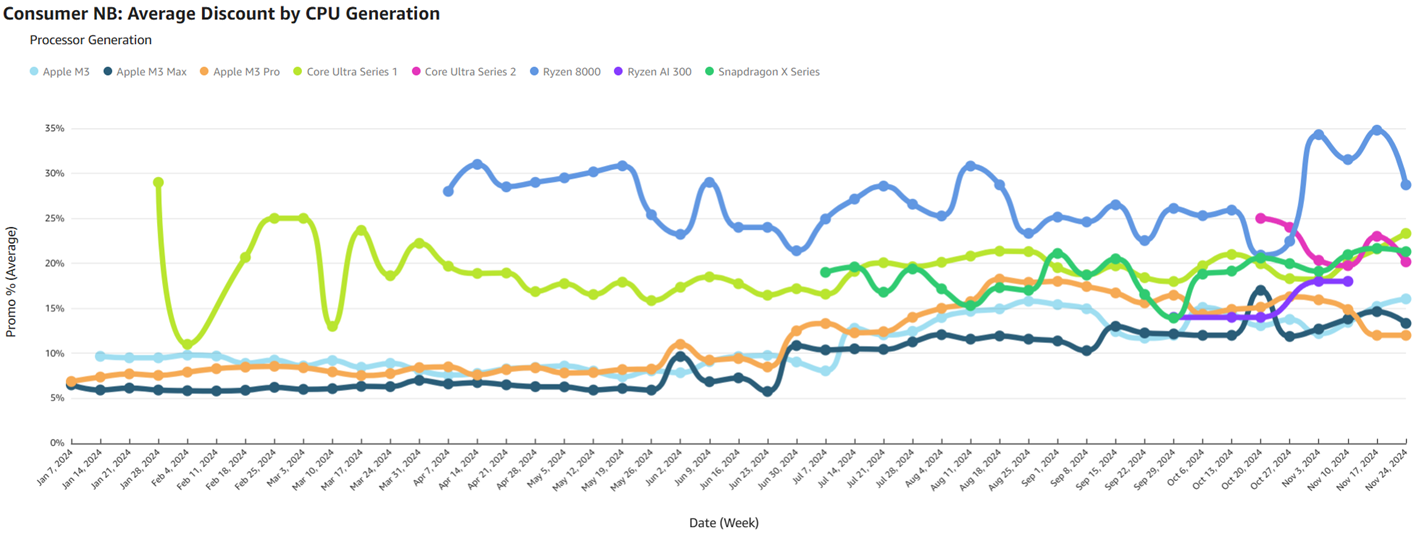
Meteor Lake notebooks and their elevated discounts almost immediately after gaining in-store placements defined the unusually discount-focused first half of the year. Best Buy was the first to gain these SKUs, with other brands and merchants quickly following suit.
Copilot+ Finally Arrived
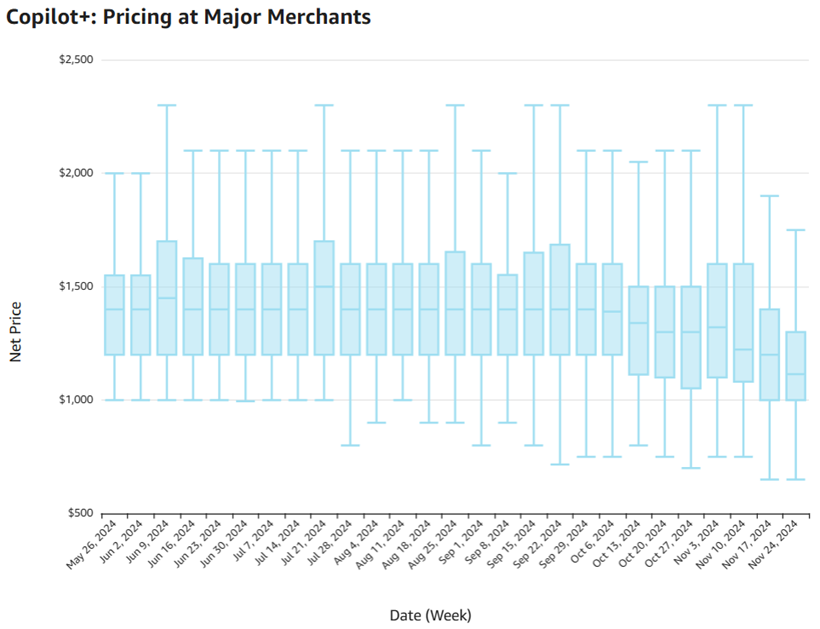
After much anticipation, the first wave of Copilot+ notebooks powered by Snapdragon X processors were announced over the summer. Despite challenges and mixed performance, it was the most significant boost to Windows on ARM to date. Since then, other players have entered the segment, with Intel and Lenovo’s partnership for Aura edition laptops signaling closer cooperation between processor manufacturers and OEMs.
Intel Gamer Days Grows But Remains a Work-in-Progress
While it’s still years away from being on par with Prime Day, Intel Gamer Days continues to grow. This year’s edition was the longest to date (21 days) and featured soft bundles worth up to $220. Due to Intel’s 13th and 14th Gen desktop chip woes, however, gaming desktops took the backseat this year as notebooks were the dominant focus.
Walmart and Apple Shake Up Consumer
Walmart and Apple announced a groundbreaking partnership in the spring, with the big box leader offering the M1 MacBook Air for a then record-low $699 before discounts. It’s a development that’s put pressure on mainstream and premium Windows placements and showed the benefits of Apple’s decision to drop Intel for in-house processors. Looking ahead, it opens the door to potentially more Apple notebooks and desktops entering what has historically been a budget Windows stronghold.
New Names from Major Laptop Brands
HP announced it would be discontinuing its bloated product family structure and revamping notebooks and desktops under a clearer “Omni” portfolio. While only a handful of new notebooks have been released, 2024 undoubtedly has more on the way for both notebooks and desktops. The company followed this up by announcing the new Omen 35L, which will supersede the Omen 25L and 45L families. It also represents the most concrete synergy between HP and HyperX to date for gaming desktops.
Key Promotional Events
- Amazon Prime Day 2024: Notebooks
- Amazon Prime Big Deal Days 2024: Notebooks
- Black Friday 2024 Overview: Notebooks
- Notebooks: Cyber Monday 2024 Overview
2025 Outlook for Desktop Market
2025 will be an eventful year for the notebook market, with it being a true litmus test for Copilot+, as well as Intel, AMD, and Qualcomm on if their much hyped AI processors will encourage end-users to pay a premium on their next notebook. For Apple, Walmart’s 2025 portfolio will be an indication of not only whether the M1 MacBook Air placement was a success, but potentially whether or not Walmart moves on to an M2 MacBook Air. Finally, Nvidia will launch new gaming GPUs after a protracted lifecycle for its post-pandemic RTX 40 SKUs.
Get more information
About the Author

Desktops: 2024 Year-In-Review
2024 wasn’t an uneventful year in the desktop retail channel, but it felt like a year laying the groundwork for 2025. While consumer debuts were incremental, the gaming channel moved upmarket as it prepared for a long-awaited refresh. Below are some of the most significant trends that impacted the notebook channel this year.
- AI Desktops Remain in Their Infancy
- Walmart Moves Upmarket
- Best Buy’s Big Gaming Refresh
- New Names from Major Brands
- Key Promotional Events
- 2025 Outlook
Read through all the 2024 pricing and promotions insights below or email the report to read later.
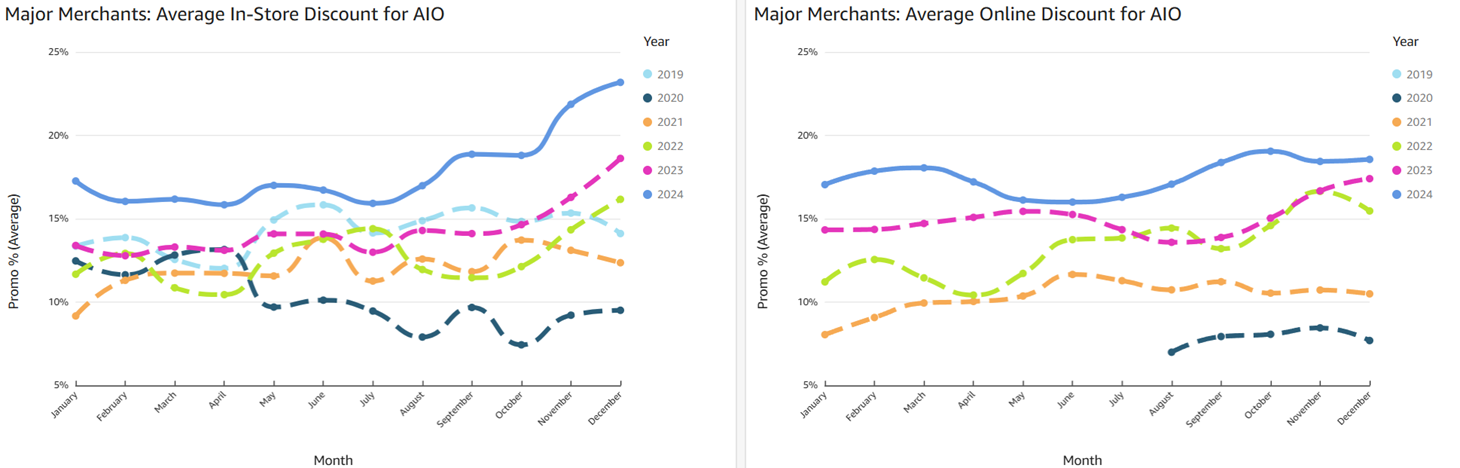
Major Merchant Discounts Over Time

AI Desktops Remain in Their Infancy
2024 was defined by a lack of change for consumer desktops, with Intel and AMD focusing on notebook chips and AI PCs at the expense of compelling desktop processors. Regardless, HP was the first out of the gate with a Core Ultra desktop featuring an integrated NPU, even as consumer desktops with NPUs remain scarce. Surprisingly, it was Staples that gained the first of these placements in the brick-and-mortar channel for national merchants.
Walmart Moves Upmarket
As part of its ongoing attempt to assort more premium notebooks and desktops, Walmart offered a couple unexpected SKUs. Its main in-store gaming placement for most of the year was the $899 CyberPower GMA6900WST, which was priced much less aggressively than its predecessor. This set the stage for Walmart’s test SKUs of $1,999 iBuyPower RTX 4060 towers, with one such model being prominently featured for Black Friday. On the consumer side, Lenovo and Asus ended HP’s longstanding dominance among the merchant’s consumer assortment with unusually premium AIOs.
Best Buy’s Big Gaming Refresh
While the merchant has consistently maintained a large gaming assortment in-stores, 2024 saw its most significant refreshes post-covid. From a Valorant-branded limited edition SKU to more options featuring AMD GPUs and the most premium in-store placements we’ve seen post-Covid, Best Buy didn’t neglect any part of the gaming market in 2024.
New Names From Major Desktop Brands
HP announced it would be discontinuing its bloated product family structure and revamping notebooks and desktops under a clearer “Omni” portfolio. While only a handful of new notebooks have been released, 2024 undoubtedly has more on the way for both notebooks and desktops. The company followed this up by announcing the new Omen 35L, which will supersede the Omen 25L and 45L families. It also represents the most concrete synergy between HP and HyperX to date for gaming desktops.
Key Promotional Events
- Amazon Prime Day 2024: Desktops
- Amazon Prime Big Deal Days 2024: Desktops
- Black Friday 2024 Overview: Desktops
- Desktops: Cyber Monday 2024 Overview
2025 Outlook for Desktop Market
Merchants and brands focused on clearing the way for the upcoming RTX 50 refresh in H1 2025, with most consumer refreshes being incremental. With Arrow Lake desktops ramping up for early refreshes in 2025 and the spectre of Windows on Arm hitting desktops in the future, 2025 may turn out to be a pivotal year. Additionally, Walmart will be the merchant to watch, between its more premium debuts and the possibility of a Mac mini disrupting the channel in the same way that the MacBook Air did for notebooks in 2024.
Get more information
About the Author