


Are the Big Box HI Stores Getting Their Fair Share?
This piece was updated on January 26 to reflect the latest OpenBrand US and Monthly data
OPE Maintenance and Repair Parts
When consumers need to invest in Outdoor Power Equipment (OPE) like line trimmers, mowers, leaf blowers, etc. they often turn to Big Box Home Improvement (HI) stores. These stores are usually regional or national chains with a big footprint. Home Depot, Lowe’s, and Menards – the three largest Big Box HI stores in the US have dominated the OPE market over the last few years, and collectively command 50% of the unit share of OPE products (source: OpenBrand, R4Q end Dec 2020). Two of the key factors for their market dominance are the continuing decline of Sears, as well as a decrease in the number of smaller Independent Power dealers. In fact, the OPEAA has observed that the independent dealer count has declined almost 20 percent since 2004.
Retailers large and small not only sell OPE to consumers but also benefit from the sale of repair parts for those products. Comparing retailer market share for OPE vs market share for parts can highlight opportunities for retailers to succeed where their counterparts fail.
Big Box Retailers are not getting their fair share of OPE parts purchases
As it turns out, Big Box retailers like Home Depot, Lowe’s, and Menards are underperforming with parts as compared to their OPE sales (34 percent unit share and 50 percent unit share, respectively). While the usual culprit – online shopping – seems to be to blame, there may be other reasons consumers choose smaller stores over their larger counterparts.
In terms of what consumers are purchasing at the Big Box HI stores, there can still be some disparity between OPE and OPE part purchases. Retailers are seeing the largest gaps between Walk-Behind Mowers and Riding Mowers (54 percent vs 34 percent and 42 percent vs 25 percent, for in-store vs online, respectively). Although it still exists, that gap narrows for products like Line Trimmers and Power Leaf Blowers.
Big Box Retailers are not a parts “destination location”
Much like Miami, Florida is considered a vacation destination location over somewhere like Miami, Ohio, shoppers just don’t regard Big Box retailers as a stop for maintenance and repair parts in the same way they regard Big Box as a stop for OPE in general. For example, Home Depot shoppers are nearly 60% percent more likely to shop the store for OPE than for OPE parts.
That said, when shoppers do visit Big Box HI stores for OPE parts, the Big Box stores are more likely to close the sale. In fact, close rates for parts at Big Box retailers are 5-10 percent higher than close rates for their respective OPE products. Consumers cite the convenience of purchase as their top reason for buying parts at a Big Box, mentioning reasons like Convenience, Already in store, and Seeing a Display.
So, if consumers aren’t shopping at Big Box HI stores, where are they going? The three biggest competitors are Walmart (itself a Big Box store, though not solely focused on HI), Independent Power Dealers, and Amazon
You cannot neglect online retail
When it comes to online versus brick and mortar, about 25 percent of repair parts are purchased online. Compared to that industry benchmark, Big Box HI stores have a lot of ground to make up—only 9 percent of their parts sales are made online. When shopping online for repair parts, data indicates that consumers gravitate elsewhere due to a perception of better prices and selection as compared to Big Box HI’s online storefronts.
Big Box HI Stores Have Share to Claim
Big Box retailers have dominated the OPE market over the past few years, driven by aggressive marketing efforts combined with the decline of rivals such as Sears and Independent Power Dealer locations. However, when it comes to parts, these large retailers lag behind independents. Consumers have not yet embraced Big Box HI retailers as a destination for parts purchases, preferring to make purchases based on convenience. By being more aggressive with advertising and increasing their focus on online selection, Big Box HI retailers may make a play to gain share more in line with their OPE share.
Until recently, retailers only had their own internal sales data for visibility around customers’ purchases of maintenance and repair parts. Recognizing this gap in available data, OpenBrand developed a survey designed to track OPE maintenance and repair part (MRP) purchases. With data going back to 2018, we can begin answering questions like “Are Big Box HI stores getting their fair share of OPE parts purchases?” Interested in the data behind this piece? Contact David Garcia at OpenBrand today!


Not All Products Are Created Equal: Thermometers
This piece was updated on January 25, 2020 to reflect the latest OpenBrand Monthly data
In September we introduced a new series highlighting categories that contribute to bottom lines, even if they don’t always contribute to news cycles. We kicked off the series with a piece on Auto Batteries. As we enter 2021 with the global pandemic still a part of our everyday lives, this report focuses on one of the most important consumer products keeping us safe at home and at work.
Nearly as emblematic as wearing masks when out and about, Thermometers are adding an extra layer of reassurance as we engage with people in schools, stores, and offices across the country. Thus it is perhaps unsurprising that we’ve seen sales increase. Looking at the mix of Thermometer sales as a percentage of health supplies tracked by our consumer survey (including Glucose Test Trips, Blood Glucose Meter/Glucometers, Bathroom Scales, and Blood Pressure Monitors), shows a significant share increase versus the same month a year ago. (Interestingly enough, Bathroom Scales saw a significant decline and I am guessing that’s because no one wanted to actually record the impact of their “Quarantine 15.”)
The ongoing COVID-19 pandemic is influencing thermometer demand in different ways.
What types of Thermometers are people buying?
While approximately half of all thermometers being purchased are oral thermometers, forehead/temple thermometers are on the rise, taking share from other formats as they post significant increases every month since August, and overall increases since April of 2020.
Which retailers sell most Thermometers?
While Walmart wins number one for unit share among all outlets, the retailer has seen a decrease in recent months, with #2 retailer Amazon picking up some of that share. However, while outlets like Target and Walmart have lost some share, most pharmacies like CVS and Walgreens have maintained a steady share of Thermometer sales (9.8 and 7.9 percent respectively for the 3 months ending December 2020). While the majority of consumers report purchasing their Thermometers in a brick-and-mortar store (61.3 percent 3ME December 2020), online purchases have seen an unsurprising and significant increase as well.
Which Thermometer Brands sell the most?
There are a multitude of brands available to consumers. With all these options, consumers don’t seem to gravitate toward any one brand: One top brand, Vicks, captured only 4 percent of the total Thermometer market, and approximately 1 in 5 self-report that they do not know what brand they purchased.
It appears that availability was more important to consumers than any particular brand loyalty. However, during the early days of the pandemic, Braun saw a boost to unit shares of forehead/temple Thermometers. Brands like iProven and Equate have seen significant increases to their unit share of forehead/temple Thermometers, though they each only make up 3 percent of the market.
Has Thermometer average price shifted?
Given the shift in mix towards more expensive forehead/temple Thermometers, average prices paid for thermometers peaked at $24 in the 3ME June 2020 (up from $18 from the three months ending September 2019), in between the initial lockdowns of the pandemic and the start of schools beginning to reopen. Consumers realized that this would be a prolonged quarantine as states had shuttered non-essential stores. Average price paid has slowly started to fall and sits at $22, which is still a few dollars higher than the averages for Thermometers from pre-pandemic.
Changes in Consumer Healthcare Purchases due to the Pandemic
A year ago none of us could have predicted the soaring demand in Thermometers or Health Supplies in general. Until the COVID-19 vaccine is more widely available and more people have some measure of immunity, keeping track of physical health will be important to consumers. Interested in understanding more about our monthly survey and the products tracked? For more information on some of the monthly products we track, please contact Eric Voyer.

How Craftsman Found Growth Within Its Legacy
When I was younger my grandparents had a farm where we did a lot of building – treehouses, birdhouses, fences, stalls, etc. What I remember most was how many tools my grandfather had in his garage. Fast forward to when I packed up for college and my first apartment: I recall asking my mom to get me a toolbox. I did not want a generic “toolbox”; I wanted one with only Craftsman Tools like those my grandfather and I used for all our projects. Fast forward to today: I began to wonder how Craftsman’s legacy has changed over time specifically with Sears closing so many of their retail locations. What has changed for this incredible brand that has left its mark on so many?
If you are not as familiar with the tool market, Craftsman plays in the Hand Tools & Outdoor Power Equipment (OPE) categories. When we examine Hand Tools specifically, the Craftsman brand covers nearly a third of all wrenches – sets and individual, a quarter of all tool chests, ratchet and mechanics tool sets sold – dollar share is as equally strong, if not better, among these key products. Craftsman still retains its position as the leader in the US tool market for both unit share and dollar share (Source: OpenBrand 2020), but their journey has been rocky.
The outlook was grim for Craftsman as their share saw year-over-year declines starting in 2013 and continued to 2018 with only 2017 not seeing a significant decline – all likely a result of Sears closing their doors (Source: OpenBrand R4QE September, 2020). In early 2017, Stanley Black & Decker (SBD) made the bid to purchase the 90-year old tool brand in an effort to build up their growing tool business – which currently commands 10 percent of the brand share for the last year as reported by OpenBrand. SBD leveraged their partnerships and moved to extend the Craftsman name to key retailers.
One major Home Improvement (HI) chain benefitted greatly as Lowe’s began selling Craftsman in 2018. It was then that Craftsman share began to make some uphill strides following the tumultuous decline seen in prior years. In addition, we can see a direct transition from Sears to Lowe’s for the OPE category – exactly where Sears significantly drops, Lowe’s significantly gains unit share among Craftsman purchases.
While it has not completely rebounded to its earlier highs, Craftsman has been gaining unit shares. The brand has also seen significant growth in some quarters since the partnership began. However as with many key businesses, COVID-19 has likely played a part in the significant declines seen by Craftsman in the last several months.
While the journey has not been easy for the Craftsman brand, it’s good to see they are weathering the storm with time and new outlets. Want more information on your brands and how they compare over time? Contact a OpenBrand Representative today – we are happy to help you identify key traits among your brand purchasers as well as your overall brand performance.
Consumer Electronics Market Infographic
What are the best brands and outlets in the US Consumer Electronics market share? – An infographic
OpenBrand answers the “who”, “what”, “where”, “when”, “why”, and “how” for consumer electronics market shares. Our quarterly survey will help you understand who’s buying consumer electronics, where they’re buying them, and what drives their decisions. Our Consumer Electronics Market infographic will help you answer the following questions about the US Consumer Electronics market and how it is changing…
Who is leading sales in the Consumer Electronics market?
Our infographic will give you greater details, but for now, here’s what you need to know about the market leaders for Consumer Electronics:
- Best Buy takes the lead for dollar share in the Consumer Electronics market.
- Samsung consumer electronics win almost 14% of consumer dollars.
- Apple stores outdo Costco for dollar share, at 8% versus Costco’s almost 5%.

How much do consumers spend on Consumer Electronics?
When buying Consumer Electronics, the industry average price paid for these products is $284. However, the average amount spent at different retailers can vary. For example:
- Shoppers buying consumer electronics at Apple spend $704 on average.
- Shoppers at Amazon, on the other hand, spend about $198 on average.
What demographic is buying Consumer Electronics?
Just who buys Consumer Electronics? OpenBrand’s census-balanced respondent pool has given us insights like:
- Almost half of all purchasers are men shopping alone (49%).
- The South over-indexes on Consumer Electronics purchasers: 40% live in that region.
Consumer Electronics Market – Online Sales Trends:
With 43% of Consumer Electronics product purchases being made online, it’s a good idea to keep track of online sales trends. Here’s just some of the trends that OpenBrand has uncovered:
- 67% of buyers do at least some shopping for Consumer Electronics online.
- The average price paid for products at Apple is higher online than it is in-store.
Consumer Electronics Market Share Facts:
Curious about other information OpenBrand’s survey has uncovered? Here’s another preview for you:
- Walmart and Best Buy had the highest draw rates of all Consumer Electronics retailers.
- The average price paid for Consumer Electronics ($284) is up 2% compared to last year’s average price.
- When Consumer Electronics buyers shop both Sony and Samsung, Sony wins 54% of the time.
To see everything we’ve included on our infographic, fill out the form below and download your own copy:

The Data Isn't Wrong: Why are my comps up but my market share down?
One of the questions that our account directors and executives hear most frequently from their clients is “Can you explain why my shares are down on OpenBrand even though my in-store sales have increased?” As someone who picked her college major because it didn’t require any math classes, this seemed like a fair question to me! I went to David Garcia, one of our National Account Directors, and asked him to break down the disparity that sometimes occurs between a store’s comps and OpenBrand share. As it is a question he has fielded before, he was able to quickly highlight the differences for me:
What do we mean by Market Share?
Market share is a brand or retailer’s percentage of products and/or services sold in the marketplace over a given time-period. Because OpenBrand surveys a representative portion of the US population, we can give a confident overview of the entire market. This means that both large national chains and smaller hometown stores are represented in the data – all adding up to 100% of the market. Regardless of the base size of the market – 1 million units in Q1 or 1.5 million units in Q2, market share always adds to 100% in each quarter.
What about store comps?
Retail stores keep careful records of category sales from one period to the next. Based on that record keeping, a retailer may see that in Q1 they sold 100,000 units of a product, and in Q2, they sold 120,000 units. This retailer saw a twenty percent increase in sales from Q1 to Q2 (and a commensurate increase in revenue for that category).
Comps are just the tip of the iceberg
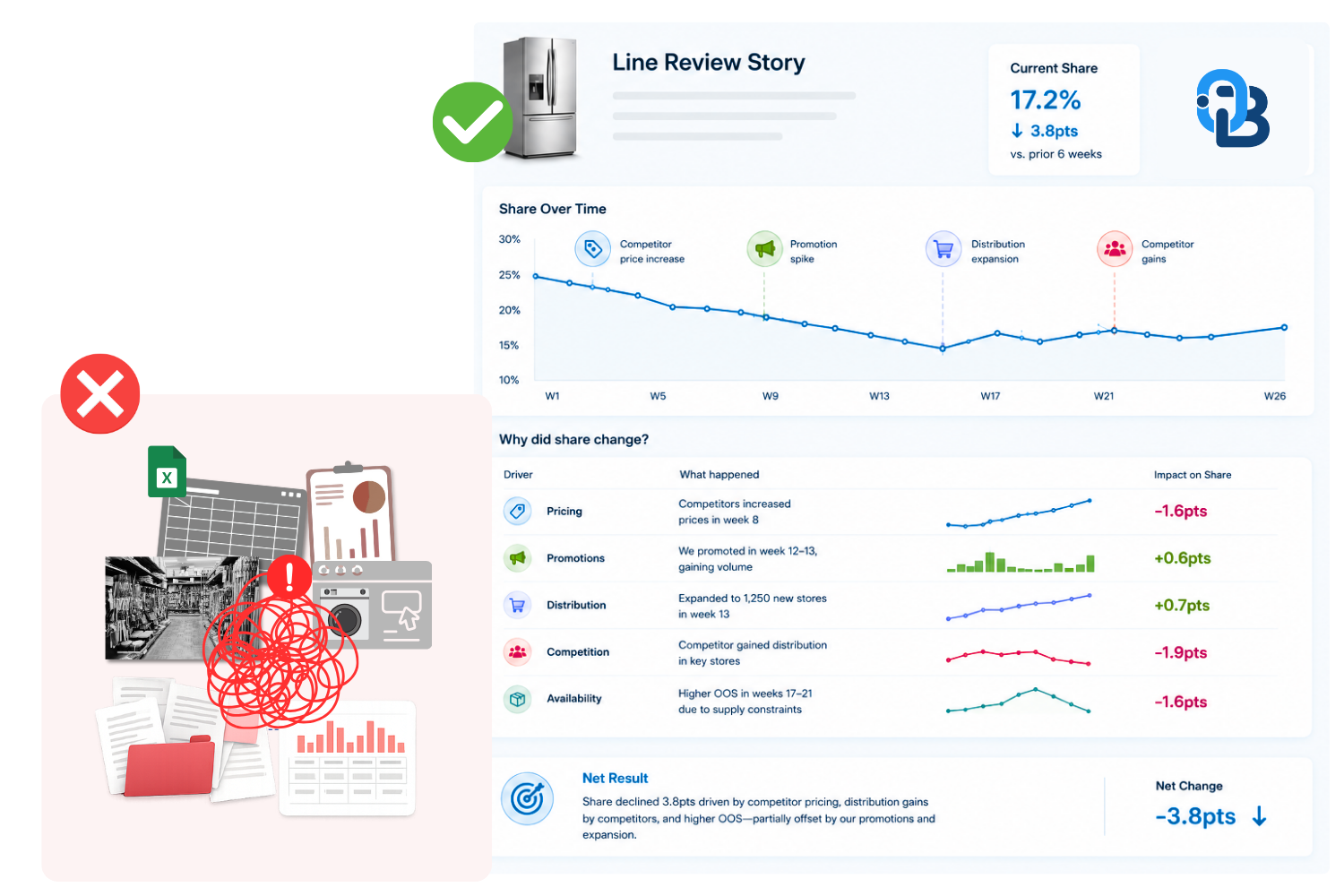
A store’s comps are a little bit like an iceberg, where only a fraction of the whole is visible. Because retailers cannot see their competitors’ in-store sales, it can be difficult to get a sense of what the entire market looks like. Just using the numbers in our earlier examples, we can see that our imaginary retailer had ten percent of the entire market in Q1 (with selling 100k units out of the 1MM that made up the entire market). However, in Q2, the market grew more quickly than sales at the retailer did. The retailer would see a slight loss in market share, dropping to eight percent of the market (120k units out of 1.5MM total) .
Without a tool like OpenBrand to get a holistic look at the market, it would be easy for our retailer to feel extremely confident and not realize that while they’ve done well, their competitors are outselling them. However, that first look at the data can be a shock. The immediate impulse is to feel that the data is incorrect. And, just as David explained it to me (albeit, in a very simplified manner), the OpenBrand team is able to demonstrate how the math works out. Both observations are true, and both are important for understanding your place in the market and why comps are up but shares are down.
Have any other questions about understanding the data OpenBrand provides? Do you want easily digestible explanations on analyzing data? Let us know how we can keep you updated. If you are not already subscribing to OpenBrand, our world-class team is ready to chat with you and help you access the most trusted source for consumer durables data.
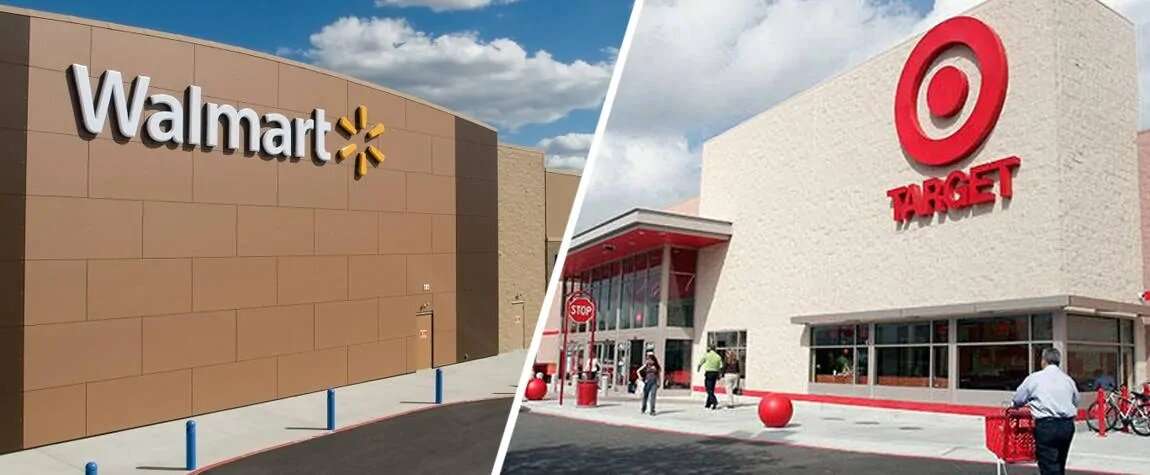
Retail Landscapes: Walmart vs Target
When I think about current events and the changing landscape of retail, I pause to consider two of the undisputed leaders in American retail: Target and Walmart. While I continue to work from home during these much-maligned unprecedented times, I have given a lot of thought to how these retailers are adapting as well. That is most likely a result of me reinvesting in our home space to accommodate two adults and three kids—all of whom need their own dedicated spaces for work, school, entertainment, and more. I miss milling about brick and mortar stores like Target and Walmart looking for all the things I need (and all the things I didn’t know I needed until I saw them in the store). But I have found a way to support retailers and meet my family’s needs all while responsibly social distancing.
My shopping has focused on three key categories that both Walmart and Target share: Consumer Electronics (CE), Home Furnishings, and Small Appliances. All three categories have played a vital role in sustaining our family’s quality of life during quarantine. The acceleration of curbside pickup means that I have made countless online orders over the last several months that gave me the freedom to arrive onsite and receive my goods without ever leaving my car. Walmart and Target have had to think fast on their feet to forge new paths to meet consumers’ needs. Read on to find out how they stack up against each other in these competitive categories.
CONSUMER ELECTRONICS
Walmart’s dominance over Target is uncontested given their share difference – Walmart’s market share is nearly five times that of Target’s in consumer electronics. Walmart’s share continues to increase, boasting gains in 5 out of the last 6 quarters. The brand mixes for both retailers has two brands that share the top three spots for each: Samsung and Sony. Sony wins the highest dollar share for Target and comes in second for Walmart; Samsung leads the brand mix for Walmart and takes second place for Target. In addition to selling significantly more Sony branded CE products than Walmart, Target also sells significantly more Apple and Nintendo. When looking at CE purchases made online, Nintendo jumps to the number one brand for Target, significantly outselling Walmart. Samsung maintains its lead position for dollar share at Walmart regardless of whether the purchase was made online or in store. Other than myself, just who has been shopping for Consumer Electronics at these two retailers? Here are a few key differences:
- Walmart shoppers are more likely to have only finished high school compared to the national average (That said, they also over index on shoppers with some college degree or having completed an Associate’s Degree).
- Retirees are more likely to shop for CE at Walmart than they are at Target, but Target attracts more student shoppers.
- Walmart over indexes with CE shoppers whose annual income is $49,999 or less, Target over indexes with shoppers whose annual income is between $50,000-$124,999.
HOME FURNISHINGS
Walmart’s share in Home Furnishings is roughly double that of Target. However, despite the strong unit share, each retailers’ overall share of consumer dollars spent is low, likely due to the affordably priced selection carried by both retailers. However, despite my significant contributions to Target and Walmart’s revenue, Target had a significant decline in units versus a year ago, while Walmart’s dollar share remained steady with year-over-year growth for the third consecutive quarter in a row.
Due to the large volume of import and private label brands, it is difficult to get a read on top brands for Home Furnishings. Home Furnishings do provide one of the greatest benefits of milling around either retailer as you (okay, I) grab those Home Furnishing impulse items. Every. Single. Time. However, when we do break down some of the brand data, nearly half of those purchasing Home Furnishings at Target classified those purchases under Target, Room Essentials, and Threshold—the latter two brands being strong proprietary brands for Target. There are differences between Walmart and Target Home Furnishing shoppers - here’s a quick overview of the main differences:
- Shoppers are mostly making smaller purchases—most of both Target and Walmart’s Home Furnishing purchases are $44 or less.
- While about half of their home furnishings shoppers own their home, both retailers perform better than the industry average among renters.
- While both Target and Walmart appeal to Millennials and Gen Z, Walmart also over indexes with Gen X shoppers. Target’s highest demographic is Millennials, by quite a lot.
SMALL APPLIANCES
Walmart tends to be consumers’ go-to for the Small Appliance category, compared to Target, despite a significant drop in share for the current quarter versus a year ago. However, a closer view of Walmart’s performance over the last year and a half shows Small Appliances increasing its dollar share in 3 out of 6 quarters. Walmart manages to hold slightly more than a third of the share as Target settles in around 8 percent for overall dollar share. Nevertheless, Target’s performance is holding steady for the category, with the ongoing national crisis having little impact on the current quarter.
Online shopping is front and center for retailers across the country, therefore it is important to understand category performance among those buying Small Appliances online as well. Walmart’s online only share for the category is almost 3 times Target’s share- 14 percent versus 5 percent for the last year. Interestingly, when drilling down to the product level, both retailers have the same top 3 Small Appliances sold online (and in-store, for that matter): Microwaves, Full Size Vacuums, and Coffee Makers. However, each retailer seems to have their sweet spot: Target sells significantly more Coffee Makers - both online and in-store, while Walmart sells significantly more Microwaves.
The brand mix for these two retailers is also different, with Walmart selling significantly more Bissel, Hamilton Beach, Hoover, and GE. The brands that make significant inroads at Target are slightly higher-end, and include Keurig, KitchenAid, Dyson, and SharkNinja. As with our other categories, here is a look at the differences in consumers buying these appliances at Target and Walmart:
- Shoppers at both Target and Walmart are more likely to spend $89 or under for Small Appliance products. That said, consumers at Target are more likely to be spending $150+ at Target than they are at Walmart
- Target again over indexes on Small Appliance shoppers with a college degree or some level of post-grad. Walmart over indexes for all other levels of education, but especially in high school graduates and some college.
- Walmart over indexes with homemakers for Small Appliances, while Target over indexes with students, similar to how shopper demographics break down with Home Furnishings.
KEY DIFFERENCES IN DEMOGRAPHICS: TARGET VS. WALMART:
Many argue that these two retail leaders do not attract the same core consumers. In fact, even Walmart’s CEO is calling for his store to attract an expanded customer base by shifting their focus from lower income to higher income customers, who not only spend more, but expect more as well. Does Target have the customers they are looking for?
Overall, Walmart does draw in more customers than Target. And frequently, those customers are looking to spend similar amounts on goods and services. One thing Walmart could lean into more is the sheer volume of Walmart stores across the country versus Target. Target serves primarily urban/major metro area consumers—Walmart does a much better job reaching consumers who live in rural parts of the country. A key advantage that Target has is its ability to attract students. Building loyalty in student shoppers, may translate to shopper loyalty for Target once they’ve finished school.

One additional note of interest: when comparing the online sales between both retailers, Target made significantly more of their sales online than Walmart did across all three categories for the last year. While not as substantial as the quantity of in-store sales, online shopping does fit with the younger, chic, urban, and trendy profile that many believe to be the primary Target shopper. While Walmart does have the higher overall volume of sales, Target seems to do a better job catering to shoppers who prefer an online experience.
Not All Categories Are Created Equal: Auto Batteries
All too often we focus on the big categories hitting the headlines right now like Appliances and Lumber. I want to give the smaller (but no less worthy of discussion) categories their own spotlight. In this ongoing series, I will create some discussion around smaller consumer durables categories that help drive the bottom line but don’t always make headlines. Remember: Not all categories are created equal but having the right data and insight can bring success to all categories.
This week, Auto Batteries sparked my interest (see what I did there?), likely because I needed a new one last month. As always, that got me thinking about who shops where, who has the greatest share, and what sets retailers apart. Let’s take a quick look at the overall Auto Batteries Market:
- Auto Zone and Walmart have been in the lead over the past year.
- Walmart experienced significant declines this last quarter versus a year ago, which gave first place to Auto Zone.
- Advanced Auto and AAA picked up Walmart’s lost shares, gaining significantly in both unit and dollar share for Q2 2020.
- AAA as a retailer? Whatever your thoughts, they have innovated how they reach their customers in need of a battery replacement with ‘two quick steps’.
The Auto Battery category’s online growth has nearly doubled from Q2 2019, though it is not as substantial as Total TVs or Appliances (which grew 10 and 12 points, respectively, in online unit share this year versus las year). Here’s a quick overview of who was seeing growth in online sales for Q2:
- Battery Plus came in second, behind Amazon. The retailer over-indexed relative to the industry for both online shopping and for purchases made online.
- Costco took third place and saw the greatest gains for online purchases.
- Walmart and Sam’s Club were a close tie for fourth place.
(source: OpenBrand Head-to-Head, L4Q Q2 2020).
Curious about what else gets consumers motivated to buy Auto Batteries from one retailer or another?
- AAA over-indexed with consumers on “Good Repair Service” and “They stand behind the products they sell”.
- Auto Zone buyers cite “Previous Experience with Retailer” and “Convenient Location”.
- Costco, Sam’s Club and Walmart over-index on “Competitive Price” for Why Bought Store
- Delivery Method lets different retailers really shine:
- Auto Zone, Batteries Plus, Costco, Cam’s, and Walmart all over-index for “Pick up at the store or some other location”
- AAA over-indexes for ‘Delivery’ (a real game changer in our opinion—they come to you AND install the battery)
Is there a category you would like more details on? Or do you need to surface some key insights before a line review? Contact us at traqline.com so we can help!

Computer Market Infographic
What are the best brands and outlets in US Computer market share? - An infographic
OpenBrand answers the "who", "what", "where", "when", "why", and "how" for computer market shares. Our quarterly survey will help you understand who's buying computer products, where they're buying them, and what drives their decisions. Our Computer Market infographic will help you answer the following questions about the US Computer market and how it is changing...
Who is leading sales in the computer market?
Our infographic will give you greater details, but for now, here's what you need to know about the market leaders for computers:
- Best Buy takes the lead for dollar share in the computer market.
- Apple brand computer products wins over 34% of consumer dollars.
- Amazon outdoes Walmart for dollar share, at just over 13% versus Walmart's 8%.


How much do consumers spend on computer products?
When buying computers, the industry average price paid for these products is $481. However, the average amount spent at different retailers can vary. For example:
- Shoppers buying computers at Apple stores spend $911 on average.
- Shoppers at Walmart, on the other hand, spend about $279 on average.
What demographic is buying computer products?
Just who buys computer products like laptops and tablets? OpenBrand's census-balanced respondent pool has given us insights like:
- It isn't just men purchasing computer products! 39% of buyers are women shopping solo.
- The South slightly over-indexes on computer product purchasers: 39% live in that region.
Computer Market - Online Sales Trends:
With 53% of computer product purchases being made online, it's important to keep track of online sales trends. Here's just some of the trends that OpenBrand has uncovered:
- Amazon closes 71% of its computer sales.
- 75% of buyers do at least some shopping for computers online.
- 62% of computer buyers have an Amazon Prime account.
Computer Product Market Share Facts:
Curious about other information OpenBrand's survey has uncovered? Here's another preview for you:
- Amazon has consistently gained computer market share for the last 9 years.
- The average price paid for computers ($481) is up 3% over last year's average price.
- When choosing a computer brand, American shoppers favor features slightly more than quality.
To see everything we've included on our infographic, fill out the form below and download your own copy:

How To Design An Effective Mobile Survey
From in-person, to paper and pencil, to online, those of us who have been in the market research industry for years have seen big changes in how surveys are administered. As Bob Dylan once sang, “for the times they are a changing”- but I beg to differ. The times have changed already. The newest change in administering surveys? Making those surveys mobile friendly.
Here are a few tips for ensuring that your survey is optimized for being taken on mobile devices:
“Brevity is the soul of wit” – Watch Your Length
Mobile devices (phones, tablets, etc.) typically have smaller screens than a traditional desktop computer. As a result, online surveys that seem quick and easy to complete on a desktop can become long and arduous on a mobile device. As “brevity is the soul of wit”, you will want to apply the principles of brevity to both the length of your interview (as in the number of questions asked) as well as the length of the questions themselves. It’s a good idea to keep question wording as direct as possible. As an example, instead of asking “What is your gender?”, you can simply ask “Gender?” with the appropriate multiple-choice responses.
Survey Layout
Certain types of questions that look great on a PC or laptop may not look quite so nice on a phone or tablet. For example, large “grid” type questions with multiple scale choices and lots of attributes to rate on that scale should be recalibrated to fit on mobile screens. Either reduce the number of attributes to rate, or at the very least break them up onto multiple screens. Lots of scrolling down in a mobile survey can be frustrating.
Similarly, questions that require a large text box (i.e. open-ended questions) should be used sparingly on mobile interviews. Typing on a small mobile keyboard is problematic, and as with a large “grid” question, the respondent may have to scroll. Keep text boxes manageable. Also, consider an audio option for collecting open ended responses. Instead of typing their answers, respondents can simply speak their answer into their device’s microphone. This is faster and less likely to contain errors. While this option may not always be feasible, it should at least be explored.
“Make it simple, but significant”- Consider several survey sections

Bite-sized survey sections may be best. That is, break the survey into smaller pieces with a very short intro that has the respondent focus on a particular topic (i.e. where did you purchase and why). As Mad Men has taught us, “keep it simple, but significant.” Having distinct sections of the survey could help keep mobile respondents more engaged and help with overall participation incidence.
One of these things is not like the other – test your survey on multiple devices
As Sesame Street has taught generations of children, “One of these things is not like the other”. Due to the variance between screen sizes and operating systems among mobile devices, different devices will display your survey differently. The upshot is that it is important to test your survey on multiple devices- from desktops, tablets, and phones, as well as across multiple browsers and operating systems.
Additionally, images may not be displayed the same way on different devices. If you need to show images in your survey, a good idea is to have a thumbnail (or small image) that expands into a full-screen image when clicked upon. That way the text and thumbnail can be shown together, but the option of more image detail is available as needed.
Don’t ask unnecessary questions
Chances are you are conducting your survey through a panel provider. If so, do you really need to include questions about the demographics you are interested in tracking? Most of the major panel providers have recent demographic info on their panel participants. You may be able to append this data without having to ask these questions in your survey. This goes back to the survey length concern mentioned earlier.

The ubiquity of mobile phones as peoples’ primary way to access the internet means that for conducting good research, a mobile-friendly survey isn’t just a “nice to have”, it’s a “critical to have” component. Following best practices like those we’ve outlined here, as well as general best practices when designing and testing your survey will help ensure that you get quality, actionable data from your research. Working with experienced teams like the research group at The Stevenson Company will help you align your survey for the best results possible.

Two-Thirds of Respondents Delayed Purchases in April
As many have said, we are in unprecedented times. Much ado has been made about how consumer behavior may be changed forever. The fact is, most of us don’t know what consumer behavior looked like in March, or what it looks like now. To get this information, OpenBrand surveyed over 13,000 respondents to give a unique and representative perspective on the pandemic’s effects on current and future purchases. Because this is a monthly tracking survey, it allows us to continuously track how the economic and social unrest is affecting consumers and how they are dealing with social distancing and stay-at-home orders. This initial data highlights trends and behavior as they form, and will follow customer behaviors and trends next month and for as long as the pandemic and its associated shutdowns last.

In this initial wave collected April 1, 2020, 13,000+ respondents were asked questions about the following:
- Impact of the pandemic on their purchase plans of durable goods
- Impact on how they shop
- Impact on their employment situation
- Personal behaviors related to COVID-19 (i.e. self-isolation, receiving testing, etc.)
Consumers are delaying purchases due to COVID-19
Two-thirds of consumers are delaying planned purchases
As you are aware, March saw a drastic drop in consumer spending across nearly all retail categories. Those most likely to delay their purchases include women, lower-income households, and consumers under 55. Luckily, only 10 percent of those consumers report that they no longer intend to make that purchase, even once the crisis is over. This provides a strong indication that consumers see a light at the end of the tunnel, and do not expect the pandemic to disrupt their normal lives permanently.

Half of all consumers currently believe that life will return to normal by June or July. Unfortunately, the situation shifts nearly daily, so future surveys could show a shift in consumers’ views. One in five respondents answered “Don’t Know” in response to the question “When do you expect the COVID-19 crisis will be over”, which reflects the uncertainty that everyone feels as each day brings new statistics and procedures intended to keep people safe and healthy. Retailers and manufacturers should be at the ready for when consumers feel safe to engage with the economy again.

“Essential” items are more likely to be replaced or repaired if they stop working
While planned purchases are one thing, the survey also examined consumer behavior in a related scenario: what they plan to do if a product stops working. In an unexpected and potentially emergency situation, the majority of respondents say that rather than go without, they would either replace or repair a broken product. This would indicate that in such a situation, the pandemic would not be a key factor in their purchase decision-making process; at least not yet. There are some products more likely to be replaced than others, though.
In the event that they break, products that are strongly associated with convenience and
comfort are more likely to be replaced. This includes products such as hot water heaters, cell phones, and refrigerators. Consumers are more likely to do without those products that are deemed less crucial (such as barbecue grills or power tools) should they break. The situation is compounded for those consumers in lower-income households, who are more inclined to go without a replacement or repair until the crisis is over.
Home improvement projects get pushed back and Shoppers focus Online and Local
Impact on Home Improvement Plans
With lots of moving parts, and usually involving multiple large purposes, consumers are choosing to put planned Home Improvement projects on hold. While Remodelers and Home Designers had previously indicated that the ongoing crisis was of concern to their businesses, this data gives a new look at how consumers are dealing with the same precariousness. Given the complexity of home improvement and the uncertain end date for strict social isolation, it is unsurprising that many consumers are putting their plans on hold.
Online shopping and small retailers attract shoppers
With 42 states currently enforcing stay-at-home orders, as well as many experiencing a need to maintain social distancing, consumers’ shopping habits have shifted accordingly. Whether avoiding crowds, staying home to self-isolate, or simply being unable to shop in brick-and-mortar stores due to closures, 55 percent of respondents indicated they were somewhat or much more likely to shop online at this time. Additionally, 40 percent of consumers indicated an increased likelihood to shop in smaller stores, eschewing Big-Box style retailers. This should be an early warning indicator for Big-Box stores and an opportunity for smaller stores in the event this evolves into a permanent shift in behavior once the crisis has subsided.

Employment, self-isolation, and other consumer experiences
Consumers expect to return to their jobs post-crisis
At the time of the survey, 61 percent of respondents said no one in their household had been laid off or furloughed during this crisis. However, this is a very dynamic situation, with job loss results expected to be much higher now than originally anticipated. Unemployment is at an all-time high and record numbers of Americans are filing for unemployment insurance, therefore subsequent surveys will show even greater job loss. Despite this, consumers feel confident that those who have been laid off or furloughed will not be permanently affected by job-loss due to the pandemic and will be able to return to their jobs as normal when the crisis ends.
The majority of consumers are self-isolating
As previously mentioned, most local governments have requested that people self-isolate and practice social distancing. The majority of consumers indicate that they have done so. However, there is a significant minority (23 percent) who indicate that they have not yet started self-isolating.
Of those non-isolating consumers, 76 percent reported they would not self-isolate unless explicitly directed to do so. This gives a net impact of about 18 percent of consumers who are pushing back on the idea of self-isolating.

Very few consumers have been tested for COVID-19

At the time of fielding, only 5 percent of respondents said they had been tested for COVID-19 and 1 percent indicated they prefer not to answer. Of the 94 percent of consumers who had not been tested, more than half believe that they will be tested in the future. A small percentage (4 percent) of those who had not been tested indicated that they had sought testing but were unable to receive it. As time passes and testing becomes more widely available, levels of testing should increase, which will likely be reflected in the next wave of data.
OpenBrand Consumer Behavior and Market Insight
The COVID-19 pandemic has clearly impacted consumer behavior. Many have changed their purchasing plans, have or will make changes to their shopping habits, and find themselves in the midst of employment uncertainty.
When the economy opens back up, retailers and manufacturers will likely face two competing forces: pent up demand and potential economic uncertainty. While consumers may be ready to make delayed purchases, they may also have limitations depending on the degree to which the crisis has impacted their personal finances. Businesses recognizing this and providing the greatest support with respect to purchasing (i.e. deep discounts, delayed/interest-free payment plans) will find themselves in the best positions post-crisis.
A second wave of data and insights will be available in a few weeks to compare new sentiments vs. old. Until then, subscribe to OpenBrand updates or partner with our market research experts to stay attuned to these changes.