




Samsung led every major appliance brand in consumer consideration in Q1 2026 and still lost more unit share than anyone else in the category. LG took the top spot instead, its highest in five quarters. US major appliance market share shifted more at the brand level this quarter than it has in a year, even as Lowe’s and Home Depot held retail almost exactly where they were.
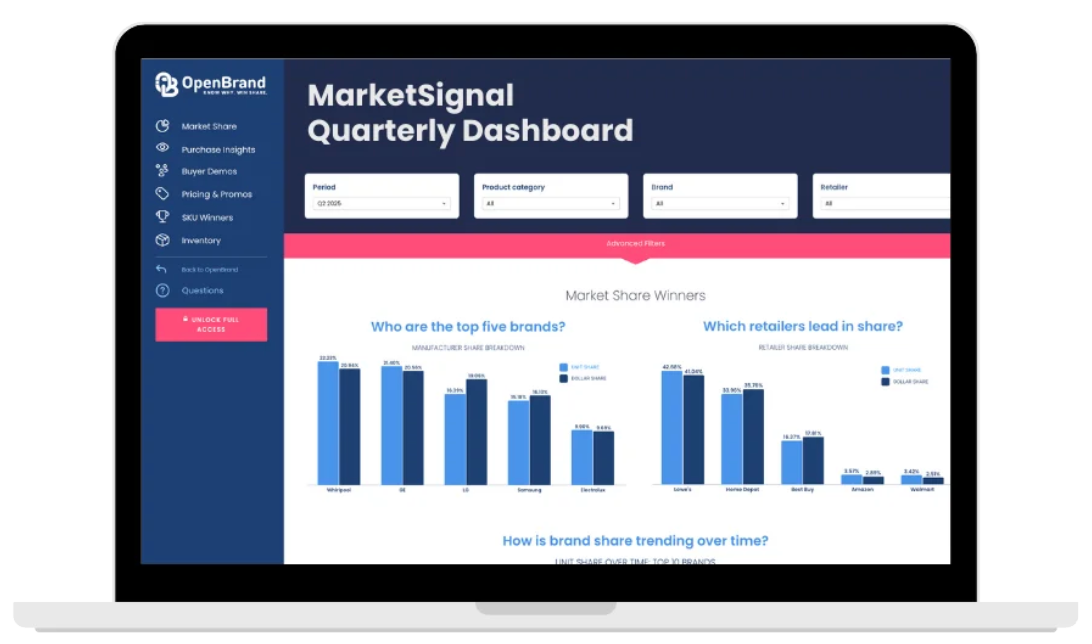
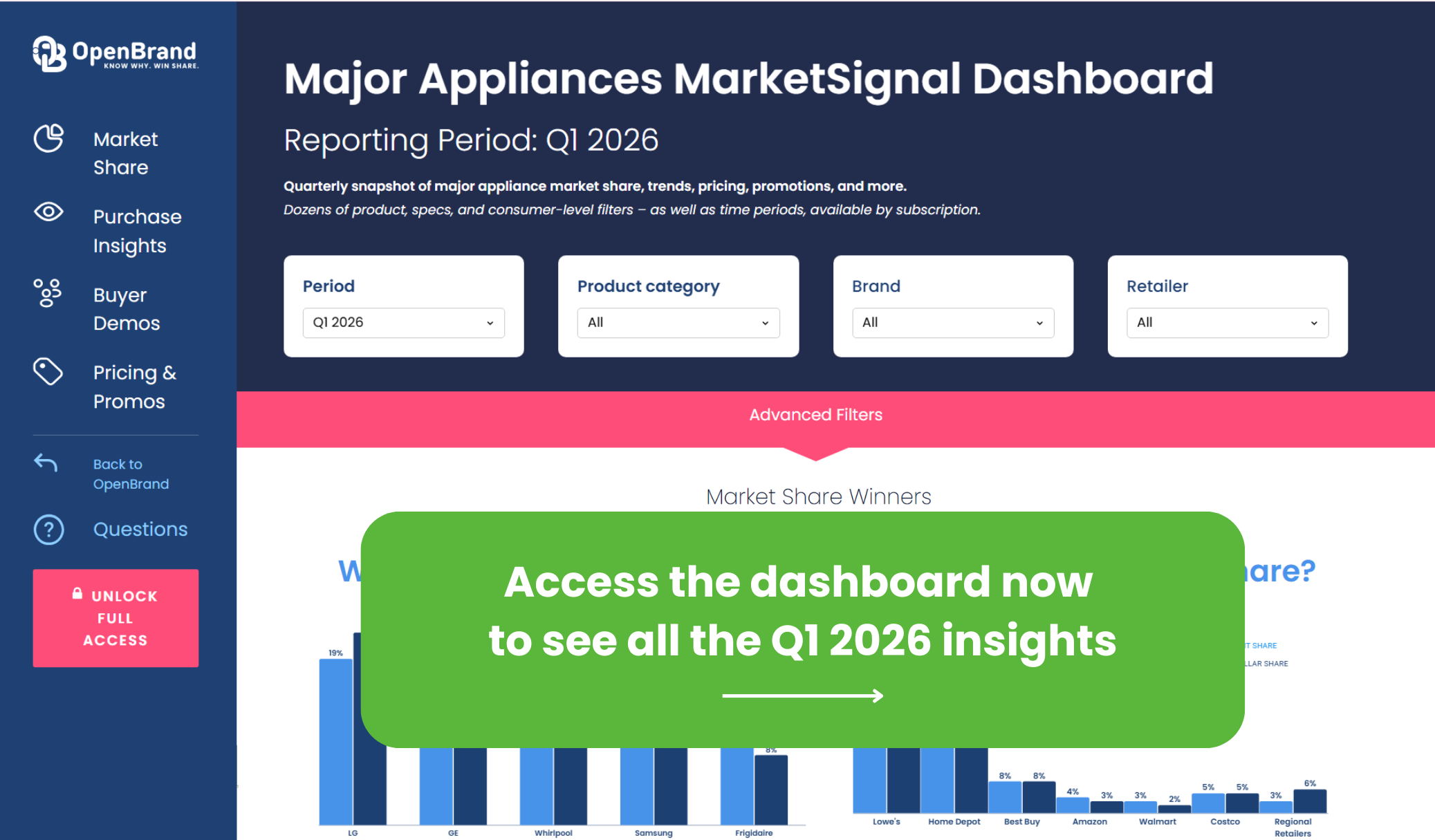
Our public MarketSignal dashboard tracks this at the brand, retailer, SKU, and shelf level.
Keep reading for the latest Q1 2026 insights, or explore the full dashboard for a deeper view into the market.
SOURCE: All data insights in this article cover Q1 2026 data within the OpenBrand Market Measurement suite. This category covers an aggregate of several products including Refrigerator, Clothes Washer, Clothes Dryer, Dishwasher, Freezer, Free-Standing Range, Cooktop, Wall Oven, Compact Refrigerator, and Built-In Range.
Key Takeaways:
Q1 2026 U.S. Major Appliance Market
- Lowe’s leads retail with 42% unit share (+0.5 pts QoQ), the largest unit gain of any national retailer; Home Depot posted the largest dollar share gain (+0.6 pts)
- Walmart saw the largest declines in both unit share (-0.5 pts QoQ) and dollar share (-0.5 pts), reversing three quarters of gains
- LG leads brand unit share at 19%, its highest in five quarters, and leads dollar share at 22%
- Samsung fell to 12.4% unit share (-1.8 pts QoQ), the largest brand decline of the quarter, despite leading all brands in consideration
- 75.4% of appliance purchases happen in-store, up 1.8 pts as the online shift reversed post-holiday
- Millennials and Gen X account for 60% of appliance buyers; price drives 49% of retailer selection decisions, down from 52%
- Frigidaire leads close rate among major brands, converting 65% of shoppers
Who are the top major appliances retailers by market share?
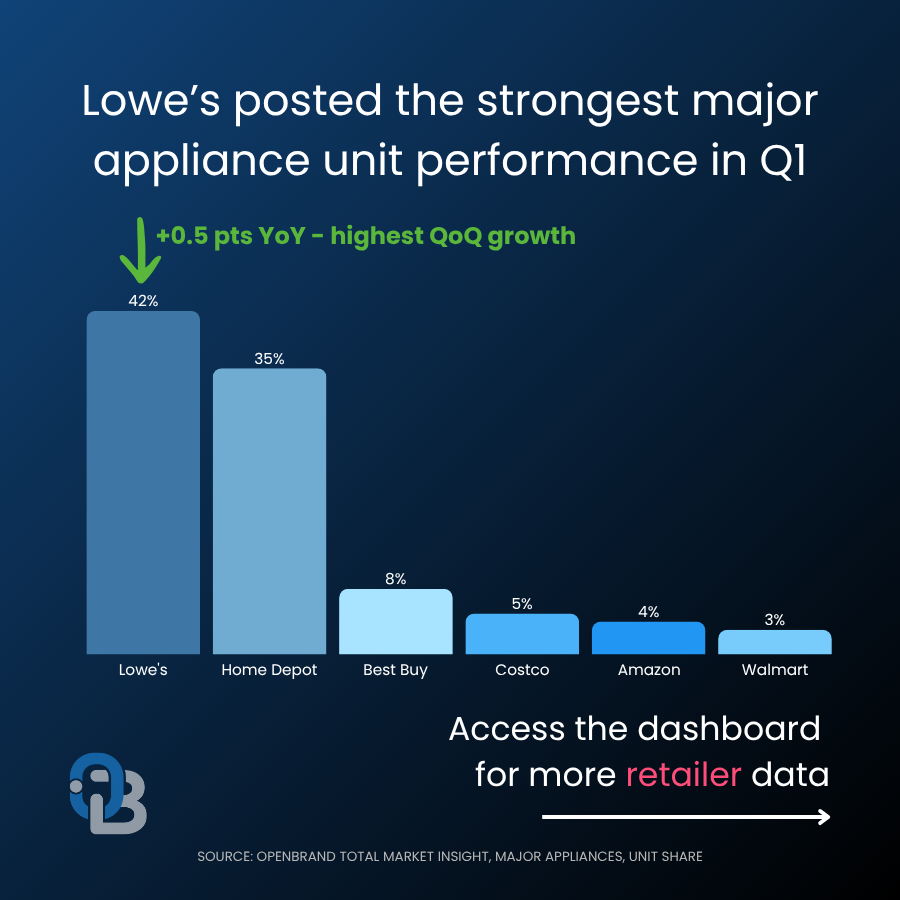
According to OpenBrand’s Q1 2026 market data, retail leadership held steady in Q1, with Lowe’s and Home Depot continuing to capture more than three-quarters of appliance volume.
Q1 2026 Major Appliances Retailer Unit Share Winners
| Major Appliance Retailer | Q4 2025 Unit Share | Q1 2026 Unit Share | QoQ Change |
| Lowe’s | 41.9% | 42.4% | +0.5 pts |
| Home Depot | 35.2% | 35.0% | -0.2 pts |
| Best Buy | 7.5% | 7.5% | -0.1 pts |
| Costco | 4.6% | 4.7% | +0.1 pts |
| Amazon | 3.9% | 3.8% | -0.1 pts |
| Walmart | 3.8% | 3.4% | -0.5 pts |
Q1 2026 Major Appliances Retailer Dollar Share Winners
| Major Appliance Retailer | Q4 2025 Dollar Share | Q1 2026 Dollar Share | QoQ Change |
| Lowe’s | 38.7% | 38.6% | -0.1 pts |
| Home Depot | 35.6% | 36.2% | +0.6 pts |
| Best Buy | 8.5% | 8.3% | -0.2 pts |
| Costco | 5.7% | 5.4% | -0.3 pts |
| Amazon | 3.1% | 2.9% | -0.2 pts |
| Walmart | 2.9% | 2.4% | -0.5 pts |
Biggest QoQ Major Appliance Movers (Q4 2025 → Q1 2026)
- Largest unit share gain: Lowe’s (+0.5 pts)
- Largest dollar share gain: Home Depot (+0.6 pts)
- Largest unit share decline: Walmart (-0.5 pts)
- Largest dollar share decline: Walmart (-0.5 pts)
OpenBrand’s Major Appliance Trend Insight
Lowe’s posted the strongest unit performance in Q1, adding +0.5 pts to reach 42.4% and extending its lead over Home Depot to 7.4 pts. Its dollar share held essentially flat at 38.6%, indicating volume growth at a steady average ticket rather than a premium-driven lift.
Home Depot moved the opposite direction, giving back -0.2 pts in units while gaining +0.6 pts in dollars. That combination points to a richer mix, with fewer transactions carrying higher value.
Best Buy stabilized after three quarters of decline, holding 7.5% of units and easing -0.2 pts in dollars, its smallest quarterly movement in the past year.
Among secondary retailers:
- Costco edged up in units (+0.1 pts) but slipped -0.3 pts in dollars, a reversal of the pattern it showed in Q4
- Amazon lost ground in both units (-0.1 pts) and dollars (-0.2 pts), pausing the gradual progress it made through 2025
- Walmart posted the quarter’s clearest reversal, losing -0.5 pts in units and -0.5 pts in dollars after gaining share in three consecutive quarters
Regional and independent retailers, which sit outside the national accounts above, took 6.2% of category dollars on just 3.3% of units and recorded the largest dollar share gain of any retail group at +0.7 pts. That makes independents the highest-value channel per transaction in major appliances.
Q1 2026 Major Appliance Retailer Draw Rates
According to OpenBrand’s consumer survey data, the top major appliance retailers continue to lead in consumer traffic:
- Lowe’s: 38.9% draw rate
- Home Depot: 38.7% draw rate
- Best Buy: 19.1% draw rate
OpenBrand’s Major Appliance Trend Insight
Lowe’s and Home Depot are now separated by just 0.2 pts of draw, effectively tied at the top of the funnel. The 7.4 pt gap in unit share between them is built almost entirely on conversion.
Best Buy continues to stand out on that measure, closing 69.6% of shoppers who consider it, compared to Lowe’s (64.3%) and Home Depot (61.1%). It holds the highest close rate in the category on roughly half the consideration base of the home centers.
Walmart shows the widest gap between traffic and conversion, drawing 9.0% of appliance shoppers but closing only 40.2%, meaning roughly six of every ten shoppers who consider Walmart buy elsewhere.
This reinforces a consistent pattern: secondary retailers face a traffic challenge, not a conversion problem.
For more insights on draw rates, and to see how these retailers compare in closing the consumers they brought in, explore the quarterly major appliances MarketSignal dashboard.
Who leads the major home appliances market share by brand in Q1 2026?
Brand rankings reordered at the top in Q1, with LG taking the unit share lead and Samsung recording the steepest decline of any major brand.
Q1 2026 Major Appliances Brand Unit Share Winners
| Major Appliance Brand | Q4 2025 Unit Share | Q1 2026 Unit Share | QoQ Change |
| LG | 17.4% | 18.7% | +1.3 pts |
| GE | 16.2% | 16.4% | +0.2 pts |
| Whirlpool | 15.3% | 14.5% | -0.8 pts |
| Samsung | 14.2% | 12.4% | -1.8 pts |
Q1 2026 Major Appliances Brand Dollar Share Winners
| Major Appliance Brand | Q1 2026 Dollar Share | Q1 2026 Unit Share | Unit-to-Dollar Gap |
| LG | 21.6% | 18.7% | +2.9 pts |
| Samsung | 13.1% | 12.4% | +0.7 pts |
| GE | 13.1% | 16.4% | -3.3 pts |
| Whirlpool | 11.7% | 14.5% | -2.8 pts |
Biggest QoQ Major Appliance Movers (Q4 2025 → Q1 2026)
- Largest unit share gain: LG (+1.3 pts)
- Largest unit share decline: Samsung (-1.8 pts)
- Highest dollar share: LG (21.6%)
- Widest unit-to-dollar gap: GE (-3.3 pts)
OpenBrand’s Major Appliance Trend Insight
LG took the unit share lead in Q1, rising from 17.4% to 18.7% (+1.3 pts), its highest level in five quarters. It also holds the top dollar share position at 21.6%, making it the only major brand leading both metrics at the same time.
GE gained modestly in units, moving from 16.2% to 16.4% (+0.2 pts), and now sits 2.3 pts behind LG in volume. Its dollar share of 13.1% against 16.4% of units reflects a value-weighted mix, the widest negative unit-to-dollar gap among the leading brands.
Whirlpool declined from 15.3% to 14.5% (-0.8 pts), giving back most of the momentum it built in Q4.
Samsung recorded the steepest drop of the quarter, falling from 14.2% to 12.4% (-1.8 pts). Its dollar share of 13.1% still exceeds its unit share, so the pressure is on volume rather than price realization.
Overall, Q1 shows a shift toward premium-weighted growth, with LG extending its lead in both units and dollars while value-oriented positions lost ground.
Brand Consideration Rates
When purchasing major appliances, consumer consideration remains concentrated among a few key brands. OpenBrand’s Q1 2026 survey data shows:
| Major Appliance Brand | Q4 2025 Brand Consideration Rate | Q1 2026 Brand Consideration Rate |
| Samsung | 34% | 36.9% |
| LG | 32% | 34.9% |
| Whirlpool | 27% | 25.7% |
| GE | 26% | 23.5% |
OpenBrand’s Major Appliance Trend Insight
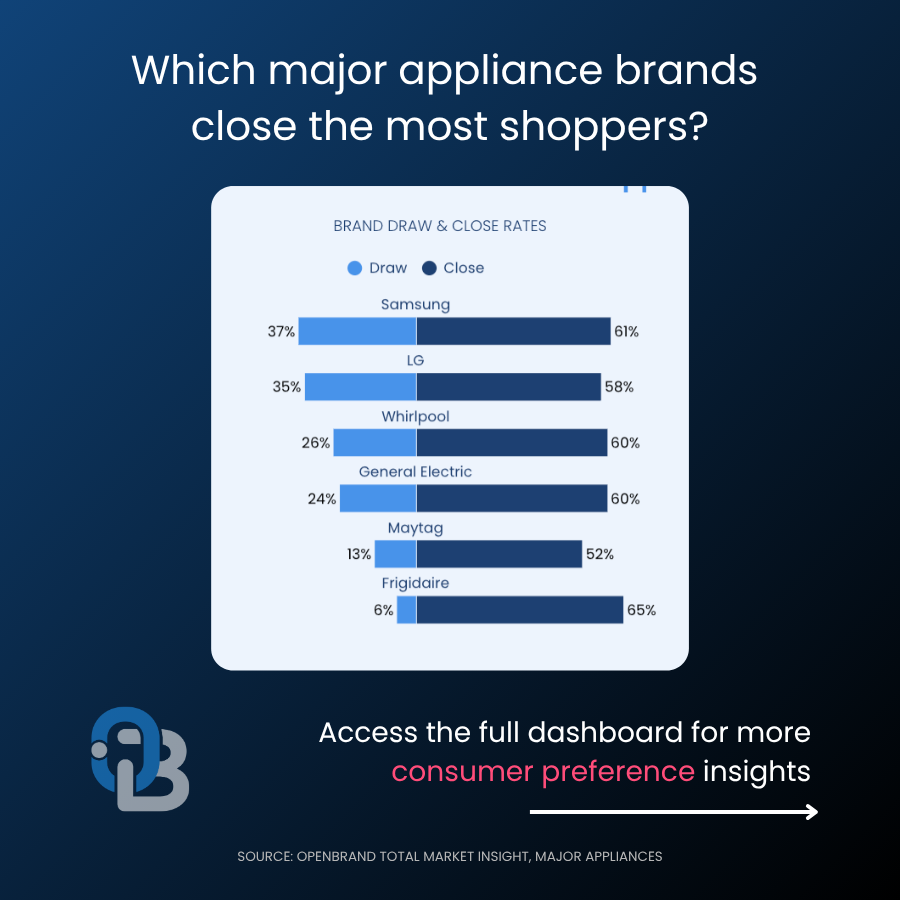
- Frigidaire again stands out for efficiency. While considered by just 6.5% of shoppers, it converted 64.7% of those into buyers, the highest close rate among major brands.
- Samsung and LG both grew consideration this quarter, but only LG converted it into share. Samsung closed 61.4% of the shoppers it drew and still lost 1.8 pts of unit share, which points to a volume problem at the point of purchase rather than a demand problem.
- GE and Whirlpool both saw consideration decline while holding steadier on share, indicating they are converting a smaller funnel more efficiently.
Discover the factors, from pricing dynamics to promotional activity, influencing lower conversion rates in our latest quarterly major appliances MarketSignal dashboard.
How are online and in-store sales trending for the Major Appliance market?
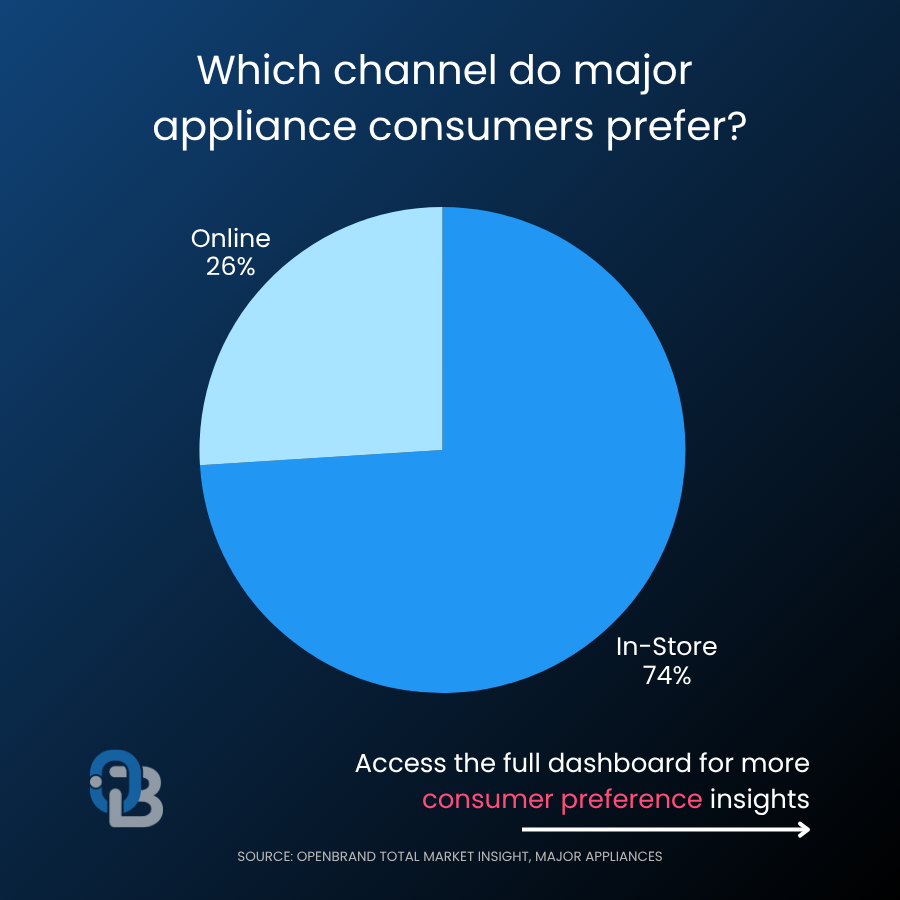
Channel mix shifted back toward physical retail in Q1. According to OpenBrand’s Q1 2026 data, in-store now accounts for more than three-quarters of all appliance purchases.
| Major Appliance Purchase Channel | Q4 2025 | Q1 2026 | QoQ Change |
| In-Store | 73.6% | 75.4% | +1.8 pts |
| Online | 26.4% | 24.6% | -1.8 pts |
OpenBrand’s Major Appliance Trend Insights
Online purchases declined in Q1, giving back the gain recorded during the holiday quarter and landing below where the channel sat in Q3 2025. The Q4 lift looks like a seasonal promotional effect rather than a structural move.
The retailer data lines up with this. Amazon and Walmart, the two most digitally weighted appliance retailers, both lost unit and dollar share in the same quarter that in-store buying strengthened.
The category continues to rely on physical retail due to delivery logistics, installation requirements, and the need for in-person product evaluation.
Major Appliance Consumer Demographics
OpenBrand’s census-balanced data highlights today’s appliance buyer.
In Q1 2026:
- 71% of buyers were homeowners
- 55% were married
- 62% of purchases were made by males only, compared to 38% by females only
- 60% of purchases came from Millennials and Gen X
- Millennials: 33%
- Gen X: 26%
- 19% of purchases came from Gen Z, nearly matching Baby Boomers at 19%
OpenBrand’s Major Appliance Trend Insights
Millennials remain the largest buying group, continuing to shape demand patterns across the category. Gen X also represents a significant portion of buyers.
The clearest movement this quarter is at the younger end. Gen Z now accounts for roughly the same share of appliance purchases as Baby Boomers, and 27% of all buyers are renters rather than homeowners. Compact and entry-price formats are serving a larger cohort than the category has historically planned around.
Major Appliance Purchase Drivers
Several key factors continue to influence where consumers choose to purchase major appliances, according to OpenBrand’s Q1 2026 consumer survey:
- Competitive pricing: 48.5%
- Product selection: 34.6%
- Prior experience: 25.9%
- Store location convenience: 25.8%
OpenBrand’s Major Appliance Trend Insights
Price remains the most influential factor, but its weight fell 3.5 pts from Q4, the largest single-quarter drop among the four drivers. Selection and convenience also eased slightly.
Prior experience with the store was the only driver to gain, rising to 25.9% and moving ahead of location for the first time. Against a quarter where promotional depth thinned, buyers leaned modestly more on familiarity and less on the deal.
This is a shift in emphasis rather than a break from the 2025 pattern. Value still decides most purchases, but retailer relationships are doing incrementally more work than they were during the holiday quarter.
Appliance Industry Outlook and Emerging Trends
What’s next for the US Major Appliance market in 2026?
Looking ahead through 2026, several themes continue to shape the appliance market:
Retail remains concentrated: Lowe’s and Home Depot account for 77.4% of category units, making retail partnerships critical for brands.
Q1 acts as a normalization quarter: Post-holiday, promotional intensity, and channel mix both reset toward baseline, making Q1 a cleaner read on underlying demand than Q4.
Premium and value strategies are diverging further: LG leads both units and dollars while GE carries the widest negative unit-to-dollar gap, showing two distinct paths through the same category.
In-store regained ground: After a holiday-driven online lift, three of every four purchases moved back into physical locations.
Independents are punching above their volume: Regional retailers took 6.2% of dollars on 3.3% of units and posted the largest dollar share gain of any retail group.
Younger consumers are broadening the base: Gen Z now buys at nearly the same rate as Baby Boomers, reinforcing the need for entry-price and compact assortment alongside premium replacement.
Get more insight into Major Appliance market trends
Samsung led every brand in consideration this quarter and still lost 1.8 pts of unit share. That gap is not visible in a share report. It shows up in draw, close, and leakage.
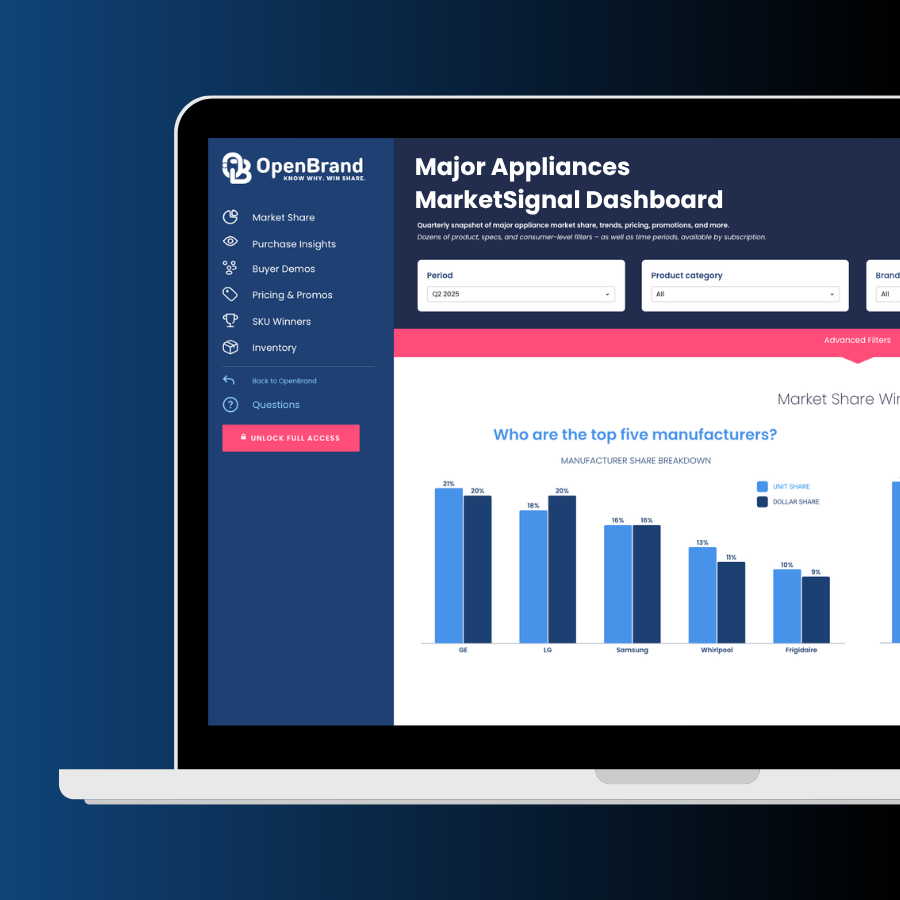
OpenBrand’s MarketSignal dashboard tracks retailer performance, brand movement, and consumer behavior across the major appliance category, updated quarterly.
Explore the Q1 2026 dashboard, or talk to our team about what the data shows for your brand.
To learn how OpenBrand can help your business stay ahead of market shifts, get in touch with our team.
