


Outdoor Power Equipment Market Share: Q2 2025 Trends & Rankings
The Outdoor Power Equipment market continues to evolve at a rapid pace, reshaping how consumers shop, which brands they trust, and what drives their purchase decisions.
From the strength of big-box retailers and dealer networks to the steady rise of online sales, the data reveals an increasingly competitive landscape where market leaders are widening their edge and challengers are finding new ways to compete.
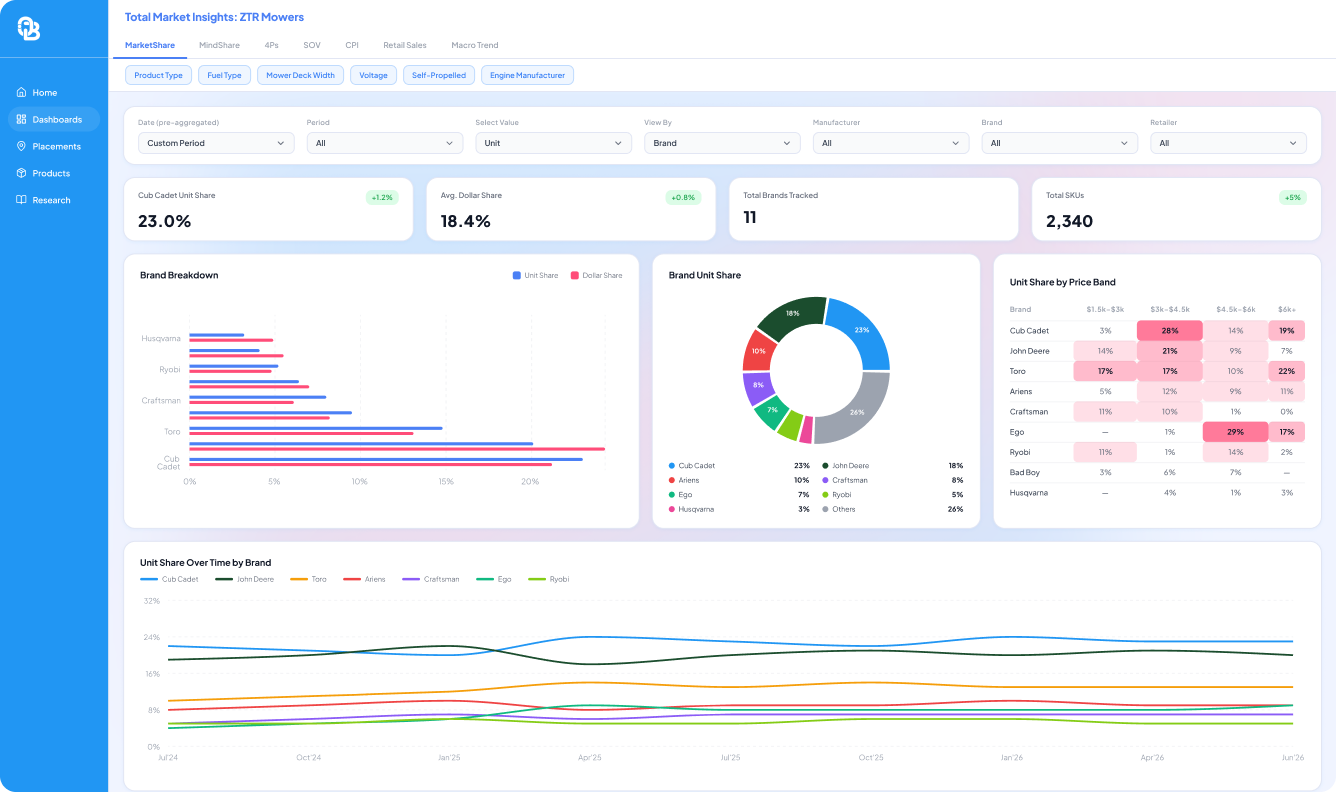
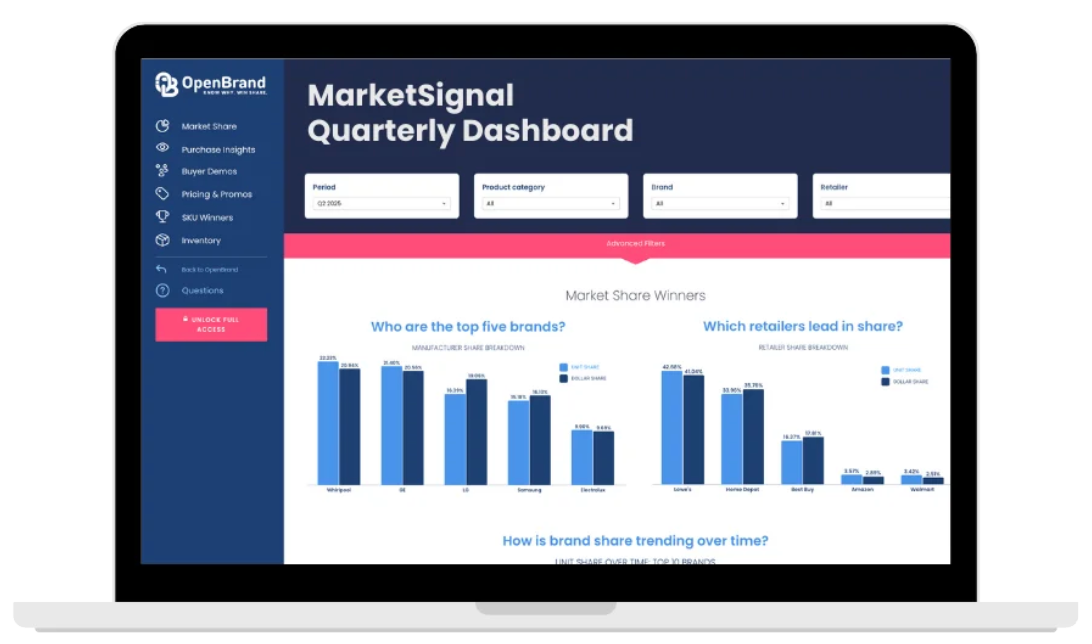
Our public MarketSignal dashboard brings these shifts into focus, offering an interactive view of retailer performance, brand share, pricing trends, and consumer behavior.
In our breakdown below, learn why:
- Walmart is winning attention but losing the sale, signaling major conversion opportunites in pricing, assortment, and fulfillment.
- Ego is punching above its weight, delivering top-three share despite lagging in consumer awareness.
- Home Depot and Lowe’s are still the class of the OPE category, powered by Ryobi’s volume machine at Home Depot and Craftsman/Ego strength at Lowe’s.
- Women and Millennials are reshaping demand, driving interest in battery ecosystems, smart features, and more inclusive product positioning.
Explore these and the rest of our latest insights or dive into the dashboard to see how the market is moving.

SOURCE: All data insights in this article cover Q2 2025 within an OpenBrand aggregate category of several products including Mowers, Handhelds, Snow Throwers and Pressure Washers.
Who are the top Outdoor Power Equipment retailers by market share?
The top Outdoor Power Equipment retailers in 2025 remain Home Depot and Lowe’s, leading in both unit and dollar share – with Amazon and Walmart gaining ground.
Note: OpenBrand’s share split is based on our retailer panel, which currently consists of Home Depot, Lowe’s, Amazon, Walmart, and Best Buy. These retailers make up a majority of non-individual dealer sales in the OPE industry. More retailers are coming soon.
Outdoor Power Equipment Retailer Unit Share Winners
| Outdoor Power Equipment Retailer | Q2 2025 Unit Share |
| Home Depot | 38% |
| Lowe's | 30% |
| Amazon | 16% |
| Walmart | 15% |
Outdoor Power Equipment Retailer Dollar Share Winners
| Outdoor Power Equipment Retailer | Q2 2025 Dollar Share |
| Home Depot | 41% |
| Home Depot | 39% |
| Amazon | 10% |
| Walmart | 9% |
OpenBrand’s OPE Retailer Trend Insights
Lowe’s and Home Depot compete for unit and dollar share in OPE; Home Depot’s Ryobi exclusivity heavily influences their place as unit share winner: While Home Depot reigns for most units sold, Lowe’s keeps pace in unit and dollars earned. Ryobi makes up 58% of units sold at Home Depot, with a majority of those units falling in the $499 and below range. Meanwhile, Craftsman and Ego make up 31% and 23% respectively at Lowe’s, accounting for nearly as many units sold at the retailer as Ryobi’s 56% at Home Depot. Correspondingly, Craftsman and Ego both skew into mid to high price brands in their sales at Lowe’s.
Amazon dollar share sees YOY stability after growth, lightly driven by Prime Day events in July and Oct. Amazon’s share YoY remains flat, however they saw a 4 percentage point growth in unit share from Q2 2024 to Q4 2024, likely indicating the success of their heavy promotional periods from Prime Day in Q3 to Prime Big Deal Days and Black Friday/Cyber Week in Q4.
| Amazon | Q2 24 | Q3 24 | Q4 24 | Q1 25 | Q2 25 |
| Dollar Share | 9.5% | 10.5% | 13.5% | 11% | 9.7% |
| Unit Share | 16.6% | 17.4% | 18.4% | 18.1% | 16.1% |
Outdoor Power Equipment Retailer Draw Rates
Our top market leaders also continue to lead in outlet draw rate, with:
- Home Depot drawing in 42% of all Outdoor Power Equipment purchasers
- Lowe’s drawing in 36%
- Walmart following as the third most considered outlet at 19%

OpenBrand’s OPE Retailer Trend Insights
Walmart beats Amazon in draw rate – but not in market share: Walmart attracts nearly one in five Outdoor Power Equipment shoppers, outperforming Amazon in initial consideration. Yet despite its strong draw rate, Amazon’s equal close rate of 68% gives it an edge in converting interest to actual sales, highlighting Walmart’s opportunity to strengthen conversion through assortment, pricing, or fulfillment advantages.
Home Depot closes the same percent of shoppers as Amazon: Home Depot continues to lead the category in reach, drawing 42% of Outdoor Power Equipment shoppers and closing 68%. Notably, Amazon matches this 68% close rate — despite drawing in just 14% of shoppers — signaling untapped potential. If Amazon can expand its shopper base, even modestly, its ability to convert at Home Depot–level efficiency could translate into meaningful share gains in the quarters ahead.
For more insights on draw and close rates – and to see who is stealing the shoppers lost by the leading retailer — check out our quarterly Outdoor Power Equipment MarketSignal dashboard.
Who leads the Outdoor Power Equipment market share by brand?
The top three Outdoor Power Equipment brands are Ryobi, Craftsman, and Ego.
Outdoor Power Equipment Brand Unit Share Winners
| Outdoor Power Equipment Brand | Q2 2025 Unit Share |
| Ryobi | 22% |
| Craftsman | 10% |
| EGO | 9% |
Outdoor Power Equipment Brand Dollar Share Winners
| Outdoor Power Equipment Brand | Q2 2025 Dollar Share |
| Ryobi | 13% |
| EGO | 11% |
| Craftsman | 9% |
For more brand share insights, including share trend over time, access our public OPE dashboard now.
OpenBrand’s OPE Market Trend Insights
Ryobi dominates in unit share, but sells at a lower price point: With over 10 ppt more in unit share than the second and third leading OPE brand, Ryobi wins these sales with a lower price point, with 60% of sales coming in at the lowest price band ($499 and below). Notably, Ryobi did see a 3 ppt growth from Q1 to Q2.
Ryobi leads the market, despite being exclusive to Home Depot: Ryobi continues to hold the top spot as Outdoor Power Equipment brand winner, capturing 21% of unit share and 13% of dollar share — all through a single retail partner, Home Depot. Its dominance underscores the strength of Home Depot’s channel reach and Ryobi’s appeal among value-driven shoppers. Even without a multi-retailer presence, Ryobi’s combination of accessibility, breadth of lineup, and competitive pricing keeps it well ahead of broader-distributed rivals like Ego and Craftsman.
Brand Consideration Rates
When purchasing Outdoor Power Equipment, consumers consider the following three brands most often:
| OPE Brand | Brand Consideration Rate |
| Ryobi | 14% |
| Craftsman | 11% |
| Black & Decker | 8% |
| Toro | 8% |
| Stihl | 8% |
| DEWALT | 8% |
OpenBrand’s OPE Market Trend Insights
Ego ranks high in share but lags in consumer consideration: Despite holding a spot in the top three Outdoor Power Equipment brands for unit and dollar share, Ego doesn’t appear among the six most-considered brands, signaling low top-of-funnel visibility. This gap suggests that while Ego performs strongly once shoppers reach the purchase stage, likely driven by premium positioning and retailer partnerships, its overall awareness and early-stage influence trail behind competitors like Ryobi, Craftsman, and DEWALT. For Ego, growing mindshare could be key to sustaining its market momentum.
Ego captures Ryobi’s lost shoppers despite low consideration: Even though Ego isn’t among the top six most-considered Outdoor Power Equipment brands, it still captures 9% of Ryobi’s lost shoppers, a notable win given Ryobi’s 25% walk rate. The trend highlights Ego’s strength in converting late-stage buyers, often those trading up for higher performance or premium features, despite weaker early-stage awareness. Increasing visibility earlier in the purchase journey could help Ego translate this conversion efficiency into broader share growth.
Explore the drivers and promotions data that may impact low conversion rates in our quarterly Outdoor Power Equipment MarketSignal dashboard.
How are online and in-store sales trending for the Outdoor Power Equipment market?
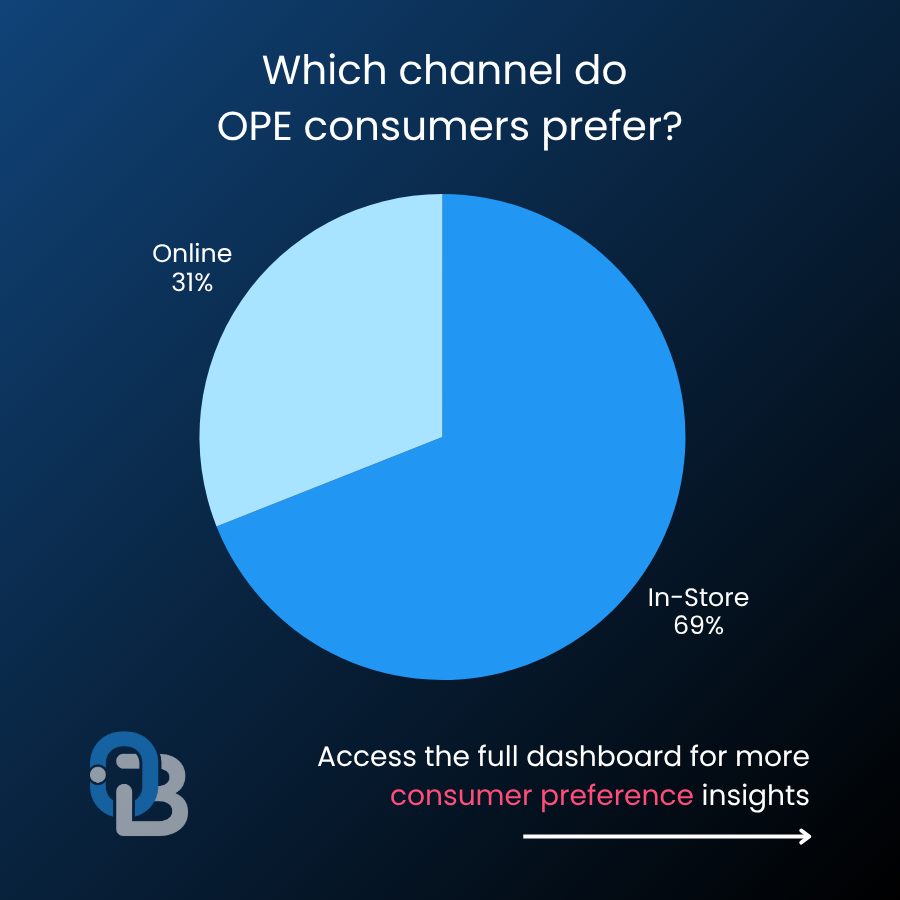
In Q2 2025, brick-and-mortar stores continued to dominate OPE sales, though online purchases have carved out nearly a third of the market:
- In-store: 69% of purchases
- Online: 31% of purchases
OpenBrand’s OPE Channel Trend Insights
Online Can’t Be Ignored: In-store remains the dominant channel for Outdoor Power Equipment sales, capturing 69% of purchases. However, the 31% of sales happening online signals a major behavioral shift. Amazon’s growing influence in this space is driving much of that movement, reshaping expectations for pricing visibility, delivery speed, and post-purchase support. Brands that align their omnichannel strategy — maintaining consistent pricing, strong digital merchandising, and seamless BOPIS integration — are best positioned to capture the next wave of online-driven growth.
Outdoor Power Equipment Consumer Demographics
OpenBrand’s long-standing consumer tracking survey delivers census-balanced market insights that highlight the typical Outdoor Power Equipment buyer.
As of Q2 2025, Outdoor Power Equipment consumers showed the following traits:
- 76% of purchasers are homeowners, 21% rent
- 56% of purchasers are married
- 69% of purchases were made with males only in the buying process; 31% were made with female only
- 30% of purchases were made by Millennials, coming in just above Gen X buyers (29%)
OpenBrand’s OPE Consumer Trend Insights
OPE buying remains male-dominated, but opportunity exists: Nearly seven in ten OPE purchases involve men as the sole decision-makers. However, a significant 31% are driven by women. As female homeownership and DIY participation grow, expanding product messaging and retail experiences to resonate beyond traditional male audiences could unlock incremental growth.
Homeowners remain the engine of OPE sales: With 76% of purchasers owning their homes, OPE demand continues to be rooted in property maintenance and improvement, signaling that replacement and seasonal upkeep remain key purchase triggers. As rental rates rise nationally, the category’s dependence on homeownership underscores the importance of targeting stable, higher-income households.
OPE Purchase Drivers
Why do consumers select a specific retailer for purchase? The most mentioned reasons for purchasing Outdoor Power Equipment at a specific retailer were:
Why consumers select a specific retailer
- Competitive price — 52%
- Good selection of products — 31%
- Convenient location — 25%
- Previous experience with store — 21%
OpenBrand’s Trend Insights
Value wins in Outdoor Power Equipment retail: More than half of OPE shoppers (52%) cite competitive pricing as their top reason for choosing a retailer, reinforcing the importance of affordability in this category. This price-first mindset aligns with Ryobi’s leadership at Home Depot, where the brand’s dominance in sub-$499 products fuels both shopper traffic and unit share. In a market where cost-conscious homeowners dominate, accessible pricing remains a decisive edge.
OPE Industry Outlook and Emerging Trends
What’s next for the US Outdoor Power Equipment market in 2025?
Looking beyond Q1 2025, several factors are shaping the Outdoor Power Equipment market:
- Sustainability and compliance reshape product strategy: The future means cleaner OPE. Battery-powered equipment continues to gain ground as states tighten emissions rules and phase out gas engines. Brands with mature battery ecosystems are best positioned to meet new standards and capture eco-conscious demand.
- Robotics and automation move from novelty to necessity: Advancements in robotic mowers and connected “smart” tools are redefining the category. As labor costs rise, both homeowners and pros are turning to automation for efficiency and convenience. We can expect to see more higher-capacity battery packs, faster charging, with an emphasis on durability and premium features like bluetooth and smart app compatibility.
- Omnichannel execution grows in importance: In-store still dominates, but online sales continue to climb, with Amazon’s equal close rate to Home Depot shows its potential to gain share. Consistent pricing, strong digital merchandising, and BOPIS integration will separate winners from followers.
- Margin pressure accelerates brand consolidation: Electrification, software integration, and compliance costs are raising barriers to entry. Expect more focus on platform ecosystems, fewer redundant SKUs, and tighter alignment between brands and retail partners to protect profitability.
Get more insight into Outdoor Power Equipment market trends
The market insights don’t stop here.
For more retail sales data, market share, and insights on the Outdoor Power Equipment industry, access the Outdoor Power Equipment MarketSignal dashboard now.

To see insights for other industries or find out how we can help power growth for your business, contact us today.


OpenBrand Expands MarketSignal to Outdoor Power Equipment: Free Quarterly OPE Data
OpenBrand is excited to share the expansion of MarketSignal into the Outdoor Power Equipment (OPE) industry, delivering quarterly data to the market at no-cost.
Building on the success of the Major Appliance launch earlier this year, MarketSignal is a public-facing dashboard designed to put critical market trends into every team’s hands. The dashboard is updated quarterly for ongoing visibility.

Bringing Clarity to the OPE Market
In 2025, the Outdoor Power Equipment market is defined by shifting demand, electrification trends, and increasingly competitive retail dynamics. To help stay ahead of these trends, benchmark KPIs, and back strategy, MarketSignal gives the OPE industry a single, no-cost view of share leaders, pricing and promotion patterns, and consumer behavior.
“After the strong response to OpenBrand’s MarketSignal debut in Major Appliances, expanding to OPE was a natural next step,” said Greg Munves, CEO at OpenBrand. “It’s another way we’re endeavoring to bring transparency to the market – extending availability of high-quality market intelligence to everyone, not just those with enterprise subscriptions.”
What You’ll Find Inside
The dashboard offers a category view of market share leaders, pricing and promotional dynamics, and consumer behavior, giving users a fast way to benchmark the market and a clear path to unlock deeper current time period insights in the full OpenBrand platform.
With any an email to unlock the dashboard, the market can explore:
- Market share leaders across brands and top retailers
- Pricing and promotions trends
- Consumer buying behavior drivers
- And more, updated quarterly
Q2 2025 Outdoor Power Insights from MarketSignal
- Retail leadership: Home Depot leads the Outdoor Power Equipment market with 42% of shoppers drawn to its stores and a 68% close rate, matching Amazon’s conversion efficiency. Lowe’s follows closely, drawing 36% of shoppers but closing at a lower 56%. Walmart ranks third in consideration (19%) but trails in overall share.
- Brand performance: Ryobi holds the clear lead with 22% unit share — double that of Craftsman (10%) and Ego (9%) — despite selling exclusively through Home Depot.
- Online vs. in-store: In-store remains dominant at 69% of purchases, but online sales now represent 31%, a fast-growing segment led by Amazon’s strong close rates.
Consumer demographics: Millennials (30%) and Gen X (29%) account for the majority of OPE buyers, with homeowners (76%) and married households (56%) driving the category. - Purchase drivers: Price remains the defining factor for retailer choice, cited by 52% of OPE shoppers, followed by product selection (31%) and location (25%).
Inside the dashboard, an “Unlock Full Access” call-to-action guides users to subscribe for current-quarter performance, greater granularity (brand/retailer/sub-category), item-level price & promo analytics, exports, and more.
With today’s launch, the MarketSignal dashboard is available for Major Appliances and Outdoor Power Equipment. Plans to increase coverage to more groups of categories over time are already underway, with Consumer Electronics up next.

Prime Big Deal Days Trends 2025: Durables Shopper Intent & Promotions
From Prime Day in July to Prime Big Deal Days in the Fall and Amazon’s sales during Black Friday and Cyber Week, each new Prime sales Event reshapes how consumers shop, how brands promote, and how the broader market responds.
With continuously record-breaking participation across Amazon and its major retailer competitors, this latest Prime Event revealed meaningful shifts in spend, shopper intent, and promotional behavior across the durables market.
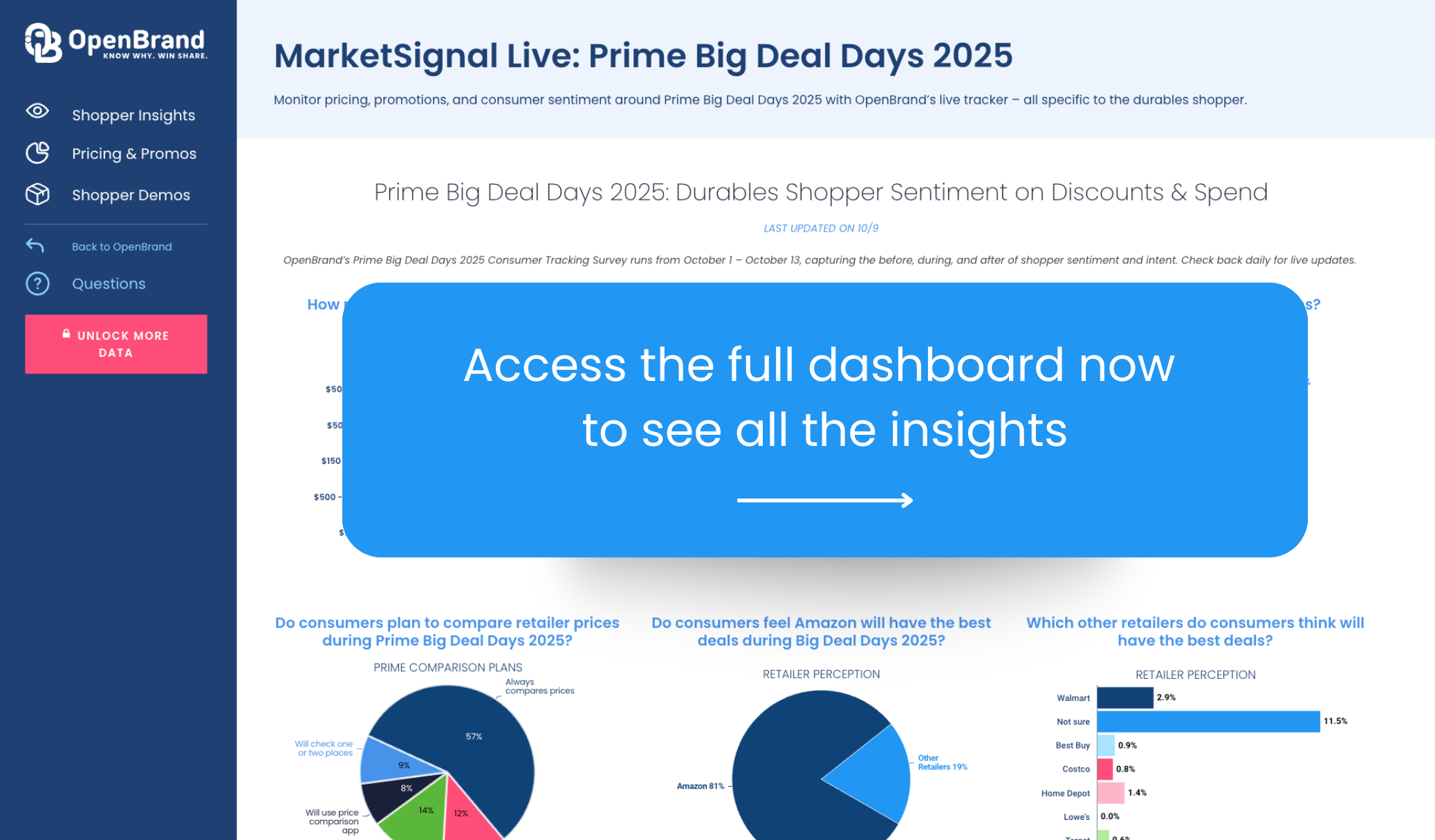
OpenBrand’s real-time Prime Day Sales Trends Trackers capture these movements as they happen, offering a category-level view into pricing, promotions, and shopper sentiment across the full event window.
SOURCE: All data insights in this article cover the rolling four quarter period ending Q1 2025 within the OpenBrand Market Measurement suite. This category covers an aggregate of several products including Refrigerator, Clothes Washer, Clothes Dryer, Dishwasher, Freezer, Free-Standing Range, Cooktop, Wall Oven, Compact Refrigerator, and Built-In Range.
Prime Big Deal Days 2025: Key Durables Market Insights
- Consumer intent vs. action diverged. Shoppers planned to buy Home Improvement (43%) and Small Appliances (35%), but actual purchases centered on Consumer Electronics (31%), Home Goods (30%), and Tools (12%)
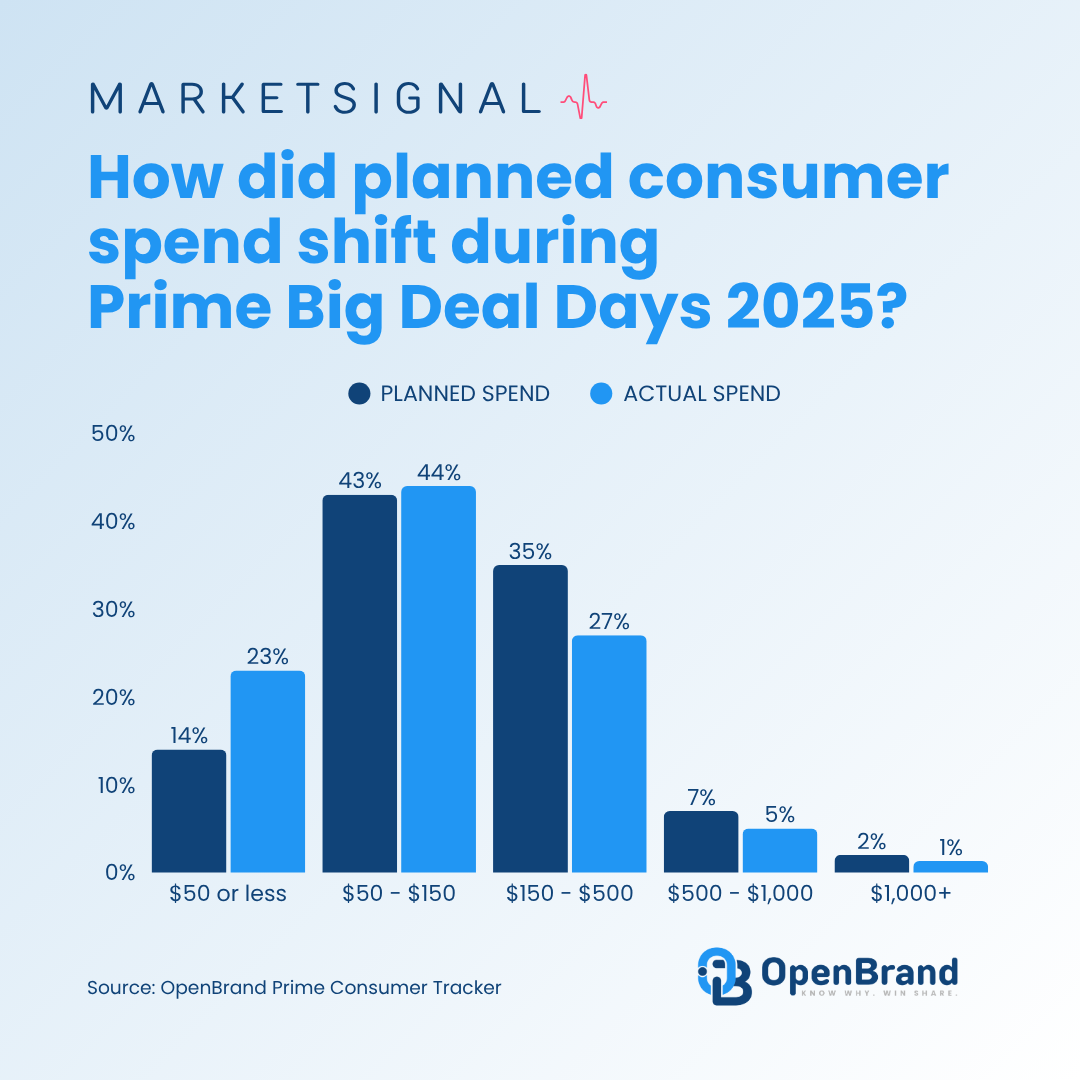
- Consumer budgets tightened. The share spending under $150 rose from 57% planned to 67% actual, signaling increased price sensitivity or low promotional appeal
- Discounts deepened. Average markdowns ranged 20–25%, led by Recreation (TVs, Headphones) and Communication (Smartphones, Monitors, Wearables)
- Amazon still led (81%), but nearly 1 in 5 shoppers credited other retailers, with Walmart strongest among competitors
- Comparison is routine. 57% of shoppers always compare prices; only 14% buy solely on Amazon
- 9,345 unique promotions were tracked across durables
Durables-First Prime Day Data & Insights
Not all insights are created equal. As Prime events continue to set new records, OpenBrand delivers what others cannot: a complete view of the consumer durables shopper journey.
Most Prime Event recaps blend together consumer-packaged goods (CPG), perishables, and general merchandise. OpenBrand’s analysis focuses only on durable goods—where the products, price movements, and promotional dynamics behave entirely differently. [See what makes durables shoppers unique compared to CPG.]
By concentrating on high-consideration categories, OpenBrand provides clarity where it matters most: understanding how shoppers make complex purchase decisions, how promotions influence conversion, and how price perception shapes outcomes across the durables market.
OpenBrand’s live Prime Event Trackers presents a view of shopper behavior, promotional trends, and pricing effectiveness across durables categories to highlight where durables brands and retailers should focus heading into the next wave of key promotional events.
Check out the tracker now or read on below for a peek into data highlights for Prime Big Deal Days 2025.
Durables Shopper Intent vs. Actual Behavior
OpenBrand’s targeted Prime Consumer Tracker Survey runs before, during, and after the event, capturing intent and sentiment of shoppers specific to the consumer durables market. Respondents are classified based on the types of products they reported shopping for or purchasing, and all data is weighted against the U.S. Census.
Here are a few callouts of the data from OpenBrand’s latest survey on Prime Big Deal Days 2025.
What categories did most consumers purchase on Prime Big Deal Days 2025?
While most consumers entered Prime Big Deal Days planning to buy consumer electronics and home goods, the data below reveals how plans shifted once deals went live.

While these were still the top categories purchases, each saw nearly a 15-point gap between what consumers expected to buy and what they actually purchased.
In fact, every major durables category underperformed against pre-event intent, signaling that shoppers were more cautious and selective once live pricing and promotions appeared.
| Category | Planned Purchases | Actual Purchases | Change |
| Consumer Electronics | 44.9% | 30.7% | -14.2 ppt |
| Home Goods | 44.2% | 30.3% | -13.9 ppt |
| Large Appliances | 12.1% | 9.4% | -2.7 ppt |
| Small Appliances | 35.1% | 19.6% | -15.5 ppt |
| Tools | 22.2% | 12.3% | -9.9 ppt |
Small Appliances saw the steepest drop — from 35% planned to under 20% purchased — suggesting limited perceived value or competing category appeal.
This pattern indicates intent compression, where consumers start the event with broad shopping interest but narrow their spending to the most compelling promotions and visible deals once the event begins.

How much did consumers spend during the Prime Big Deal Days Event?
Nearly 60% of shoppers spent less than $150, even though most planned to spend more.
| Price Band | Planned Spend | Actual Spend | Change |
| $50 or less | 14% | 23% | +9 ppt |
| $50 - $150 | 43% | 44% | +1 ppt |
| $150 - $500 | 35% | 27% | -12 ppt |
| $500 - $1,000 | 7% | 5% | -2 ppt |
| $1,000+ | 2% | 1.3% | -0.7 ppt |
OpenBrand’s Insights Repackaged:
- A Return to Cautious Spending? The data points to a return to disciplined spending, even within deal-heavy environments — a shift that could reflect broader inflation fatigue or promotional fatigue in late 2025.
- Spending consolidated in the lower tiers, with the share of shoppers spending under $150 rising from 57% planned to 67% actual.
- The mid-tier ($150–$500) bracket fell by more than 7 points, showing reduced elasticity for higher-ticket items compared to previous events.
- This suggests consumers were more selective and budget-conscious, prioritizing categories with visible value and tangible discounts rather than larger discretionary purchases.
- Compared to July’s Prime Day 2025, this is a shift. Consumers planned to spend less, but ultimately spent more.
Pricing & Promo Performance: Data-Backed Tactics
OpenBrand’s pricing and promotions data was collected in real time during the Prime Big Deal Days sales event. Our optical processing technology interprets unstructured data with human-like understanding, enabling exceptional accuracy and market-scale visibility.
Across the internet, Prime Big Deal Days saw:
- 9,345 unique promotions
- 23% average discount across durables
- Highest discount percent: Vacuums at an average of 27.6% and TVs at an average of 26.9%
- Highest average savings: TVs at $384
While average discounts ranged from ~20% to 25%, the real takeaway lies in how shoppers responded to price-to-value balance by category.
| Category | Average Net Price | Average Savings | Average Discount |
| Recreation (TVs, Headphones) | $457 | $146 | 24.7% |
| Communication (Printers, Monitors, Smartphones, Tablets, Wearables) | $431 | $103 | 24.4% |
| Home Improvement (OPE & Tools) | $250 | $77 | 23.6% |
| Appliances (Large & Small) | $206 | $63 | 20.6% |
OpenBrand’s Key Takeaways
- Recreation and Communication categories (including TVs, headphones, and mobile devices) led the pack with discounts around 25%, generating the highest dollar savings per purchase.
- Home Improvement followed closely, signaling strong value-driven engagement even in mid-tier price ranges.
- Appliances saw more modest discounts (around 20%), suggesting brands maintained tighter control on margin while still leveraging deal visibility.
- Despite similar percentage discounts, higher-ticket categories produced greater perceived value, reinforcing why consumers often shift their actual spending toward them once events begin.
To see the breakdown by product, check out the latest Prime tracker.
Retailer Behavior: How Shoppers Compared Deals and Where They Found the Best Value
What started as a single-platform sales event has evolved into a retail ecosystem moment. Each new Prime Event now sparks participation across the entire marketplace, with major retailers launching competing promotions and consumers using every tool available to compare prices in real time.
For durables shoppers, that means “Prime” no longer begins and ends with Amazon. Now, it defines a multi-retailer, multi-channel buying window where value perception, pricing transparency, and promotional timing determine who wins the sale.
Price Comparison Is Now a Standard Behavior
Durables shoppers are entering each event more analytical than ever. According to OpenBrand’s tracker, 57% of consumers say they always compare prices, while another 9% check one or two other sources before purchasing.
Even in a Prime-branded event, only 14% of shoppers say they buy exclusively on Amazon. Nearly one in five now use dedicated price comparison apps, confirming that deal validation is part of the modern shopping routine.
| Price Comparison Behavior | Share of Shoppers |
| Always compares prices | 57.2% |
| Will check one or two places | 8.9% |
| Will use a price comparison app | 7.7% |
| Only shops Amazon | 14.2% |
| Might compare but no plans | 12.1% |
OpenBrand’s Insights Repackaged: Shoppers are consciously verifying value across platforms before committing to a purchase, even during sales event like Prime Days.
Amazon Still Leads, but Competitors Earn Credibility
Amazon continues to set the benchmark for deal quality, with 81% of shoppers naming it as offering the best discounts. Still, nearly 19% credited other retailers, proving that the competitive halo around Prime Events is real and growing.
| Retailer | Share of Shoppers Naming “Best Deals” |
| Amazon | 81.2% |
| Other Retailers (combined) | 18.8% |
| – Walmart | 2.9% |
| – Best Buy | 0.9% |
| – Costco | 0.8% |
| – Home Depot | 1.4% |
| – Not Sure | 11.5% |
Walmart continues to hold the strongest non-Amazon position, followed by Best Buy, Costco, and Home Depot—all of which benefit from spillover traffic as shoppers cross-check pricing and promotions during the Prime window.
Get all the Prime Big Deal Days insights and prepare for the next big event
If you’re planning for other promotional events, now is the time to rebuild your promotional playbook with data that cuts out the manual work so you can spend more time acting on what’s happening in the market.
Are you tracking the market in real-time? Let’s get you the insights you need — before the next big event hits. Book a 15-minute conversation now to get started.
OpenBrand Brings Modeled Market Share Data to Consumer Electronics
We are excited to announce the expansion of OpenBrand’s unparalleled modeled market share data into the Consumer Electronics category group.
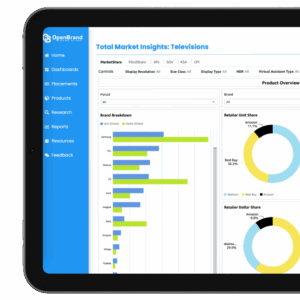 With this update, our full total market insights suite is now available for Consumer Electronics, delivering the critical combination of market share, consumer insights, and pricing and promotions data all in one place for more in-depth and actionable market understanding.
This update brings market share visibility to some of the most competitive and fast-moving Consumer Electronics categories:
- Desktops
- Monitors
- Notebooks
- Smart Thermostats
- TVs
- Wearables
- Tablets & Detachables
- Wireless Routers

This expanded coverage provides the clarity Consumer Electronics brands and retailers need to track performance, anticipate shifts, and make smarter decisions in this dynamic market.
Additionally, with this launch we also bring market share data to the Door Locks and Lawn & Garden categories. These categories join our existing suite, which already includes Major Appliances, Hand Tools, Outdoor Grilling, Outdoor Power Equipment, Power Tools, and Small Appliances. A full list of available categories can be found below.
What This Expansion Delivers
With this release, Consumer Electronics brands and retailers gain access to the only solution that pairs modeled market share with consumer insights and competitive pricing and promotions data to deliver a complete picture of what is happening in the market – and why.
Why our market share is a game changer for Consumer Electronics
Where traditional market share data falls short due to reliance on fragmented inputs and/or narrow samples, OpenBrand overcomes this with a proprietary dynamic data model that integrates multiple sources and delivers unmasked share data. Through our proprietary model, we now deliver the most reliable and holistic view of the Consumer Electronics market, and clarity that empowers stronger, strategic decision-making.
We go deeper than any other provider, with visibility down to the brand, retailer, and SKU level.
| What Other POS Providers Deliver | What OpenBrand Delivers |
| Masked Share Data | Unmasked Share Data |
| Single Source (POS) | Multi-Sourced |
| Retailer-reliant | Retailer-agnostic |
| Category level with uneven SKU depth | Consistent SKU coverage with variant mapping |
| Share without clear drivers | Share with drivers linked to price, promo, and consumer insights |
When paired with consumer insights and pricing and promotions data, this depth unlocks true total market understanding. Know not just who is winning but why – and what to do next.
With OpenBrand total market insight, brands and retailers can:
- Know who’s winning with unit and dollar share leaderboards backed by consumer sentiment.
- Act on gains and losses fast by drilling into brand, retailer, and SKU performance with pricing and promotion context.
- Uncover true growth drivers by seeing which models, features, and configurations are fueling demand.
- Decode competitor moves with visibility into assortment, pricing, and promotional strategies and how shoppers respond.
- Stay ahead of shifts by tracking trends across categories and periods, paired with consumer insight into what’s coming next.
OpenBrand continues to expand our data into new categories, striving to further empower clients through data. Subscribe to our product updates for email notifications when new data is available.
See Total Market Insight for Consumer Electronics
In a category as dynamic and competitive as Consumer Electronics, having this clarity is no longer optional — it’s essential. OpenBrand empowers leaders to not just understand the market, but to stay ahead of it.
Request a demo today to see how OpenBrand’s combined market share and consumer insights reveal the full picture of Consumer Electronics performance — helping your business track shifts, uncover opportunities, and stay ahead of the competition.
Available MarketShare Categories
UPDATED MARCH 2026
CONSUMER ELECTRONICS
Desktops
Notebooks
Monitors
Smart Thermostats
Tablets & Detachables
TVs
Wearables
Wireless Routers
HARDWARE
Door Locks
KITCHEN & BATH
Bathroom Faucet
Bathroom Sink
Bathroom Vanities
Bathtubs
Kitchen Faucets
Kitchen Sink
Shower Doors
Shower Head
Stall & Enclosures
Toilets
LAWN & GARDEN
Garden Hose
Grass Seed
Lawn Fertilizer
Pesticides
Weed Killer
MAJOR APPLIANCES
Air Conditioner
Compact Refrigerator
Cooktops & Wall Ovens
Dishwashers
Freezers
Laundry
OTR Microwaves
Ranges
Range Hood
Refrigerators
OUTDOOR COOKING
BBQ Grills
Griddles
Kamado Grills
Pellet Grills
Pizza Oven
Smokers
OUTDOOR POWER
Chainsaws
Edgers
Generators
Hedge Trimmers
Leaf Blowers
Line Trimmers
Pressure Washers
Riding Mowers
Snow Removal
Walk-Behind Mowers
ZTR Mowers
POWER TOOLS
Air Compressors
Angle Grinders
Belt Sanders
Circular Saw Blades
Impact Drivers
Jig/Sabre Saws
Power Drills
Power Multi-Tools
Nail Guns
Orbital Sanders
Reciprocating Saws
Rotary Tools
Routers
Table Saws
Wet-Dry Vacs
PAINT & STAIN
Paint, Exterior
Paint, Interior
Primers
Spray Paint
Stains, Exterior
Stains, Interior
SMALL APPLIANCES
Blenders
Coffee Makers
Countertop Microwaves
Electric Grills
Mixers
Toaster Ovens
Vacuums
OpenBrand Introduces MarketSignal: Free Dashboard Delivering Quarterly Market Data for Brands & Retailers
Today OpenBrand announced the launch of MarketSignal, a no-cost dashboard, providing a quarterly data snapshot designed to put critical market trends into every team’s hands.
MarketSignal offers a category view of market share leaders, pricing and promotional dynamics, and consumer behavior, giving users a fast way to benchmark the market and a clear path to unlock deeper, current-quarter insights in the full OpenBrand platform.
MarketSignal reflects OpenBrand’s commitment to bring clarity to the market and to empower better decision-making across the industry. For the first time, anyone in the industry can access a client-level view of the market, including retailer rankings, brand share, pricing trends, and consumer behavior — without a subscription.
By opening a streamlined view at the industry level, MarketSignal provides manufacturers, retailers, and analysts with a transparent look at the forces shaping consumer demand.
“MarketSignal democratizes high-quality market intelligence,” said Greg Munves, CEO at OpenBrand. “In minutes, leaders can benchmark where the market is and see exactly how much more is possible with our full platform — real-time visibility, advanced filtering, and the exportable data they need to act.”
With today’s launch, the MarketSignal dashboard is available for Major Appliances. Plans to increase coverage to more groups of categories over time are already underway, with Outdoor Power Equipment up next.
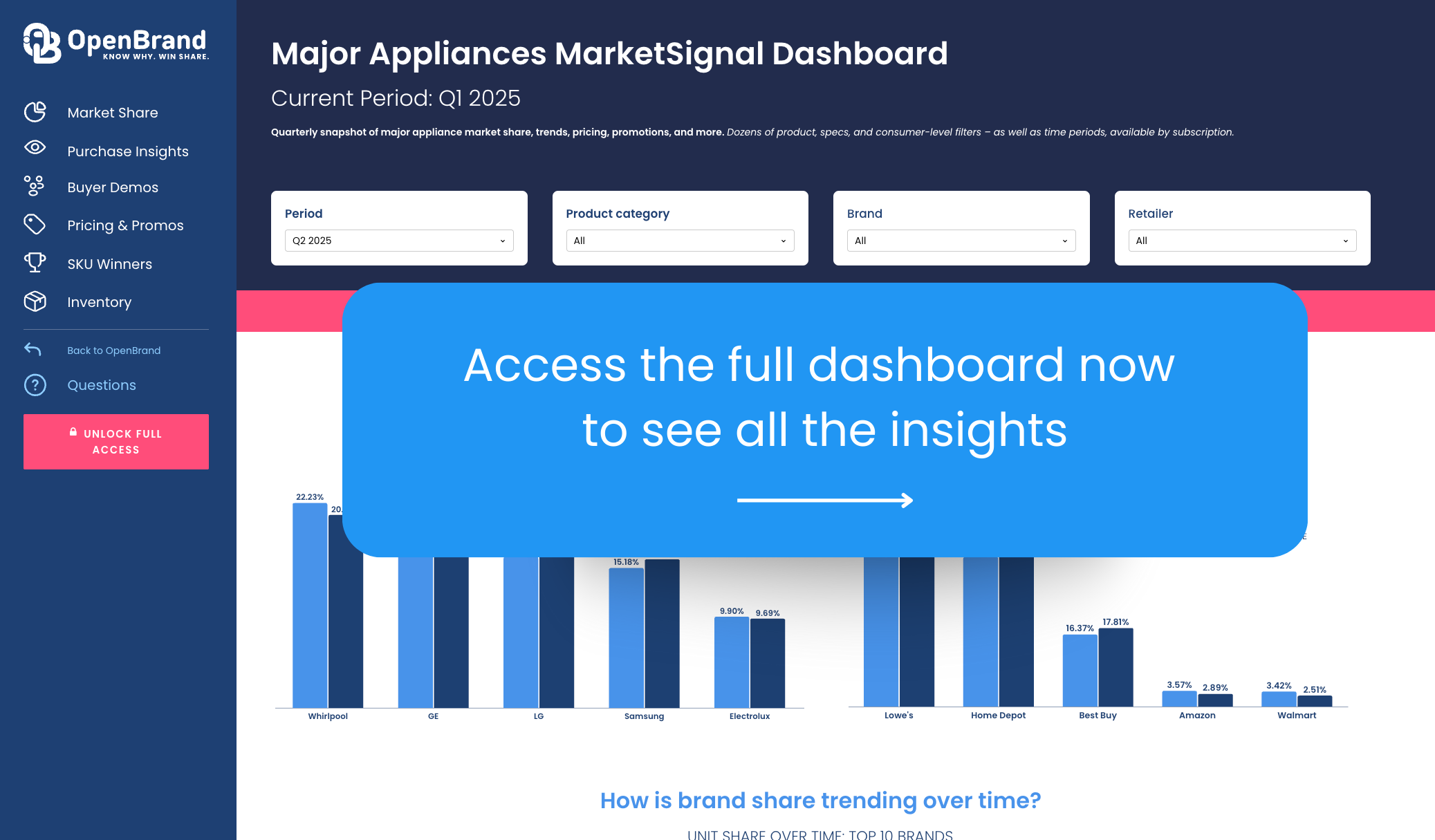
Q1 2025 Major Appliance Insights from MarketSignal
- Retail leadership: Lowe’s leads with 42.7% of unit share and 41.0% of dollar share, outpacing Home Depot and Best Buy. Home Depot, however, is gaining ground in shopper draw rates.
- Brand performance: Whirlpool (22.2% unit share) and GE (21.4%) hold the top spots, while LG and Samsung remain highly considered by nearly one-third of consumers.
- Online vs. in-store: Brick-and-mortar remains dominant, but online now represents 26.1% of purchases — underscoring the importance of omnichannel pricing and digital merchandising.
Consumer demographics: Millennials (31%) and Gen X (29%) now make up the majority of appliance buyers, signaling a shift toward more digitally influenced shopping journeys. - Purchase drivers: Competitive pricing remains the top factor (58%), followed by product selection (32%) and convenient location (29%).
Inside the dashboard, an “Unlock Full Access” call-to-action guides users to subscribe for current-quarter performance, greater granularity (brand/retailer/sub-category), item-level price & promo analytics, exports, and more.
US Major Appliance Market Share: Q1 2025 Trends & Rankings
The first quarter of 2025 confirmed what many in the industry suspected — the major appliance market is evolving faster than ever, with shifts in where consumers buy, which brands they trust, and what drives them to purchase.
From the dominance of big-box retailers to the growing share of online sales, the latest data shows a highly competitive environment where leaders are widening their gap and challengers are working to gain ground.
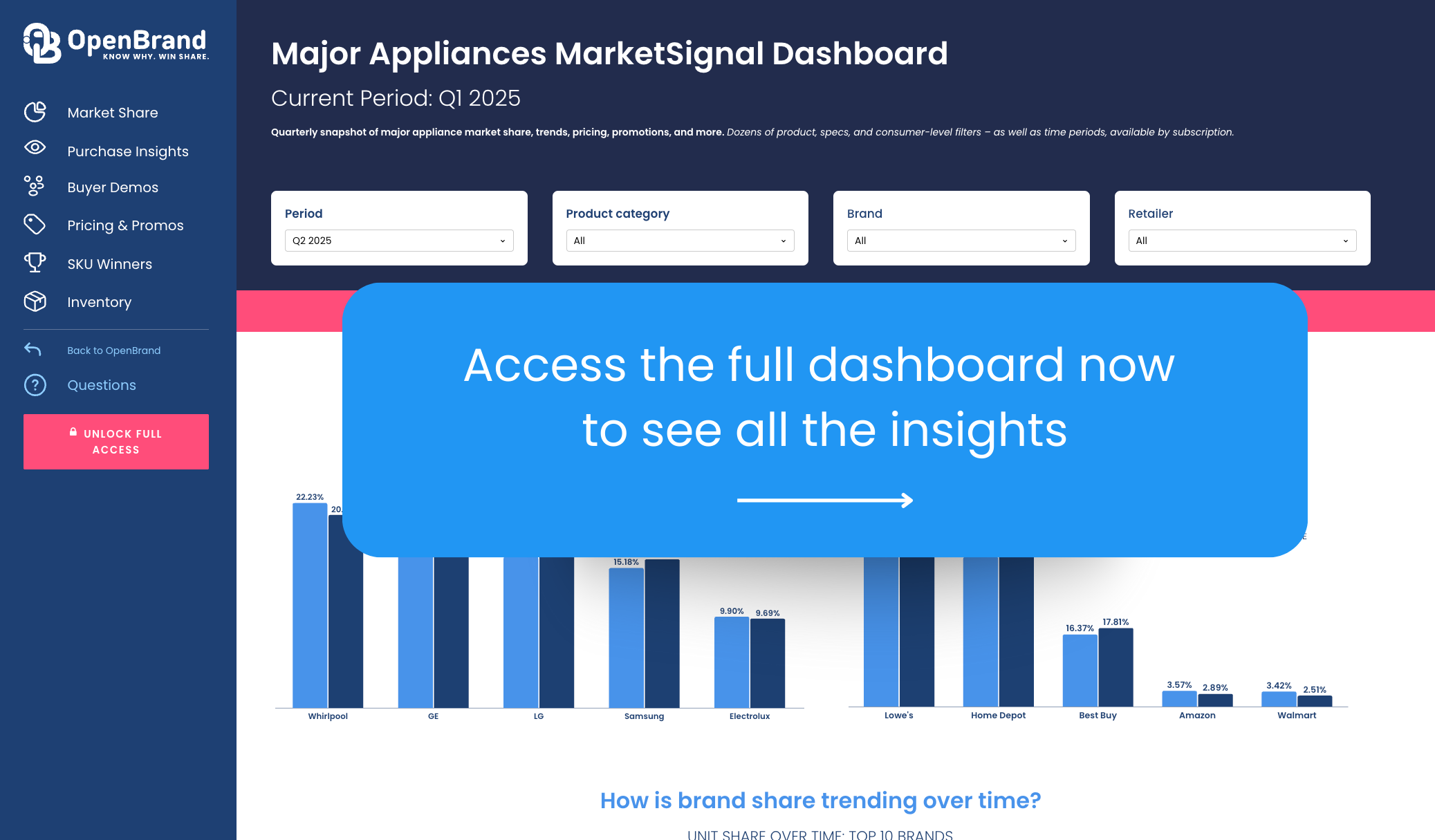
Our public MarketSignal dashboard brings this story to life, offering a deeper, interactive look at retailer rankings, brand share, pricing trends, and consumer behavior.
Read on for key takeaways from Q1 2025 or access the dashboard to explore the data for yourself.
SOURCE: All data insights in this article cover the rolling four quarter period ending Q1 2025 within the OpenBrand Market Measurement suite. This category covers an aggregate of several products including Refrigerator, Clothes Washer, Clothes Dryer, Dishwasher, Freezer, Free-Standing Range, Cooktop, Wall Oven, Compact Refrigerator, and Built-In Range.
Who are the top major appliances retailers by market share?
The top major appliance retailers in 2025 are Lowe’s and Home Depot, leading in both unit and dollar share.
Major Appliances Retailer Unit Share Winners
| Major Appliance Retailer | Q1 2025 Unit Share |
| Lowe's | 43% |
| Home Depot | 34% |
| Best Buy | 16% |
Major Appliances Retailer Dollar Share Winners
| Major Appliance Retailer | Q1 2025 Dollar Share |
| Lowe's | 41% |
| Home Depot | 37% |
| Best Buy | 18% |
OpenBrand’s Q1 Major Appliance Trend Insights
- Lowe’s leads the pack – by far: Lowe’s outpaces Home Depot by nearly 9 percentage points in unit share and more than 5 points in dollar share, underscoring its continued strength with appliance shoppers. Additionally, when we examine the performance/share by store count, Lowe’s overindexes relative to Home Depot and Best Buy. Simply put: Lowe’s accounts for ~23% more appliance units per location than expected (41% units on 33% of locations), while HD and Best Buy under-index by ~22% and ~21%, respectively.
- Best Buy fills a niche for tech-inclined shoppers: While Best Buy falls in third place for share overall, they keep in line with Home Depot regarding performance per store – suggesting its targeted appliance strategy resonates with tech-oriented buyers.
Major Appliance Retailer Draw Rates
Our top market leaders also continue to lead in outlet draw rate, with:
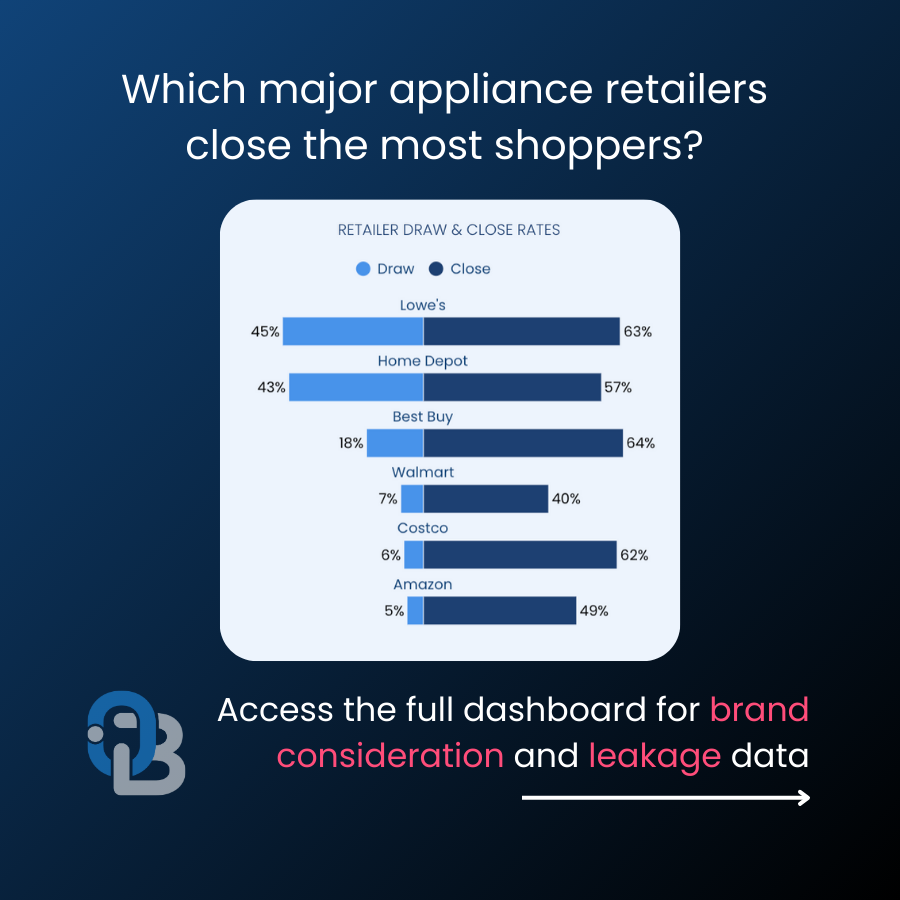
- Lowe’s drawing in 45.20% of all consumers who bought Major Appliances
- Home Depot drawing in 43.11%
- Best Buy follows as the third most-visited outlet, drawing 17.57% of consumers
OpenBrand’s Q1 Major Appliance Trend Insights
- Home Depot is closing the gap in draw rate: Compared to prior years, Home Depot is seeing a significant increase in shoppers over the last several quarters compared to Lowe’s. Additionally, Home Depot also saw gains from a significant YOY draw rate decline at Best Buy.
- Lowe’s remains best on the sales floor: Lowe’s still holds a slight advantage in converting browsing customers into buyers.
For more insights on draw rates — and to see how these retailers compare in closing the consumers they brought in — quarterly major appliances MarketSignal dashboard.
Who leads the major home appliances market share by brand?
The top major appliance brands are Whirlpool, GE, LG, and Samsung, all holding double-digit share in both units and dollars.
Major Appliances Brand Unit Share Winners
| Major Appliance Brand | Q1 2025 Unit Share |
| GE | 19% |
| LG | 17% |
| Samsung | 16% |
| Whirlpool | 15% |
Major Appliances Brand Dollar Share Winners
| Major Appliance Brand | Q1 2025 Dollar Share |
| GE | 20% |
| LG | 19% |
| Samsung | 17% |
| Whirlpool | 12% |
OpenBrand’s Q1 Major Appliance Trend Insights
Trust & reliability outweigh innovation: Whirlpool and GE’s continued strength is notable in a market where Korean brands LG and Samsung have aggressively pursued innovation-led growth. This suggests while drivers like price and variety of product offerings influence purchase decisions most, reliability and consumer trust are still powerful brand assets in the appliance category.
Brand Consideration Rates
When purchasing major appliances, almost a third of all consumers consider these top four brands in their purchase.
| Major Appliance Brand | Brand Consideration Rate |
| LG | 31.8% |
| Samsung | 31.79% |
| GE | 27.69% |
| Whirlpool | 27.05% |
Interestingly, while Whirlpool holds 15.76% of the market in unit share, they have a consideration rate that nearly matches LG and GE.
OpenBrand’s Q1 Major Appliance Trend Insights
- LG and Samsung lead all brands in consideration: Each approaches one-third of consumers, while GE and Whirlpool follow close behind at just over a quarter.
- Whirlpool has an opportunity to improve: High consideration rates don’t always translate to market share — Whirlpool in particular over-indexes on consideration relative to sales, signaling potential opportunity if conversion strategies are improved.
Explore the drivers and promotions data that may impact low conversion rates in our quarterly major appliances MarketSignal dashboard.
How are online and in-store sales trending for the Major Appliance market?
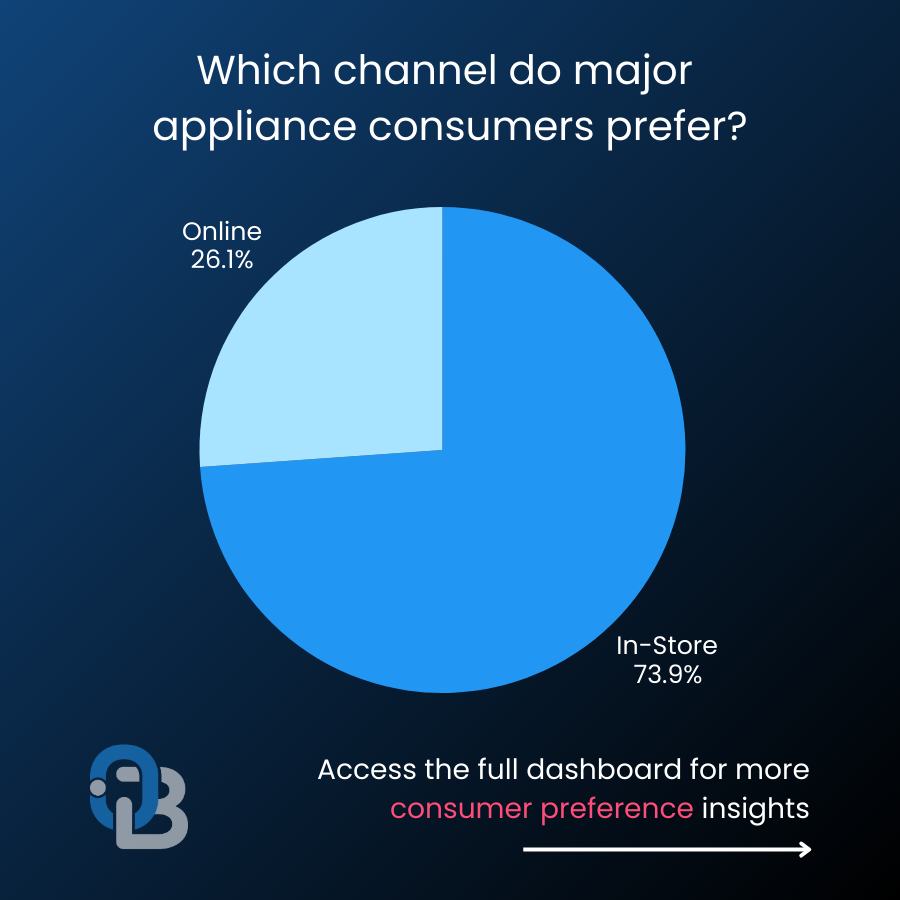
In Q1 2025, brick-and-mortar stores continued to dominate, though online purchases have carved out over a quarter of the market:
- In-store: 73.89% of purchases
- Online: 26.11% of purchases
OpenBrand’s Q1 Major Appliance Trend Insights
Online Can’t Be Ignored: While in-store remains the dominant channel, the online segment’s 26% share underscores the need for brands to maintain omnichannel pricing consistency and invest in digital merchandising. Retailers that have streamlined buy-online-pickup-in-store (BOPIS) processes are capturing a disproportionate share of online sales growth.
Major Appliance Consumer Demographics
OpenBrand delivers census-balanced market insights that highlight the typical Major Appliance customer.
As of Q1 2025, Major Appliance consumers showed the following traits:
- 75.14% of purchasers are homeowners, 21.94% are renters
- 56.27% of purchasers are married
- 60.21% of purchases were made with males only in the buying process; 39.79% were made with female only
- 60.37% of purchases were made by Millennials or Gen Xers
- 31.03% were Millennials
- 29.34% were Gen X
OpenBrand’s Q1 Major Appliance Trend Insights
Major appliance consumers skew younger: Millennials lead as the largest buying segment for the category with Gen X right behind. Millennials and Gen Z have grown significantly as key purchasers while Boomers and Matures saw significant decline overall.
Millennial preferences drive today’s market: Additionally, the uptick in Millennial purchasers signals a shift toward more digitally influenced buying journeys as well as an increasing interest in smart or energy-efficient features.
Major Appliance Purchase Drivers
Why do consumers select a specific retailer for purchase? The most mentioned reasons for purchasing major appliances at a specific retailer were:
Why consumers select a specific retailer
- Competitive price — 57.85%
- Good selection of products — 31.69%
- Convenient location — 29.33%
- Previous experience with store — 26.57%
OpenBrand’s Q1 Major Appliance Trend Insights
The importance of sales floor variety: Price remains the top driver, but “good selection” is gaining as an important differentiator. This suggests assortment planning and inventory visibility are becoming competitive levers, especially as consumers increasingly compare options online before visiting a store. With millennials making up the largest demographic buyer segment, the endless aisle is more important than ever, providing increased options.
Appliance Industry Outlook and Emerging Trends
What’s next for the US Major Appliance market in 2025?
Looking beyond Q1 2025, several factors are shaping the major appliance market:
Tariff impacts add risk: Potential changes to trade policy and tariffs on imported appliances add risk to pricing strategies, supply chains, and promotional planning. Review our breakdown of the latest tariff impacts on Consumer Durables.
Seasonal discounting holds steady: Black Friday and holiday promotions are expected to remain stable in 2025, reinforcing the importance of discount-driven buying events as volume drivers.
Economic sensitivity impacts customer demand: With inflationary pressures moderating but still present, consumers remain price-conscious. Expect promotional activity to stay elevated through 2025.
Housing market connection: Appliance demand continues to track closely with housing activity — a rebound in new home starts or existing home sales could quickly lift volumes.
Energy efficiency demand increases: Regulatory changes and rising energy costs are pushing more brands to highlight efficiency features, which could sway both consideration and purchase decisions.
Digital disruption favors online sales: The steady growth of online sales and BOPIS means retailers with superior digital experiences will likely gain share in the next 12 months.
Get more insight into Major Appliance market trends
The market insights don’t stop here.
For more retail sales data, market share, and insights on the major appliance industry, access our public major appliances MarketSignal quarterly dashboard now – no paid subscription required.

To see insights for other industries or find out how we can help power growth for your business, contact us today.
2025 U.S. Tire Market Share & Retail Sales Trends | Top Brands & Retailers
The tire market is shifting. Between record-high U.S. tire shipments projected for 2025 and the return of steep tariffs on Chinese-made tires, supply chains are being tested and pricing pressures are mounting. Total U.S. shipments expected to top 340 million units this year and new import tariffs are already driving up prices for many consumer-favorite models.
Both brands and retailers are feeling the impact. In this post, we analyzed the latest U.S. tire market data to uncover who is winning, the factors driving change, the consumers behind the dollars spent, and how the market is evolving across channels.
For a complete breakdown be sure to download our complimentary 2025 Tire Market Infographic.
Source: OpenBrand MindShare, Tires: Total Auto/Truck per Ticket, 4Q ending Q1 2025 | OpenBrand Pricing & Promotions, Total Market Overview – Tires (US), Q2 2025. For the most recent insights or further dives into the data, please contact us.
Tire Market Snapshot & Summary
Before diving into the full results, here’s an overview of what the data reveals. These top-line stats and trends capture where the market stands and where it’s shifting as of early 2025.
| Metric | 2025 Insight | YoY Change |
| Top Brand by Dollar Share | Goodyear | –1.4 ppt ↓ |
| Biggest Brand Gainer (Units) | Continental | +0.3 ppt ↑ |
| Top Retailer by Unit Share | Walmart | +0.8 ppt ↑ |
| Retailer with Highest Close Rate | Discount Tire | 83% (flat) |
| % of Shoppers Who Start Online | 31% | +1 ppt ↑ |
| % Who Actually Buy Online | 13% | +1 ppt ↑ |
| Share of Buyers Who Forget Brand (Units) | 20.5% | – |
| Avg Tire Discount (Q2 2025) | 14% | – |
| Avg Net Price Paid (Q2 2025) | $192 | – |
Tire Brand Performance
Which brands lead in tire market share?
Goodyear remains the leading tire brand in early 2025, holding the top spot by both unit and dollar share. While its unit share declined slightly to 14.6%, it still edges out all competitors for total volume sold. Goodyear also maintains the #1 rank in dollar share at 13.9%, though that figure is down 1.4 percentage points year over year, indicating some erosion in pricing strength or product mix.
Tire Market Share by Brand
| Rank | Brand | Dollar Share (%) |
| 1️⃣ | Goodyear | 13.9% |
| 2️⃣ | Michelin | 11.7% |
| 3️⃣ | Bridgestone | 9.2% |
| 4️⃣ | Firestone | 6.5% |
| 5️⃣ | BF Goodrich | 6.3% |
Other key insights from the top-performing brands:
- Michelin follows in second place by dollar share (11.7%) but lost unit share year over year.
- Bridgestone is climbing, gaining the most dollar share among top brands (+1.3 ppt).
- Firestone has warning signs. While the company holds the third-highest unit share (7.6%), it has dropped notably in dollar share (–1.5 ppt).
- BF Goodrich remains consistent and rounds out the top five, holding steady across both unit and dollar metrics.
While Goodyear retains category leadership they did see significant loss. Meanwhile, Bridgestone saw significant gain, emerging as a key challenger and showing momentum in both shelf presence and promotional volume.
Download the full tires playbook to see the unit share percentage breakdown by tire brand.

Tire Retailer Share: Largest Retailers, Dollar Share, & Other Trends
What are the largest tire retailers in the US?
As of Q1 2025, Walmart is the top tire retailer by unit share, accounting for 15% of units sold, while Discount Tire leads in dollar share at 16%. These two retailers continue to dominate the U.S. tire market — each holding the #1 spot in one of the two most critical performance metrics.
| Rank | Tire Retailer | Unit Share (%) | Dollar Share (%) |
| 1️⃣ | Walmart | 15% | 12% |
| 2️⃣ | Discount Tire | 14% | 16% |
| 3️⃣ | Tire Store | 12% | 10% |
Other notable retailer insights include:
- Walmart saw the largest YoY gain in unit share (+0.8 ppt), while Discount Tire held steady in units but added +0.2 ppt in dollars.
- Walmart also ranks second in dollar share at 11.8%, up significantly from last year (+0.7 ppt).
- Other top players: Costco, Firestone, and Goodyear round out the top five retailers by both unit and dollar share.
- Firestone is declining: The company is the only major retailer to lose dollar share year over year (–0.4 ppt) and also declined in online market share
While Discount Tire retains its title as the highest-dollar tire outlet, Walmart’s unit growth and digital expansion position it as a volume leader in 2025.
Shopper Demographics & Channel Preference
Online vs. in-store sales trends for the U.S. tire market?
Despite the rise of e-commerce across many consumer categories, the tire market remains firmly grounded in brick-and-mortar retail. According to OpenBrand’s 2025 data, in-store remains the dominant channel, though the digital path to purchase continues to expand.
Channel Breakdown: Where Tire Sales Happen
- 77% of tire purchases are made in-store, confirming the category’s offline strength
- 13% of purchases happen online, up 1 percentage point year over year
- The remaining 10% come from other channels, such as catalogs or third-party fulfillment

Pricing Trends & Promotional Activity
What is the average price paid in the U.S. tire market?
In 2025, the industry average price paid (APP) for tires was $192.
In a category as price-sensitive as tires, understanding the relationship between shelf presence, discount depth, and net pricing is critical for both brands and retailers. As of Q2 2025, here’s how the landscape looks:
Average price paid by retailer – tire market insights
- Average net price (APP): $192
- Average discount across the category: 14%
This reflects a market still heavily reliant on promotions to move volume, especially in light of inflation concerns and tariff-induced cost pressures.
Shelf Share and Promo Strategy: Who’s Most Visible?
Michelin was the brand with the highest share of shelf at 16%, signaling broad retailer support and availability. However, shelf space alone doesn’t guarantee growth:
- Michelin and Bridgestone are tied as the top promoted brands, each responsible for 10% of total promotional activity.
Despite heavy promotion and shelf presence, Michelin lost both unit and dollar share, while Bridgestone gained dollar share (+1.3 ppt)
Tire Market: Outlet Draw-Close Rates
Walmart drew in 20.1% of tire shoppers, while Discount Tire drew 17% — the highest draw rates among all major retailers.
But when it comes to closing the deal:
- Discount Tire leads with an 83% close rate, converting nearly all of its in-store traffic.
- Walmart’s close rate trails slightly at 76%, but its high volume still drives massive total sales.
- Fewer, but loyal shoppers: Costco sees fewer shoppers overall (8% draw rate) but retains 65% of them.
- Firestone and Goodyear trail behind in traffic, but drive similar conversion rates.
High draw + high close = high sales volume. That’s why Discount Tire and Walmart continue to outpace competitors, despite their differing pricing and service strategies
Other key US tire market insights
Tire Shopper Demographics
OpenBrand’s census-balanced data paints a clear picture of the average U.S. tire buyer:
- 71% are homeowners
- 59% are married
- 63% of buyers are male, while women represent a meaningful 37% share of tire purchasers
- 66% of shoppers are over age 45, with Baby Boomers and Gen X dominating the market
- 24% of buyers are retired, a key insight for marketing targeting based on life stage
OpenBrand’s Tire Takeaway
Don’t overlook female buyers: more than 1 in 3 tire purchases involve women, yet many retail environments still default to male-oriented messaging.
Top Selling Tire Sizes
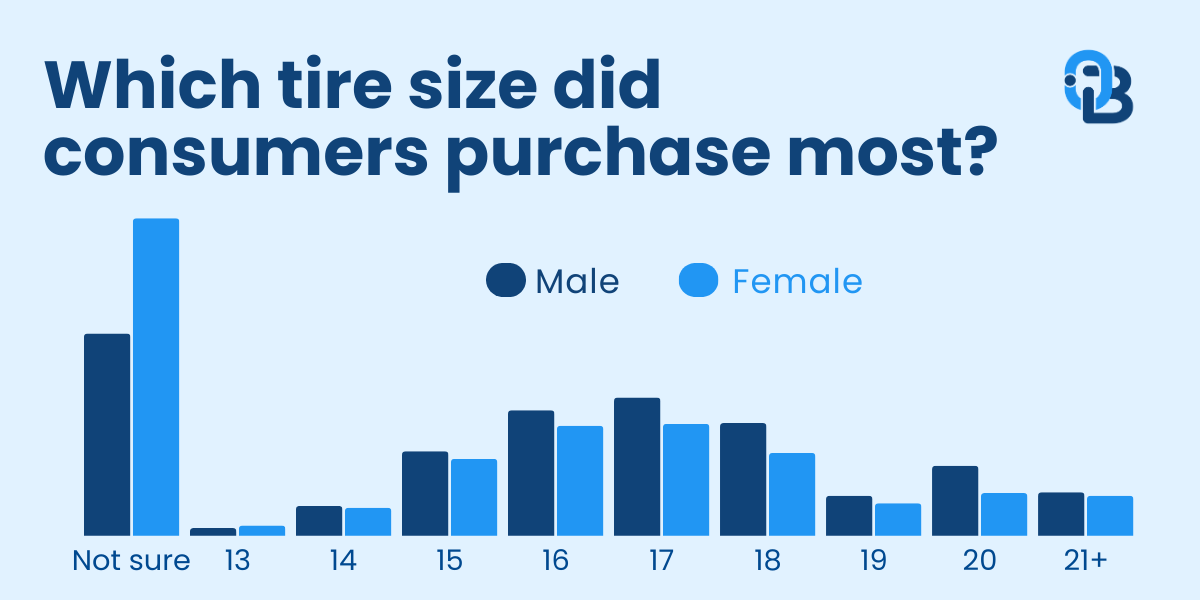
OpenBrand’s data shows that tire size—not type—is a key factor in buyer behavior. The Playbook identifies the most commonly purchased rim diameters in the U.S. market:
- 17-inch tires are the most purchased size, followed by 16″, 18″, and 15″
- 18”+ tire sizes are gaining share, driven in part by the rise of larger vehicles like SUVs and EVs
- Buyers of 19” and 20”+ tires are more likely to skew younger, with a higher incidence of Gen Z and Millennial buyers selecting larger rims
- Conversely, older consumers over-index in 15” and 16” tire purchases, indicating more traditional vehicle preferences
OpenBrand’s Tire Takeaway
Retailers and brands can use rim diameter data to align inventory with local buyer profiles — especially in regions with age – skewed populations or heavy SUV/EV adoption.
Tire Purchase Drivers
The “why” behind the buy remains consistent year over year, withprice and quality leading the decision.
- 52% of consumers say “competitive price” is the top reason for choosing a brand
- 53% say it’s the top reason for selecting a retailer
- Product quality ranks second among brand drivers (29%)
- Previous ownership and size availability round out the top purchase influences
Pricing may dominate the purchase decision, but tire size availability is a subtle yet powerful lever for conversion—especially in-store where immediacy matters.
Download the Tires Market Playbook
This is just the start. The full 2025 Tire Market Playbook delivers an even richer view into how brands, retailers, and buyers are shaping the road ahead—from market share shifts to shopper behavior, pricing patterns, and promotional strategy.
Download the exclusive playbook below to access the complete dataset and uncover opportunities to grow your share in a competitive, price-sensitive market.

Looking for insights in another category—or ready to explore how OpenBrand can help your business win at retail? Let’s talk. We’ll show you what’s happening in your space, and what to do next.
Home Depot vs. Lowe’s Earnings Call Reviews: Q4 2024 Market Intelligence
Earnings reports provide a valuable snapshot of a retailer’s financial performance, offering insight into revenue, sales trends, and overall business health.
However, they often don’t drill down into specific category drivers that contribute to that performance. That’s where OpenBrand comes in. Our market intelligence data plays a part in understanding how key consumer durables categories help drive financial results, enabling the analysis of share shifts by category, product-level contributing factors, pricing strategies, and more.
To that end, as a follow-up to Home Depot and Lowe’s Q4 2024 earnings calls, we took a look at market share shifts, competitive trends, and consumer behavior insights across three categories — major appliances, outdoor power equipment, and power tools — providing a deeper look at how the durables industry is driving results for these retailers.
JUMP TO: Home Depot Q4 Market Report
JUMP TO: Lowe’s Q4 Market Report
Key Takeaways: Home Depot vs. Lowe’s Q4 Earnings
- Home Depot reported: $39.7 billion in revenue and a 14.1% sales increase
- Lowe’s reported: $18.6 billion in revenue and a 0.26% sales decrease
- Category trends: Home Depot leads in outdoor power equipment sales and power tool sales. Lowe’s leads in major appliances. Meanwhile, Amazon is becoming a notable player in the power tools space, with only 1 ppt less share than Lowe’s.
Read on for a look at how Home Depot and Lowe’s performed in Q4 2024, and explore the full market intelligence reports available on this page.
Home Depot Earnings Call
Q4 2024 Performance & Home Depot Market Share Trends
SWIPE TO SEE FULL REPORT, CLICK TO EXPAND SLIDES






Home Depot Earnings Call Overview
Home Depot closed out Q4 2024 with strong financial performance, reporting $39.7 billion in revenue and a 14.1% sales increase. Despite a competitive retail landscape, the company saw modest comp growth of 0.8%, driven in part by key durables categories. We’ll dive deeper into select durables category breakdowns below.
- Revenue: $39.7 billion
- Sales Growth: +14.1%
- Comps: +0.8%
- Diluted EPS: $3.02
Major Appliance Insights
Market Share: Home Depot holds 36.2% of the major appliances market, coming in behind Lowe’s, who leads the major appliance market with 40.2%.
Key Product Categories Driving Growth:
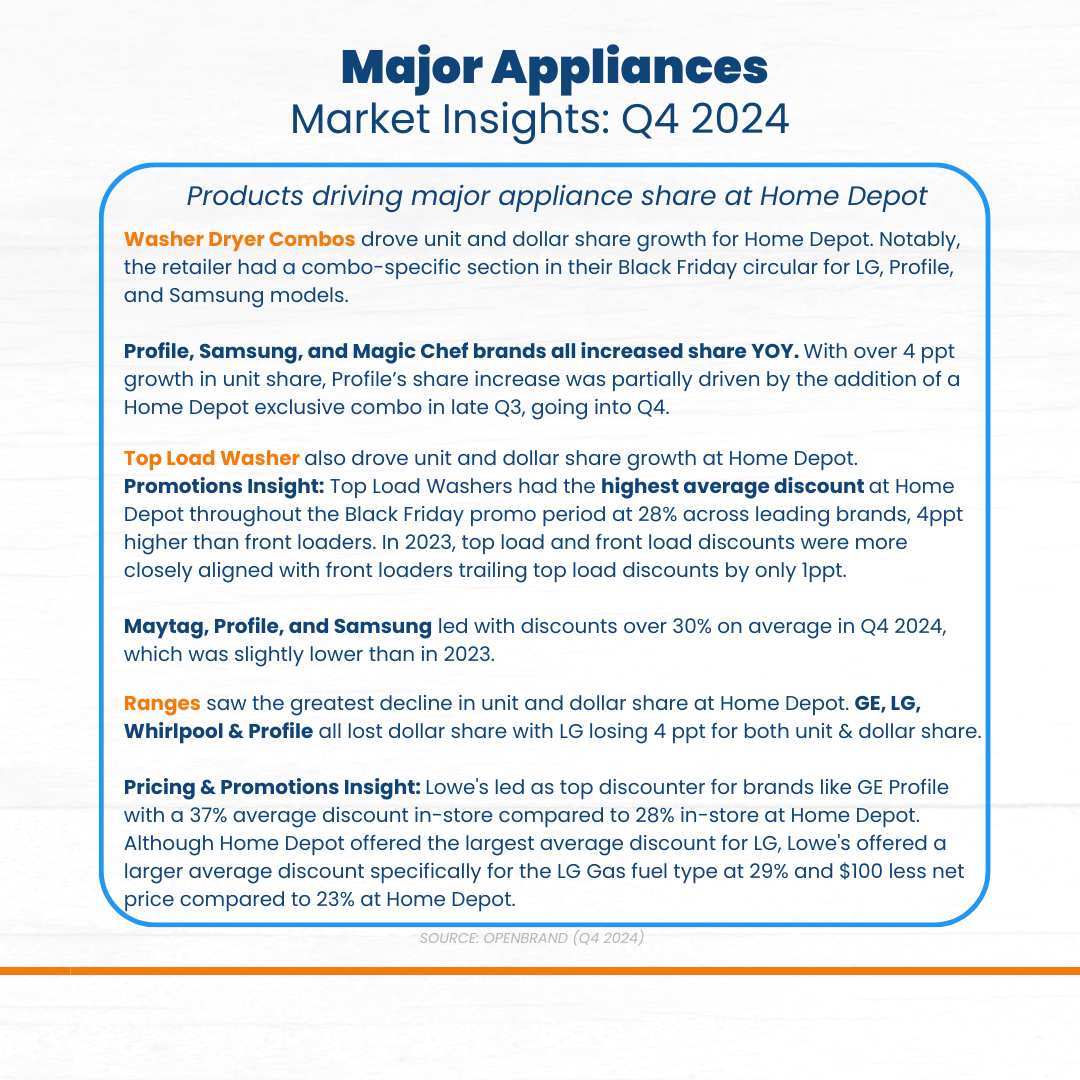
- Top load washers and washer dryer combos drove unit and dollar share growth for Home Depot. Washer dryer combo sales at Home Depot were driven in part by the retailer’s combo-specific section in their Black Friday circular for LG, Profile, and Samsung models. The leading SKU at Home Depot for January 2025 across all appliance categories was Hotpoint’s HTW265ASWWW top load washer.
- Ranges, however, saw the greatest decline in unit and dollar share at Home Depot. This was partially driven by competitive category discounting by Lowe’s, who was the top discounter for brands like GE Profile, with a 37% average discount in-store (compared to Home Depot’s 28%).
Consumer Insights:
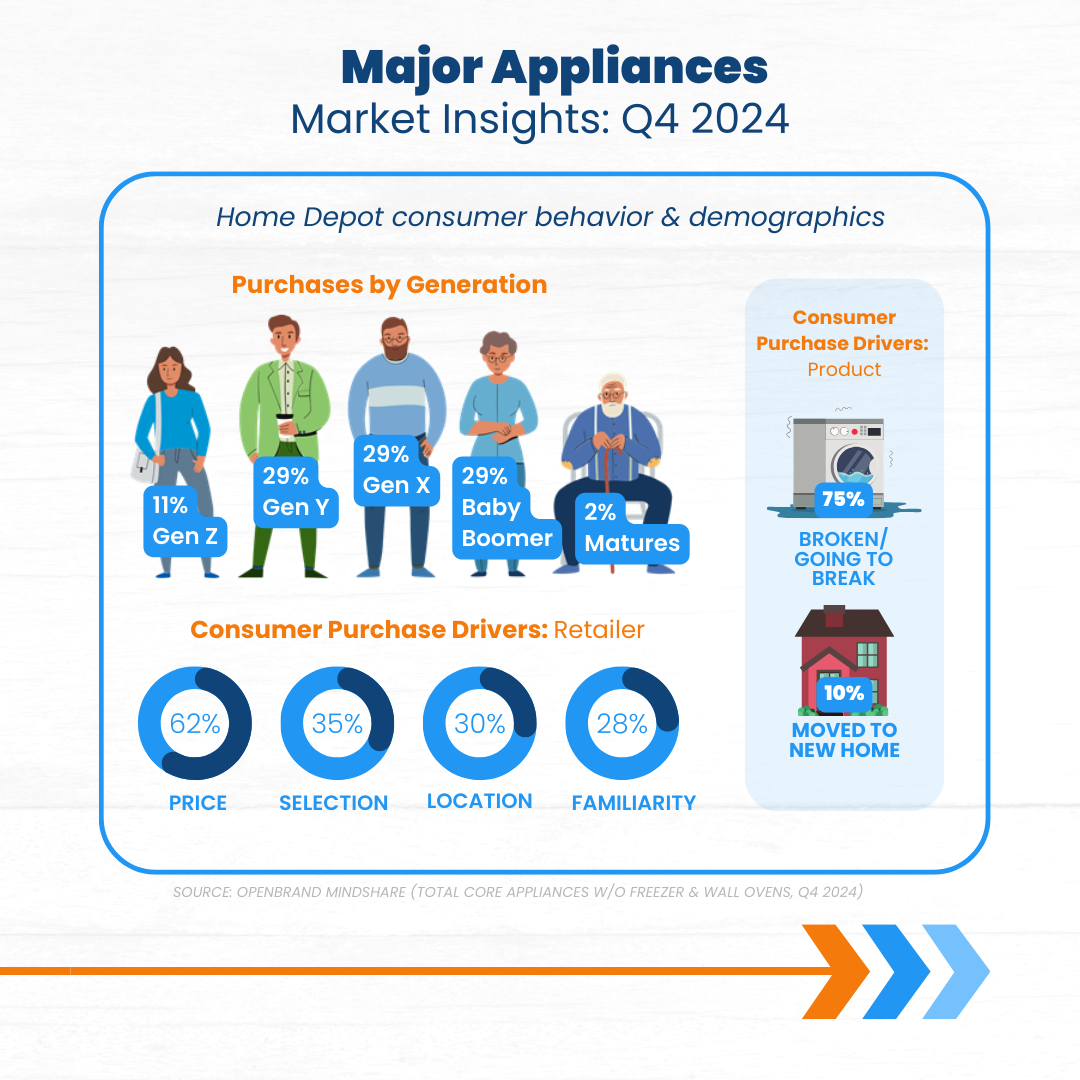
When looking at the makeup of Home Depot consumers in Q4 2024, Gen Y, Gen X, and Baby Boomers made up an equal part (29%) of the major appliance buyer split.
Purchase Drivers: Why did consumers buy major appliances at Home Depot?
- 75% replaced a broken appliance, 10% moved to a new home.
- Price, selection, and location remain key factors in retailer choice.
Outdoor Power Equipment (OPE) Insights
Market Share: Home Depot leads with 46.2%, coming in above all other retailers, including Lowe’s who won 37.3% dollar share. Notably, Walmart and Amazon are making a name for themselves in this space at 7.9% and 7.7% respectively.
Key Product Categories Driving Growth:
- Pressure washers was the only OPE category to see YOY growth at Home Depot in both unit and dollar share.
- Ryobi, exclusive to Home Depot, led unit and dollar share for pressure washers. All top 10 pressure washer SKUs in Q4 2024 were from the Ryobi brand. Additionally, the top SKU at Home Depot in January 2025 across all OPE products was the Ryobi RY120350 pressure washer.
Consumer Insights:
When looking at the makeup of Home Depot OPE consumers in Q4 2024, Gen Y and Gen X took the lead, both making up 31% of OPE buyers.
Purchase Drivers: Why did consumers buy OPE products at Home Depot?
- 36% replaced a broken unit, 21% were first-time buyers.
- Key retailer drivers: price, selection, familiarity, and location.
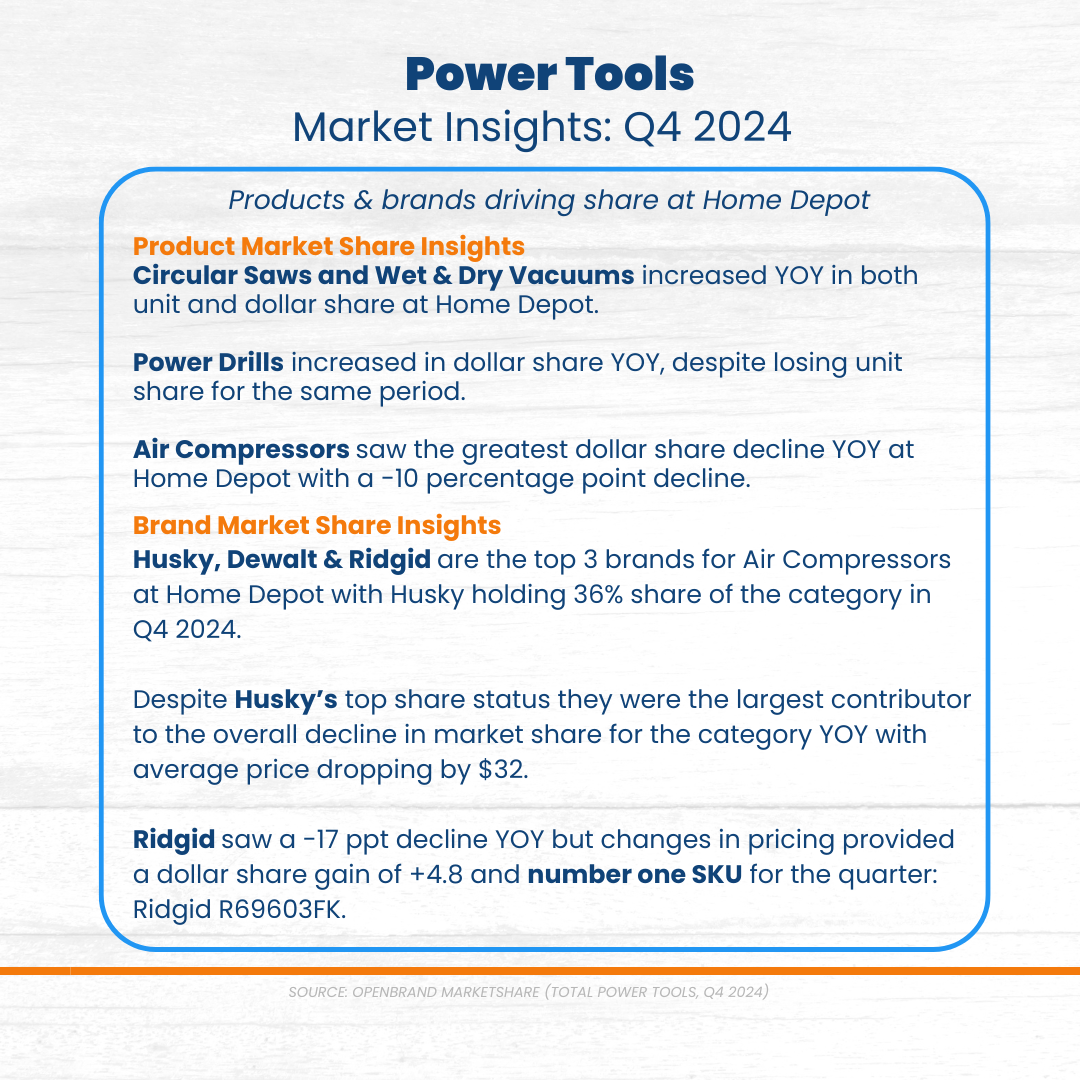
Power Tools Insights
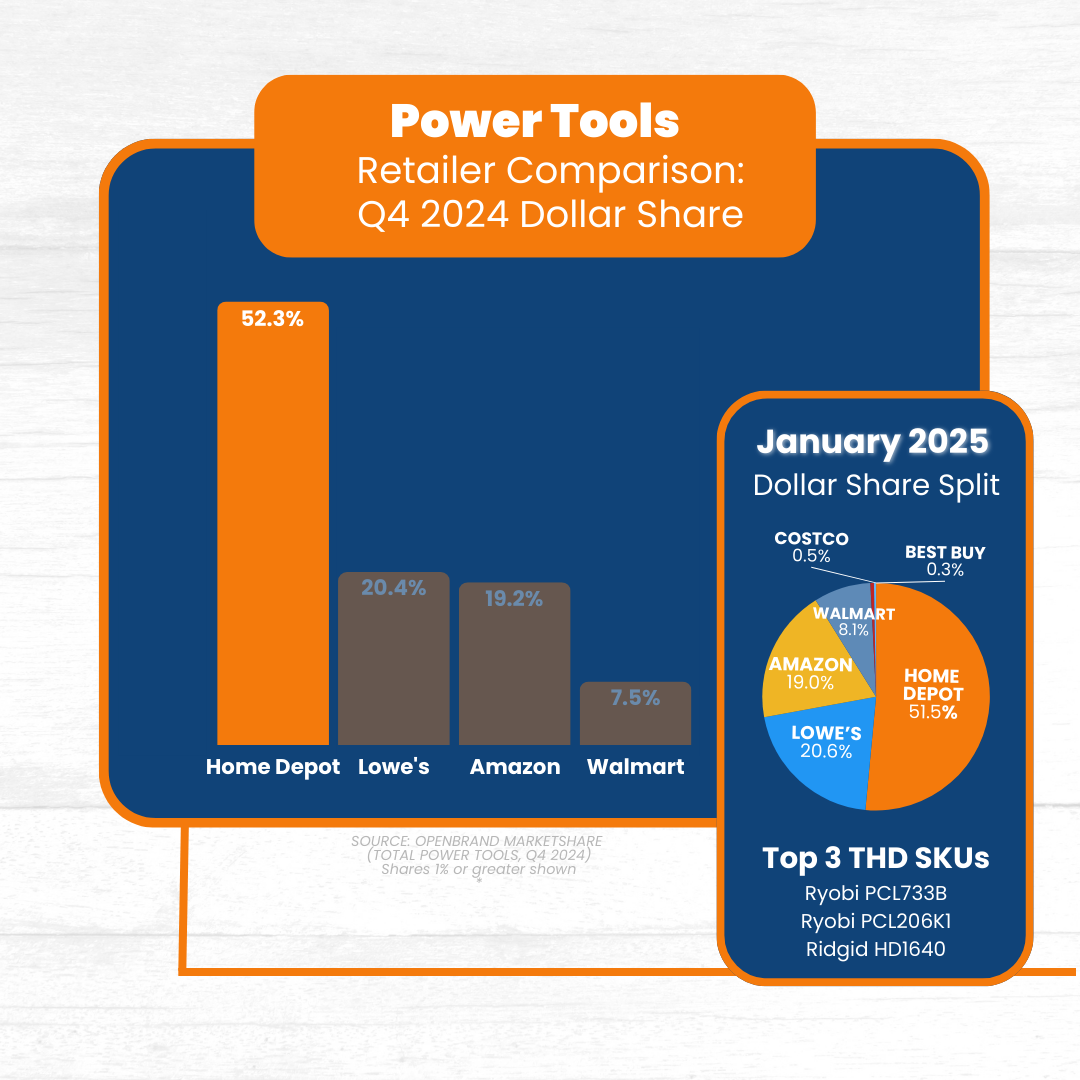
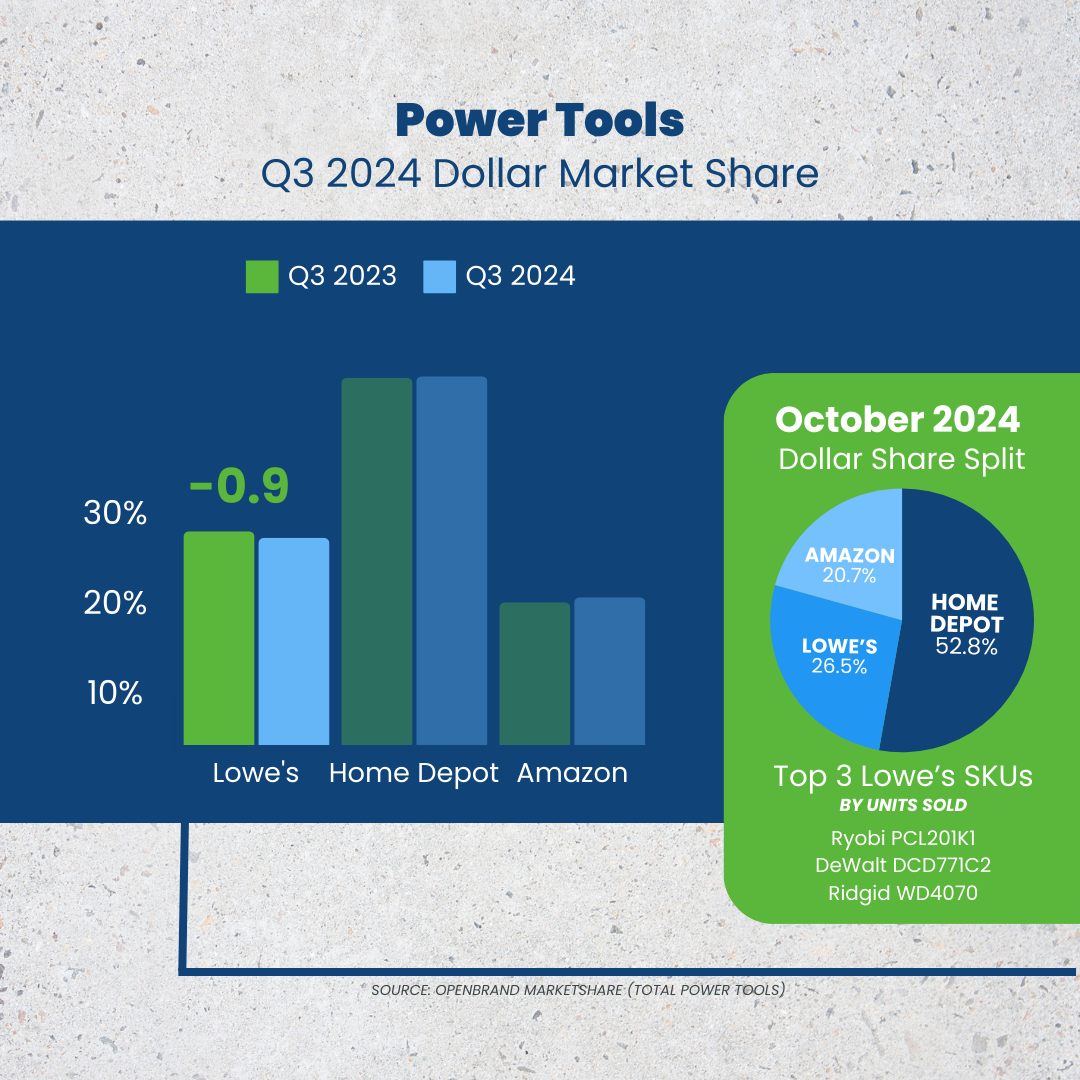
Market Share: Home Depot dominates with 52.3% (Lowe’s: 20.4%, Amazon: 19.2%, Walmart: 7.5%).
Key Product Categories Driving Growth:
- Circular saws and wet & dry vacuums increased YOY in both unit and dollar share.
- Power drills saw a dollar share increase despite losing unit share.
- Air compressors had the largest decline (-10 ppt), driven partially by Husky’s price drop (-$32 on average). Husky holds 36% of all air compressor share at Home Depot.
- Ryobi once again claimed the top SKU across all Home Depot power tools, with their PCL733B wet & dry vac.
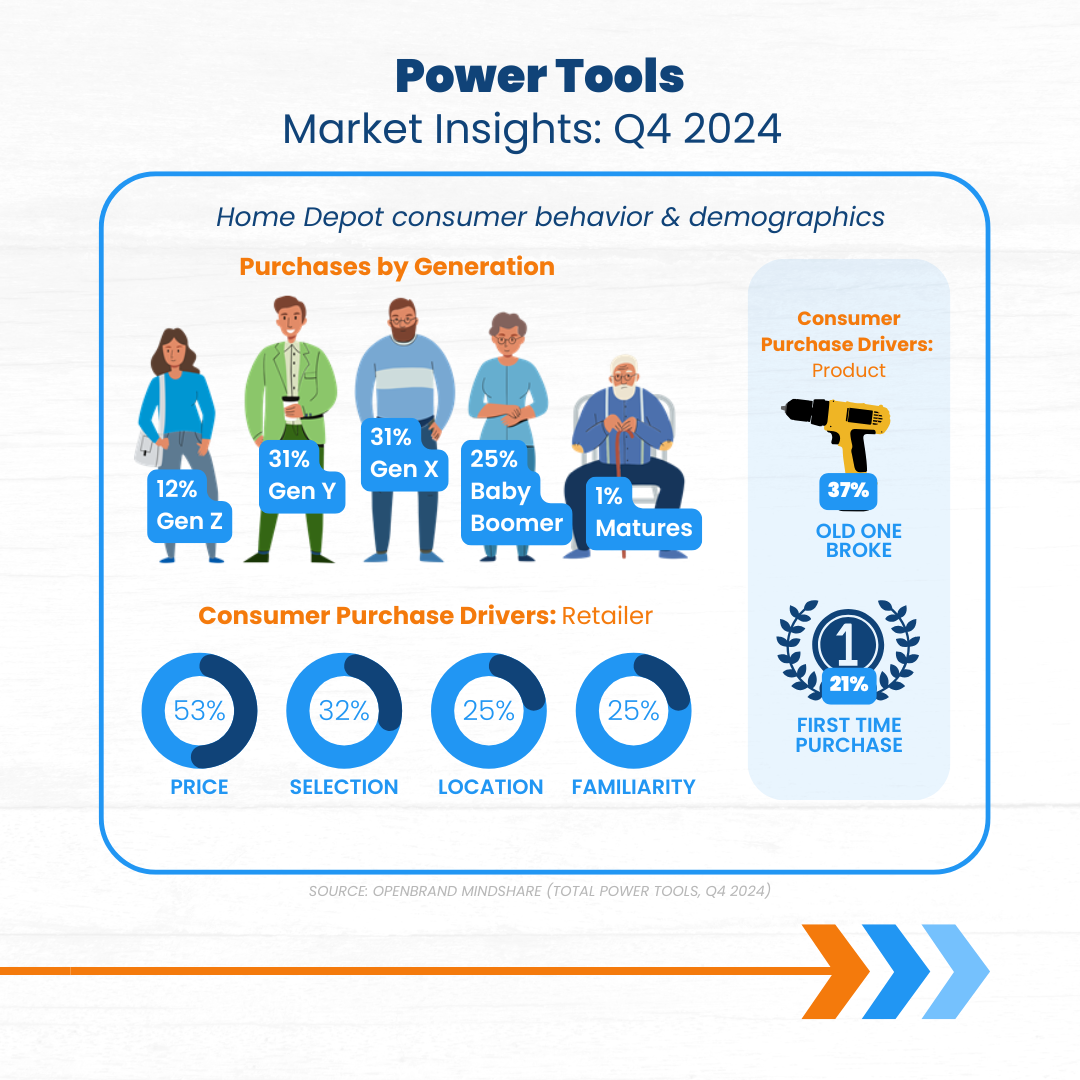
Consumer Insights: When looking at the makeup of Home Depot power tools consumers in Q4 2024 same as OPE, Gen Y and Gen X took the lead, both making up 31% of power tools buyers.
Purchase Drivers: Why did consumers buy power tools at Home Depot?
- 37% replaced a broken tool, 21% were first-time buyers.
- Price, selection, location, and familiarity continue to drive retailer choice.
Lowe's Earnings Call
Q4 2024 Performance & Lowe's Market Share Trends
SWIPE TO SEE FULL REPORT, CLICK TO EXPAND SLIDES



Lowe’s Earnings Call Overview
Lowe’s closed out Q4 2024 reporting $18.6 billion in revenue and a decrease of 0.26% in sales. Despite this decrease, the retailer did see a comp growth of 0.2%.
- Revenue: $18.6 billion
- Sales Growth: -0.26%
- Comps: +0.2%
- Diluted EPS: $1.99
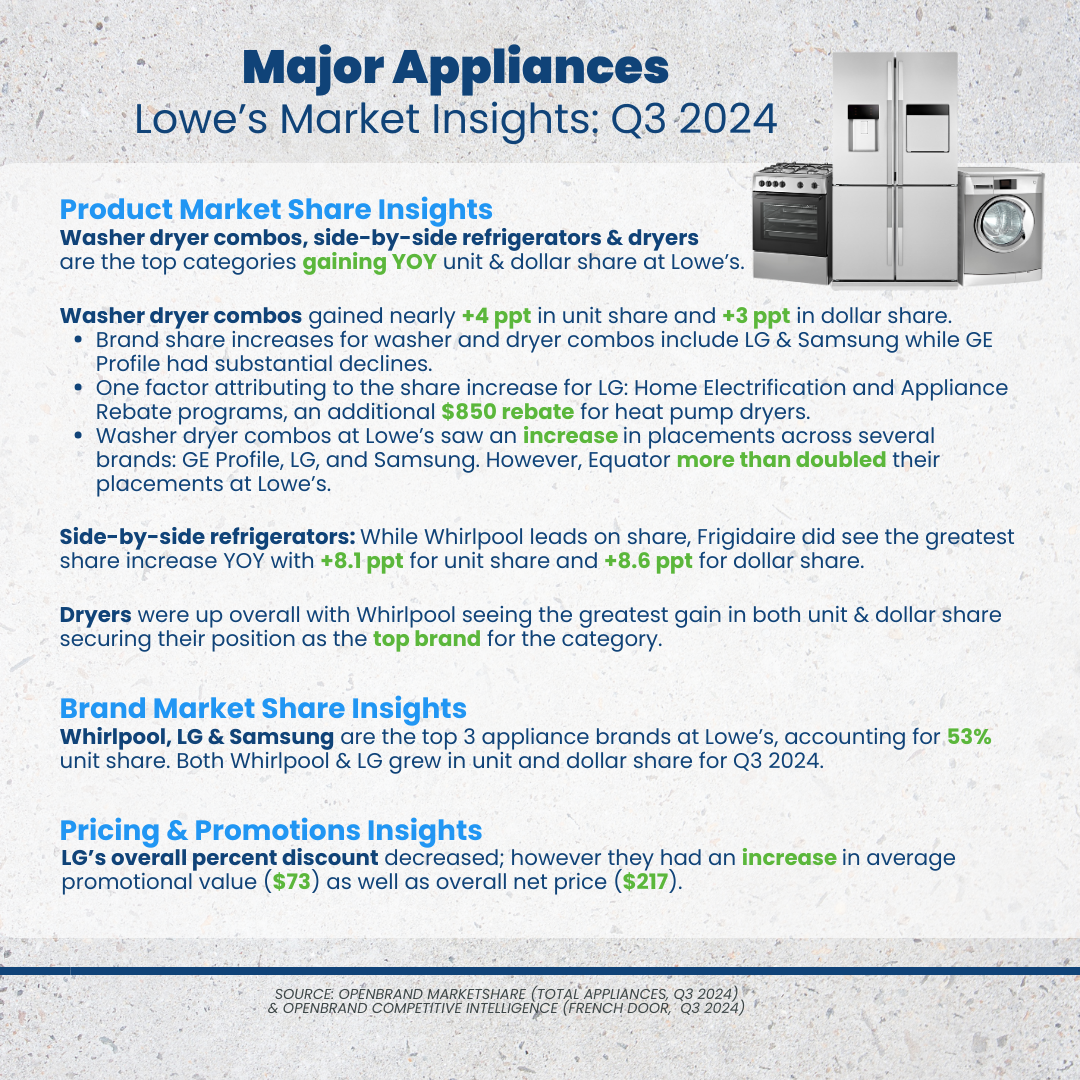
We break down how select durables categories factor into Lowe’s Q4 2024 performance below – including Lowe’s leadership in the major appliance category.
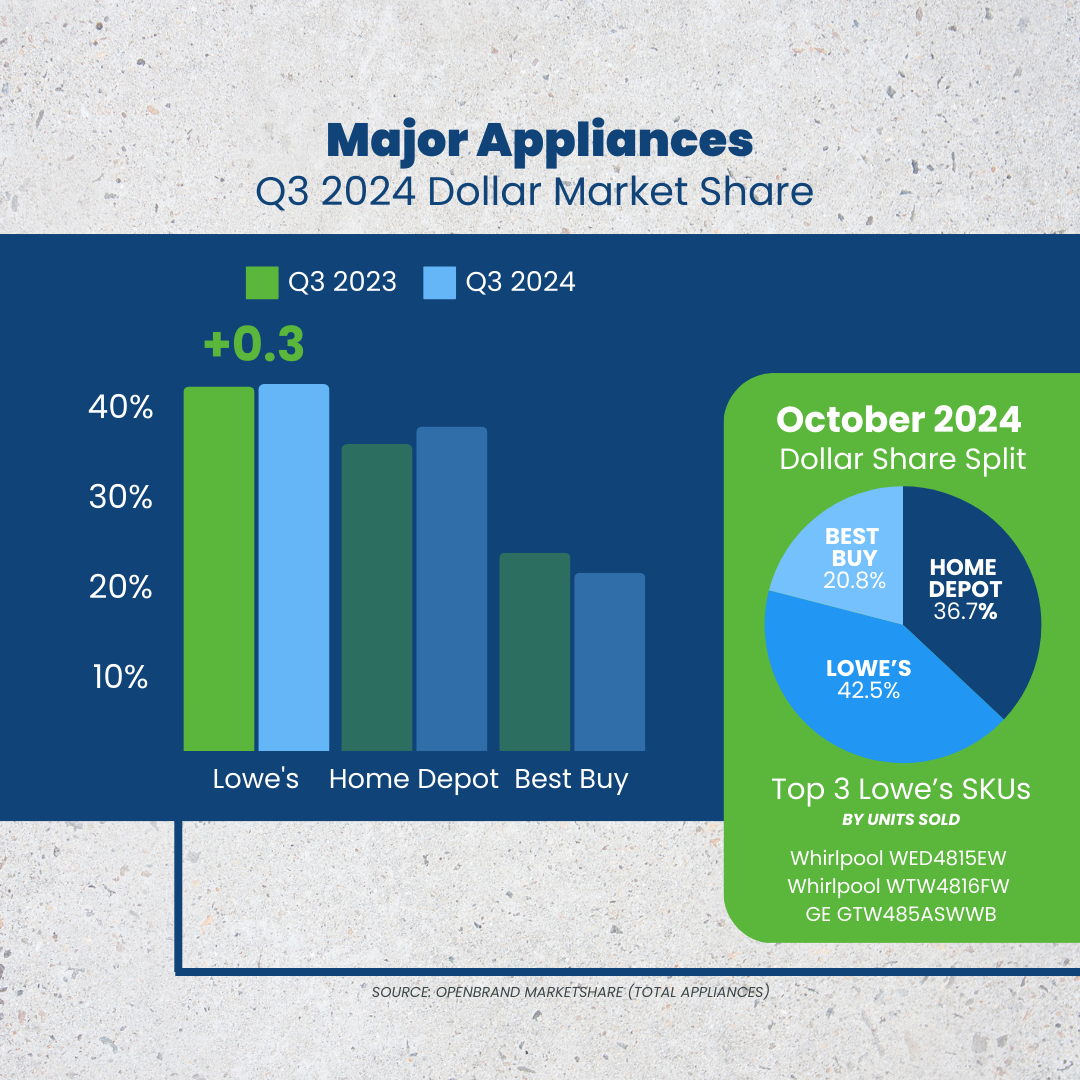
Major Appliance Insights
Market Share: Lowe’s leads the major appliances market with 40.2% share, staying ahead of Home Depot, which holds 36.2%.
Key Product Categories Driving Share
- Front Load Unitized: Lowe’s saw increases in both units and dollars for FL Unitized by 3.7ppt for each. Lowe’s share growth likely stems from its expanding portfolio, having exclusively offered LG models in Q4 2023.
- Top Load Washers saw a decrease in unit and dollar share. Maytag led overall share and was the top SKU for Top Load Washers.
- Dryers decreased in both unit and dollar share at Lowe’s. Lowe’s saw a notable YoY increase in average price for its dryer assortment in Q4 2024, increasing by around $30 on average.
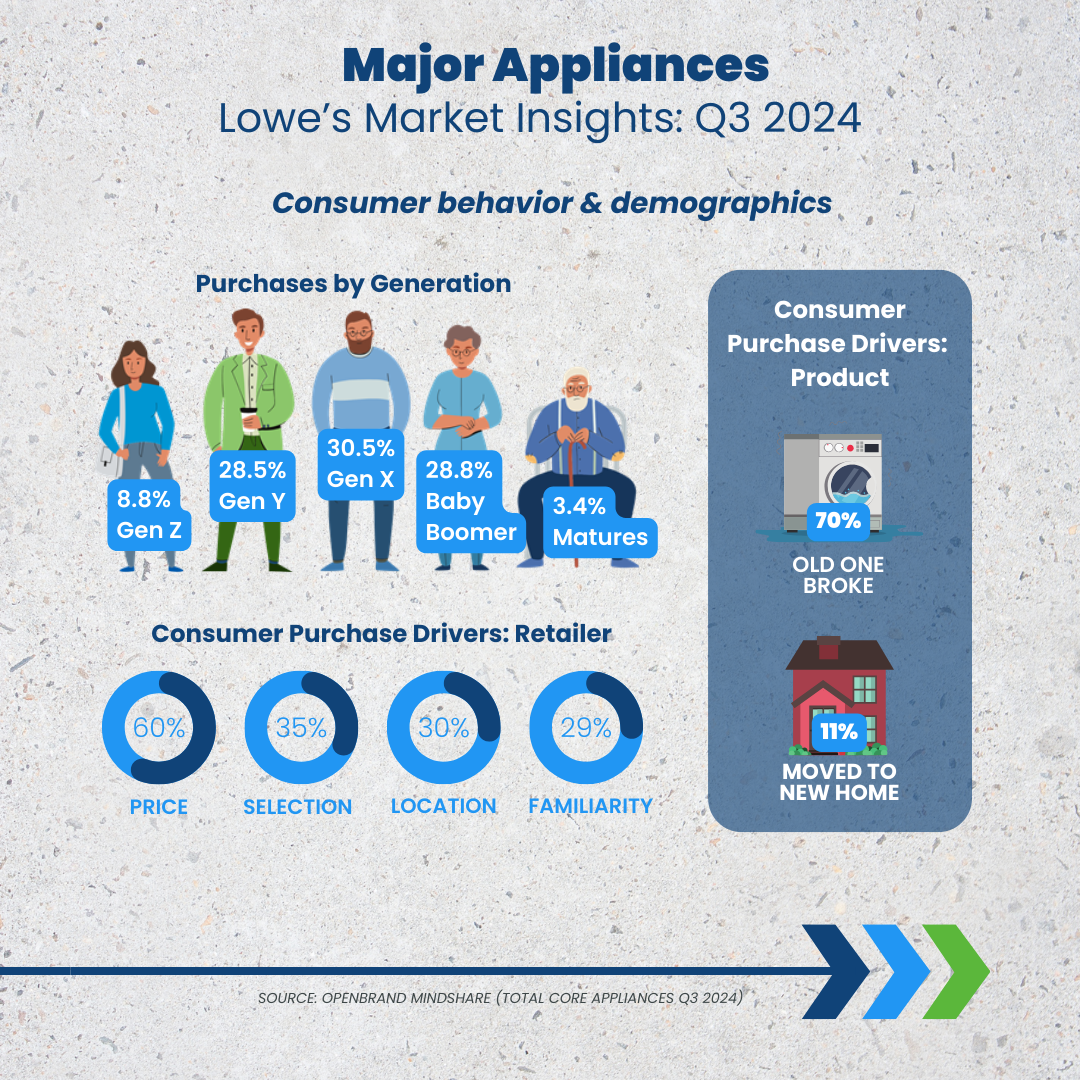
Consumer Insights: When looking at the makeup of Lowe’s major appliance consumers in Q4 2024, Gen X led the split at 32%, with Gen Y and Baby Boomers coming in at 29%. Notably, more Gen X make their purchases at Lowe’s than Home Depot.
Purchase Drivers: Why did consumers buy major appliances at Lowe’s?
- 68% replaced a broken appliance, 11% moved to a new home.
- Price, selection, and location remain key factors in retailer choice.
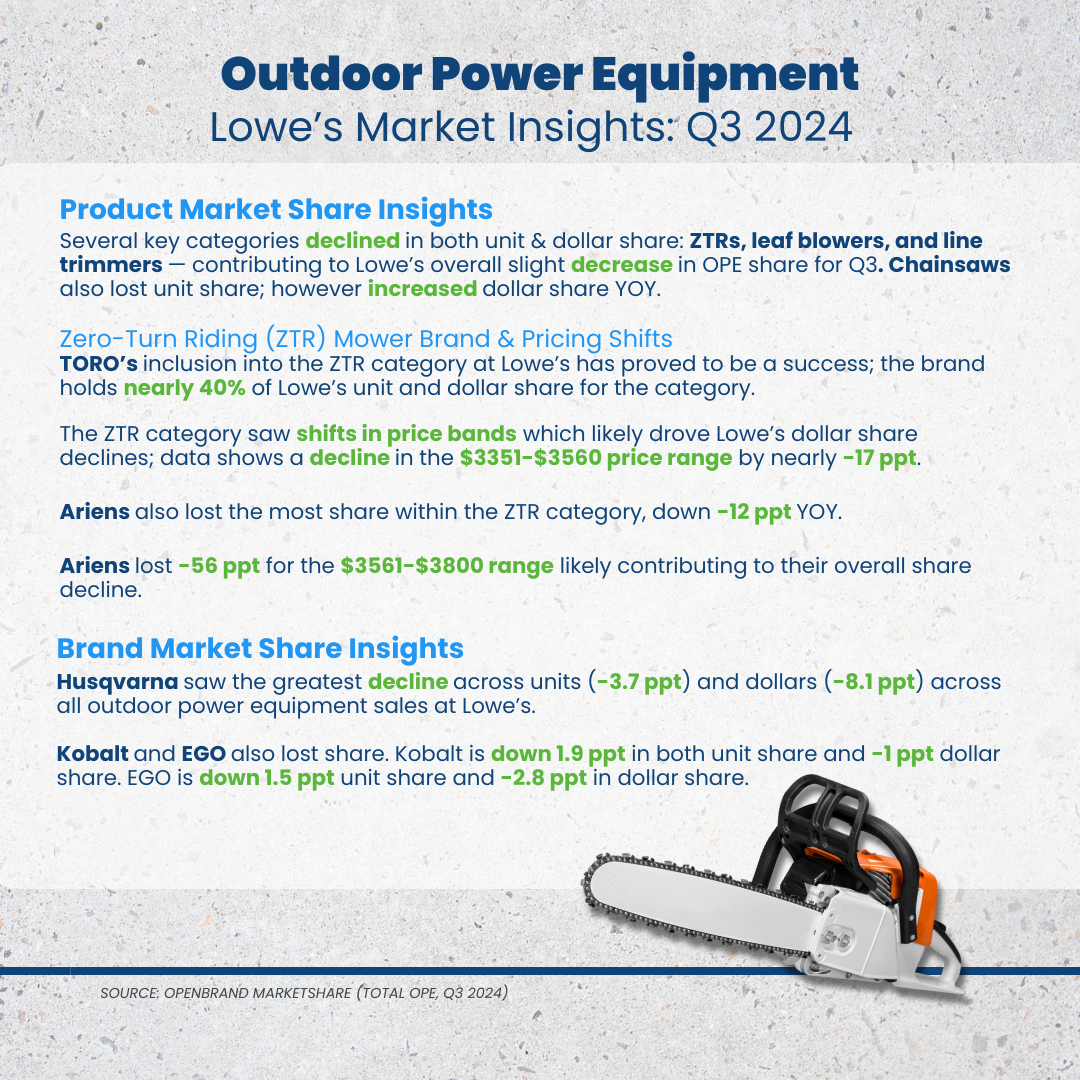
Outdoor Power Equipment (OPE) Insights
Market share: Lowe’s experienced a notable decline in OPE market share in Q4 2024, driven in part by losses in chainsaws and snow removal equipment. Chainsaw unit share dropped 14.5ppts YoY to 30.6%, with dollar share falling 6ppts to 30.5%. Snow removal unit share also fell significantly, declining to 23.5% from 36% YoY.
Key Product Categories Driving Share:
- Chainsaws: EGO gained 7.7ppts in unit share (17% vs. 9.3% YoY), securing the #1 SKU with its 56V 16-inch battery model ($249).
- Snow Removal: EGO increased to 49.5% unit share, while Toro rose to 15.4%. Ariens and Craftsman lost 8.2ppts and 10.3ppts, respectively.
- Gas vs. Electric: Battery-powered chainsaws now 71% of unit share (up from 57% YoY), while corded models dropped to 7% (from 26%).
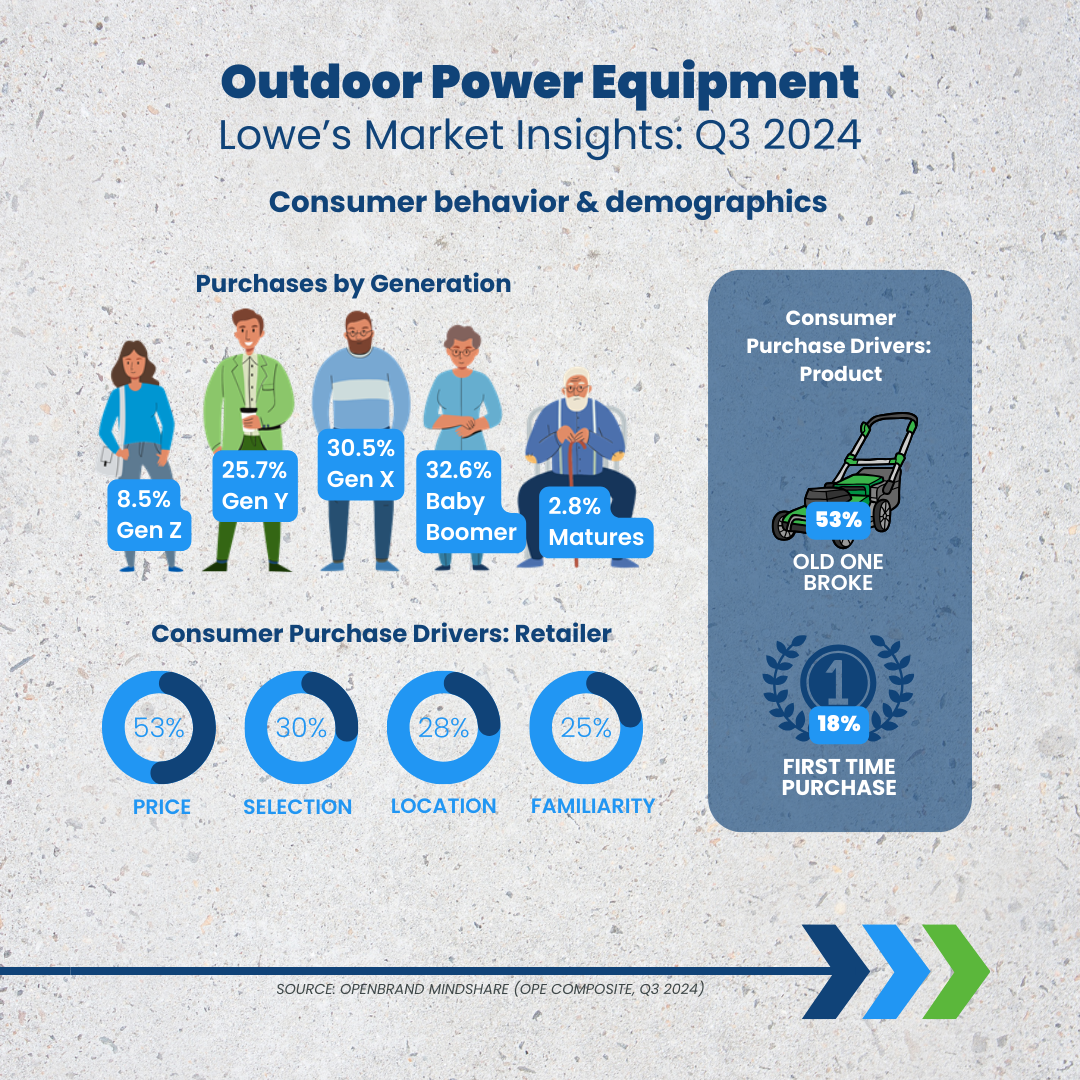
Consumer Insights: When looking at the makeup of Lowe’s OPE consumers in Q4 2024, Gen X also led the split for this category at 33.9%.
Power Tools Insights
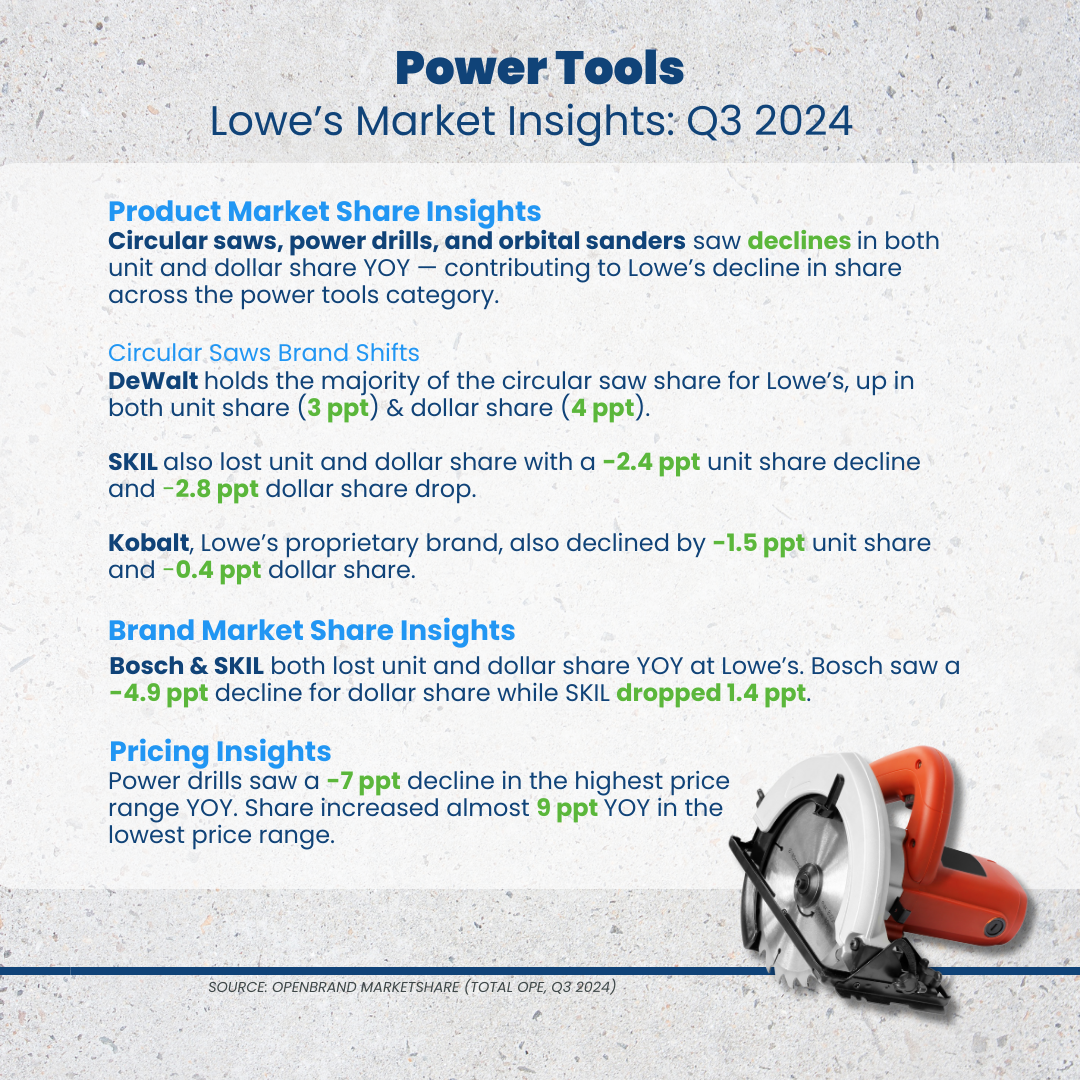
Market Share: Lowe’s comes in as the second leading retailer for power tools dollar share in Q4 2024 at 20.4%. Lowe’s saw an overall decrease in the power tools category, with Orbital Sanders (-23ppts dollar share) and Rotary Tools (-13ppts unit & dollar share) seeing the largest declines.
Key Product Categories Driving Share
- Orbital Sanders: Bosch & Craftsman lost share in both units and dollars. Dewalt gained 11ppts in dollar share, despite a drop in units. Dewalt’s average price for orbital sanders dropped 24% YoY ($145 to $111), signaling a pricing shift.
- Rotary Tools: Dremel remains the unit leader but lost 24ppts in unit share, 28ppts in dollar share. Dewalt leads in dollar share and holds the top selling SKU across the category.
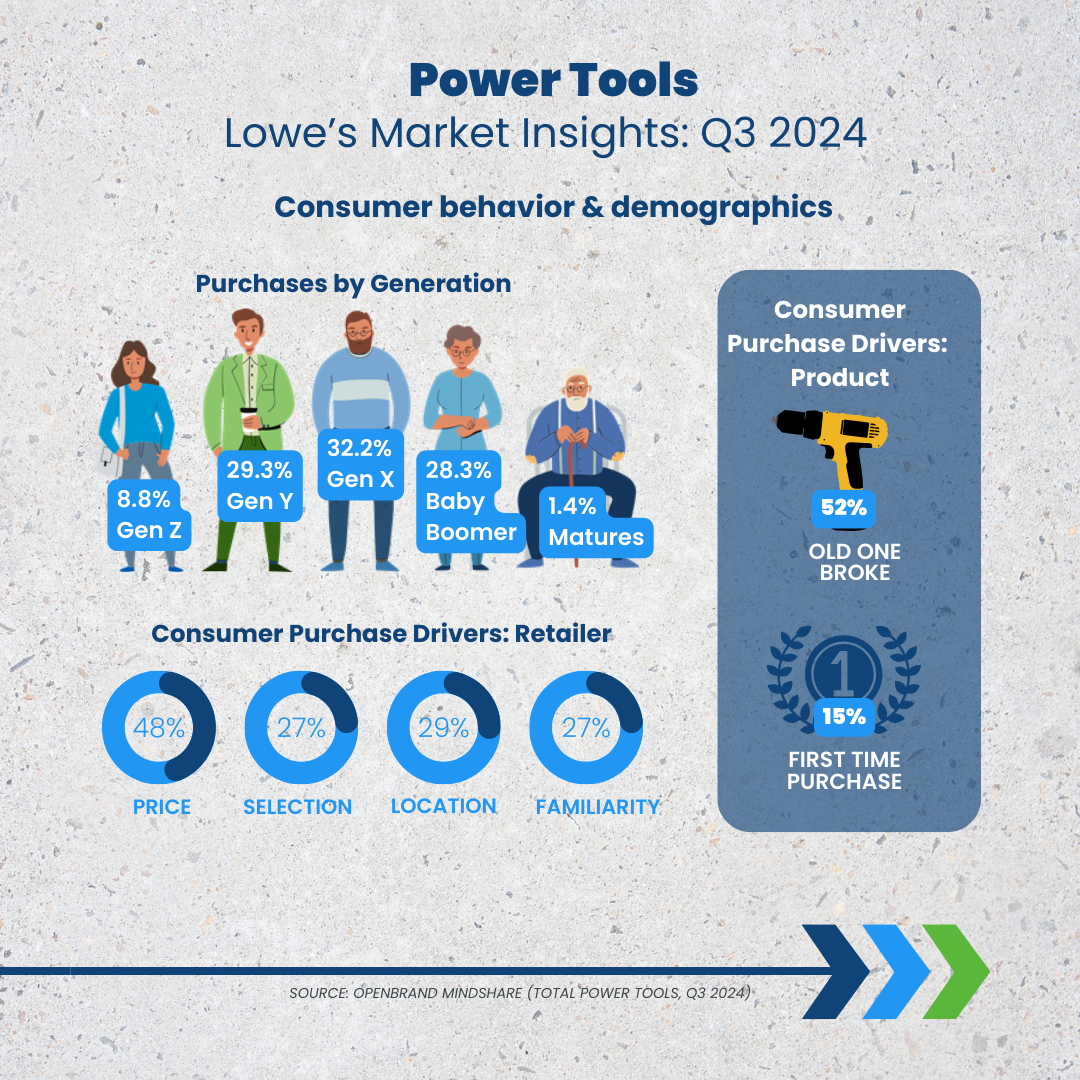
Consumer Insights: When looking at the makeup of Lowe’s power tools consumers in Q4 2024, Gen X once again led the split for this category at 33% — 3ppt higher than the next generation (Millennials at 30%).
Home Depot vs. Lowe’s: Competitive Landscape
Lowe’s and Home Depot continue to battle for dominance in key durables categories, with their Q4 2024 performance highlighting different strengths and vulnerabilities.
Lowe’s maintains its leadership in major appliances, leveraging aggressive discounting to maintain its edge. Home Depot, though trailing in share, drove volume through strategic placements like its Black Friday washer-dryer combo push.
In outdoor power equipment, Home Depot remains dominant, while Lowe’s struggled with sharp declines in chainsaws and snow removal. The rise of battery-powered tools benefited Lowe’s, but not enough to offset broader losses. Home Depot’s exclusive Ryobi lineup kept it ahead, while Lowe’s saw some gains with Toro in snow removal but lost share in key brands like Craftsman and Ariens.
Power tools remain a stronghold for Home Depot, as Lowe’s faces losses across products like orbital sanders and rotary tools. Dewalt’s pricing adjustments at Lowe’s helped boost dollar share, but Home Depot’s exclusive brands and stronger premium positioning kept it in control. Notably, both retailers need to pay attention to Amazon, who holds 19.2% dollar share — putting them only 1.2% behind Lowe’s in retailer dollar share split.
The Q4 results reinforce the distinct strategies of each retailer. Lowe’s continues to rely on pricing and promotions to attract customers, sustaining its appliance leadership but losing ground elsewhere. Home Depot’s focus on exclusive brands and strategic product placements reinforces its advantage in outdoor power equipment and power tools. As battery-powered equipment grows and pricing strategies shift, both retailers will need to refine their competitive playbook.
Get Unmatched Market Intelligence for YOUR Business
Lowe’s and Home Depot’s earnings calls offer a big-picture view of their performance, but the real story lies in how specific product categories, pricing strategies, and consumer behaviors drive those results. Our market intelligence goes beyond the numbers to provide actionable market measurement and competitive intelligence insights that help businesses win.
Want to see the insights available for your brand?
Have a specific data request you’re interested in diving into with our team?
Connect with our team below
US Fitness Equipment: Brand & Retailer Market Share & Trends
The Fitness Equipment market is poised for growth with brands like Tesla gearing up to enter the field, and consumer preferences shifting toward working out at home instead of at the gym.
With that in mind, let’s look at the current state of the Fitness Equipment market, including who’s buying, where they’re buying it, and what drives their purchase decisions. Download our free US Fitness Equipment market infographic to see all the insights as of September 2023 or read on to discover current trends in the industry, including the top brands, retailers, and more.
Source: All data in this article was pulled from the OpenBrand MindShare platform using the rolling 4Q ending Q3 2023, Exercise Total category. The OpenBrand Exercise Equipment - Total category is an aggregate of several products. For 4Q ending September 2023 this category consists of the following products: Stationary Bike, Weight Bench, Multi-purpose Gym, Rowing machine, Elliptical Machine, Stair Climber/Stepper, Treadmill, and Other Exercise Equipment. For the most recent insights or further dives into the data, please contact us.

Who are the top retailers by share in the US Fitness Equipment market?
As of September 2023, the top retailer for US Fitness Equipment was Amazon in both unit and dollar share.
In unit share, Amazon saw an increase of 5 percentage points from the same time prior year. The major online retailer continues to lead all other outlets with a share of 34%.
Dick’s enjoyed the next highest retailer unit share (6.8%). Peloton saw the largest unit share decline year-over-year (YOY), with a drop of nearly 2 points, putting them just behind Dick’s at 6.6% share.
Amazon took the lead over Peloton as industry dollar share leader, gaining 6 percentage points YOY for a total of 23.5%. In contrast, Peloton lost a dramatic 6 percentage points compared to prior year, bringing their dollar share down to 18.3%.
Outlet Draw/Close Rates
Amazon and Walmart lead all other outlets for highest draw rate, attracting the most consumers shopping for Fitness Equipment. The draw rate for Amazon is up significantly, reaching 41% in September 2023. Walmart’s draw rate was mostly flat compared to the prior year, holding steady at 19%.
As for close rates, Peloton and Amazon saw the greatest success. Though drawing in only 7% of consumers, Peloton continues with the highest outlet close rate of 89%. Amazon, leader in market share for Fitness Equipment, saw its close rate significantly increase from last year, reaching 83%.
Notably, with increases in both Amazon’s draw and close rates for Fitness Equipment, this means the online retailer is drawing in more shoppers looking to buy Fitness Equipment and closing more sales with them.
Who is winning the most Fitness Equipment manufacturer market share?
As of September 2023, the most popular Fitness Equipment manufacturer continued to be Peloton, in both unit (11%) and dollar (25%) share.
However, as seen with outlet share, Peloton saw decreases in brand share. In dollars sold, Peloton saw the largest decrease in share across all Fitness Equipment brands, with a loss of 4 points YOY; in dollar share, Peloton lost 1 point.
NordicTrack holds the second place in unit and dollar share, with 5% unit share and 10% dollar share (though decreasing 1 percentage point YOY in both). Bowflex came in as the third top brand in share, with just under 5% unit share and 6% dollar share.
Brand Consideration Rates
Peloton continues to lead as the most considered brand with 15% brand consideration rate. However, once more, the brand saw a decrease YOY.
While Peloton was down in brand consideration, the brand’s close rate did increase significantly, reaching 73%. This shows that while less people are considering Peloton when shopping for Fitness Equipment, those that do consider the brand are more likely to buy than consumers in past years.
Like our list of brand share leaders, the next most considered brands were NordicTrack (8%) and Bowflex (7%).
[Download the infographic to see the share percentage breakdown by all top Fitness Equipment brands.]
How much do consumers spend on Fitness Equipment?
As of September 2023, the industry average price paid for Fitness Equipment was $536, which is down from $606 YOY.
The average amount spent at specific retailers varies. Here are a few examples of the variance consumers can see when shopping for Fitness Equipment.
Average Price Paid for Fitness Equipment by Retailer
-
- Consumers buying Fitness Equipment at Peloton have an average price paid of $1,525.
-
- This average price paid is nearly three times higher than the industry average but is also down from last year’s $1,774 average price.
- Given the brand’s dramatic drop in dollar share, it is no surprise that Peloton’s average price saw a consistent decline over the past three years.
-
- Buyers shopping at top outlets Amazon and Walmart saw average Fitness Equipment prices significantly lower than the $536 industry average, at $364 and $296 respectively.
- Consumers buying Fitness Equipment at Peloton have an average price paid of $1,525.
How are online vs. in-store sales trending for the Fitness Equipment market?
With Amazon as the market share leader for Fitness Equipment purchases, it’s no surprise that Fitness Equipment is most often purchased online — with 66% of purchases made using an online sales channel. Only 26% of purchases are made in a retail store.
Here are some additional trends that OpenBrand uncovered:
-
- Historically, consumers pay a slightly higher average price when purchasing online.
-
- As of September 2023, consumers purchasing Fitness Equipment online paid an average price of $567.
- While this is down compared to the prior year, it was still higher than the current industry average of $536.
- Furthermore, the online average price paid for Fitness Equipment is higher than the average price paid by consumers making in-store purchases, which was only $483.
-
- Regardless of purchase channel (online or retail store), 85% of consumers shopped online before making a purchase.
- Additionally[AJ1] [SH2] , 71% of online purchasers shopped at only one store, while 65% of retail store purchasers shopped at only one store.
- Historically, consumers pay a slightly higher average price when purchasing online.
Other key US Fitness Equipment market insights
Which demographics are buying US Fitness Equipment?
Let’s look at the primary demographics for Fitness Equipment purchases using the census-balanced survey data from OpenBrand Durable IQTM.
-
- 69% of Fitness Equipment purchasers are homeowners; with purchases by homeowners significantly down by 1.4 points from this time last year
- 28% of purchasers are renters
- 53% of purchasers are married
- 45% of purchases are made with males only involved in the purchase decision
- 34% of purchases are made with females only involved in the purchase decision
- 36% of Fitness Equipment purchasers are Millennials and 28% are Gen X generations
-
- However, purchases by Gen Z (17%) continue an upward trend, as seen in the past few years, gaining ground on Millennials and Gen X
- Gen Z purchases of Fitness Equipment increased significantly by 3.8 points compared to prior year
-
Fitness Equipment Purchase Drivers
As seen in previous years, “first time purchase” was the most mentioned reason for Fitness Equipment purchases as of September 2023.
The top three reasons cited by consumers for purchasing Fitness Equipment were:
-
- “First time purchase” (46%)
- “Replacement of broken” (13%)
- “Gift for someone” (10%)
The most mentioned reasons for purchasing Fitness Equipment at a specific retailer were:
-
- “Competitive price” (59%)
- “Good selection of products” (33%)
- “Previous experience with store” (16%)
- “Convenient location” (14%)
The most mentioned reasons for purchasing a specific brand of Fitness Equipment were:
-
- “Competitive price” (46%)
- “Features desired” (39%)
- “Quality product” (31%)
- “Good brand name” (20%)
Outlets & Brands Shopped
Across all purchase channels (online, retail store, and others), 70% shopped at only one store and 77% shopped for only one brand.
Get more insight into Fitness Equipment trends and market share
The market insights don’t stop here. For more retail sales data, market share, and insights on the Fitness Equipment market, download the OpenBrand-exclusive infographic below. To see insights for other industries or find out how we can help power growth for your business, contact us today.

Home Improvement Market: 2024 Mid-Year Review
OpenBrand conducted a data analysis of the 2024 Home Improvement market, highlighting insights including:
- Brand & retailer share winners by industry
- Online vs. in-store purchase shifts
- Consumer demographic insights
- Average price paid trends
- …and more!
Download now to discover the state of the Home Improvement industry
Summary
Our 2024 mid-year review delivers a look at the state of the home improvement (HI) industry at the mid-year mark. The goal of this report is to provide a high-level snapshot of the state of the Home Improvement (HI) industry as we approach the end of 2024. To access all the insights and data available for the Home Improvement industry contact our team at OpenBrand.
Source
Our primary data source for this report is our quarterly consumer tracking survey (MindShare, previously Durable IQ), which measures market share across 100% of the market through consumer awareness. We also tap into SKU-level market share insights (MarketShare, previously Hybrid POS) as well as our pricing, promotions, product, and placement data.
For the purposes of this report, we reviewed the Home Improvement market through the lens of an aggregate of all the Consumer Durables categories relevant to Home Improvement businesses. For more details on what categories comprise the Home Improvement product aggregate, see pages 6 and 31 of the report.