

Printer Supplies: 2025 Year-In-Review
Our Ink & Laser Supplies: 2025 Year-in-Review report recaps printer supply launches, placements, pricing and advertising and promotional activity captured throughout 2025. The report features data and insights from OpenBrand’s Ink Supplies category, which feature products sold through the US ecommerce and brick-and-mortar channels.
Read through all the 2025 pricing and promotions insights below or email the report to read later.
You can also check out our 2025 Year-in-Review reports for other Print categories.
Product Launch Activity
Ink
OpenBrand did not track any new ink supplies launches from HP or Epson this year. While these OEMs did release new inkjet printers in 2025, those models expanded existing ink lines rather than introducing new ones.
Brother
Brother LC500 and BTD180 Series
In August, OpenBrand discovered 41 new Brother LC501, LC504, and LC506 INKvestment cartridges and BTD180 ink bottles at Staples.com ahead of their launch. All cartridge series offer standard and high-yield options, with LC506 adding a super high-yield tier. The BTD180 series marked Brother’s first entry into the US refillable ink tank market, supporting three new tank-based models. These developments signal a strategic shift as Brother positions itself against Canon MegaTank, Epson EcoTank, and HP Smart Tank systems.
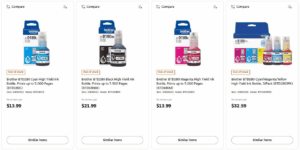
At the end of August, Brother’s LC501 ink series gained initial retail placements at Brother.com, Amazon.com, and BestBuy.com, with 12 SKUs spanning standard and high-yield formats. ERPs ranged from $11.29 for individual color cartridges to $65.99 for high-yield multipacks. Compared to the LC401 series, standard black ERP rose 33%, color ERP rose 10%, and high-yield black ERP rose 2%, resulting in CPP increases across all SKUs. The standard black cartridge improved yield by 25% but incurred a 6% CPP increase due to higher pricing. Initial placements were priced at or near ERP on Amazon and BestBuy, while Staples.com (despite hosting the earliest listings) was not offering the SKUs at the time of reporting.

Then, on September 16, 2025, Brother officially launched its LC504 and LC506 cartridges along with the BTD180 ink bottles, with availability across Brother.com, Staples.com, Amazon.com, and BestBuy.com. The LC504 series introduced a new high-yield tier and saw ERPs rise 7% to 20% over the LC404, while yields declined, resulting in CPP increases of 35% (black) and 72% (color). LC506 supplies expanded with high- and super-high yield tiers; however, CPPs nearly doubled in some cases compared to the LC406 series. The BTD180 bottles launched with aggressive pricing: $19.99 for 7,500-page black bottles ($0.0027 CPP) and $11.59 for 5,000-page color bottles ($0.0096 CPP).
Canon
Canon PG-295
In September, Canon introduced the PG-295/CL-286 ink series alongside the launch of three new PIXMA printers in September 2025. The PG-295 replaces the PG-285 as the standard black pigment cartridge, while the CL-286 remains unchanged for color prints. The new PG-295 series offers improved text clarity but retains the same page yields as its predecessor. Despite this, ERP increases of 24% (standard) and 37% (high-capacity) have also raised CPP. Supplies are now available across major retail and ecommerce channels and are integrated with the Canon PIXMA Print Plan, which offers up to 83% savings on color CPP compared to transactional purchases.
Canon PFI-5100
In January, Canon launched the PFI-5100 professional ink series alongside the imagePROGRAF PRO-310 printer, marking an expansion of its LUCIA PRO II pigment ink platform. With an ERP of $15.99 each, the PFI-5100 cartridges debuted at a 23% premium over their predecessors (PFI-300 series). The PFI-5100 series reinforced Canon’s strategy to enhance its professional-grade offerings, targeting photographers and creative professionals who prioritize print quality and longevity. Though budget-conscious consumers may hesitate due to the increased, upfront costs, the series’ technical improvements and expected expansion into more retail outlets positioned it as a strong addition to Canon’s pigment ink portfolio.
Costco Discontinues Ink In-Store
In May, Costco discontinued in-store sales of all ink supplies, shifting its entire ink assortment exclusively to online distribution via Costco.com. The move followed a multiyear contraction of its in-store ink SKUs, which declined from 27 in December 2021 to just 9 by December 2024. This shift aligns with HP’s strategy to prioritize direct-to-consumer channels and subscription-based models like Instant Ink and the HP All-In Plan. The transition reflects broader retail and consumer trends favoring online fulfillment and streamlined assortments, particularly for low-touch, low-turnover categories like ink cartridges.

Laser
OpenBrand did not track any new laser supplies launches from Lexmark and Xerox this year.
Brother
Brother announced the TN635 and TN637 series alongside its refreshed lineup of color laser printers and MFPs in October. The TN635 replaces the TN431 series in the open channel, while the TN637 steps in for the TN439 to support Brother Workhorse models sold through Brother Gold Authorized Partners. Brother has consolidated its offering between the TN431 and TN635 generations, eliminating the ultra high-yield tier from the TN635 series. Brother also adjusted page yields and prices of the supplies between generations. More specifically, Brother increased rated page yields between generations of the high-yield (+22% black yield and +13% color yield) and super high-yield TN635 supplies (+15% black yields) and the TN637 ultra high-yield supplies (+11% black and color yields), while raising ERP on all supplies by between 10% and 53%, resulting in an intergenerational increase to CPPs by between 10% to 35%.
Canon
Canon 075 Toner
Canon executed a mid-lifecycle refresh of its A4 imageCLASS lineup in Q3 2025, launching the 075 toner series alongside five new SOHO laser printers. The 075 series replaced the 067 with adjusted yields and pricing, offering improved CPPs on high-yield cartridges to incentivize volume purchases. Initial distribution included Canon’s direct webstore and major resellers such as Amazon, BestBuy, Staples, and Quill, with the latter two offering the most competitive pricing.

HP
HP EvoCycle 87XE
HP expanded its EvoCycle toner cartridge lineup in April 2025 with the introduction of the 87XE Black High-Yield Toner (CF287XE), a hybrid cartridge that is built using 100% closed-loop recycled plastics (according to HP, components that are critical to print quality like the drum and the toner are replaced with new original HP parts, which is why HP uses the term “hybrid” instead of “remanufactured” when describing EvoCycle cartridges). Functionally identical to the standard 87X cartridge, which supports the same devices and offers the same 18,000-page yield, the 87XE was priced at a 2% to 30% premium at Staples Advantage and ODP Business Solutions, respectively. This marked the first EvoCycle SKU to use an “E” suffix, indicating a possible rebranding shift. The move follows HP’s gradual expansion of the EvoCycle series from Europe to North America, bringing the total number of models in the lineup to eleven at the time of release.
HP EvoCycle 89Y
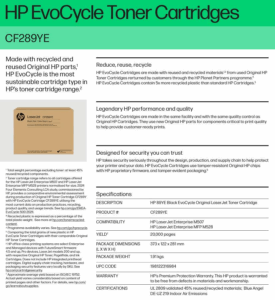
HP again expanded its EvoCycle remanufactured toner line in Q3, with the introduction of the 89Y Black High Yield Toner (CF289YE), now available in the two-tier distribution channel. Identical in yield (20,000 pages) and device compatibility to the standard 89Y cartridge, the EvoCycle version incorporates 49.9% total recycled content, which is six times more than the original. While previous EvoCycle SKUs carried an “R” suffix, the EvoCycle 89Y adopts an “E” suffix, signaling a possible rebrand of the line. Despite past EvoCycle models carrying a price premium, the 89Y was listed at $403 by TechnoLogic, 1.2% below the ERP of the non-EvoCycle equivalent, suggesting a shift toward more competitive pricing.
HP 176A/225A
In Q3, OpenBrand identified ERP pricing and widespread channel placements for HP’s 176A and 225A laser supply series, supporting the LaserJet Enterprise 8000 family launched post-2025 HP Amplify Conference. The 176A series (monochrome) and 225A series (color) include toner cartridges, drums, and waste units, with toner yields ranging from 40,000 color and 45,000 black pages. Supplies incorporate at least 55% recycled plastic and 75% recycled packaging, aligning with HP’s sustainability goals. Distribution through Amazon, CDW, Connection, PCNation, and Staples.com showed tight price alignment on core SKUs, though waste unit pricing varied. HP and Amazon offered the most complete assortments. The launch reflects HP’s disciplined supply chain execution and strategic positioning in government procurement, bolstered by early compliance with quantum-resistant security standards required for US federal systems by 2027.
Kyocera
TK-5400 Series
In February, Kyocera launched a new series of ECOSYS A4 color MFPs and SFPs supported by the TK-5452, TK-5482, and TK-5492 toner cartridges. Within the TK-5482 series, Kyocera introduced a new low-volume capacity group that was not available in the previous generation. While the TK-5452 extra-high-capacity toners saw a modest yield increase of 100 B&W pages and 200 color pages compared to the prior generation, yields for the TK-5492 remained the same compared to the previous generation. Early reseller listings discovered by OpenBrand at Kyocerastore.com and Nuworldinc.com provided insights into initial pricing and yield strategy, with high-capacity CPPs expected to increase by roughly 4% and extra-high-capacity CPPs increasing by 14% over the predecessor series.
Subscription News
Brother
In Q1, Brother expanded its Refresh EZ Print Subscription service when it launched a new 1,000-page “Power” tier for color laser devices, priced at $59.99 per month. The new tier delivers a CPP of $0.0600, which is 14% lower than the 500-page “High” tier. The new tier helps Brother appeal to higher-volume business users seeking more value. Brother would adjust the monthly cost and page allotment for the Power tier in December, increasing the monthly price by 67% from $59.99 to $99.99 and the page allotment by 50% from 1,000 pages to 1,500 pages, resulting in an 11% increase to CPP.
Between November and December 2025, Brother implemented broad pricing and structural adjustments across all toner-based and inkjet-based tiers of its Refresh EZ subscription program. While the monthly subscription cost of mono laser tiers increased by between 11% and 25%, the color laser tiers saw increased monthly costs between 50% and 100% and increased page allotments between 33% and 100%. The increase in monthly cost and monthly page allotment allows Brother to frame the increased prices as a value add.
For inkjet-based plans, monthly subscription costs increased by between 19% and 33%. The low-volume Occasional and Moderate tiers also saw reductions in monthly page allotments by 20% and 13%, respectively. The increase in monthly cost and decrease in monthly page allotment caused prices for the Occasional and Moderate tiers to spike by 56% and 52%, respectively, while the Frequent, High, and Power tiers increased by between 19% and 20%. Brother also made adjustments to its overage policy on the Power tier to reduce the number of included pages in overage charges, which should increase the amount of overage revenues it can expect to collect from those subscribers.
The price increases signal a transition in Brother’s strategy. After a year of competitive pricing and aggressive promotions to grow its subscriber base, Brother now appears poised to convert that expanded base into higher subscription revenue. Price hikes also allow Brother to protect margin erosion related to fulfillment costs on low-cost, low-volume tiers.
Canon
In July, Canon implemented its first price increase across three of the four tiers of its PIXMA Print Plan subscription service since its 2021 launch. The Occasional plan rose by 13% to $4.49/month, the Moderate plan by 17% to $6.99/month, and the Frequent plan by 10% to $10.99/month, while the Pay Per Print tier remained unchanged at $0.20 per page. Despite continued savings compared to transactional ink purchases, the increases have weakened Canon’s CPP competitiveness, particularly against Brother and HP, which offer lower CPPs and more scalable tier structures.
Epson
Epson ReadyPrint Launch and Website Redesign
On August 12, 2025, Epson officially launched its ReadyPrint subscription program in the US following a five-year beta period that began in Europe in 2020. The full launch includes four plans bundling EcoTank hardware, unlimited color printing, automatic ink replacement, and premium support under a two-year contract. While potentially 14% to 60% more costly than transactional purchases, the plans are optimized for high-volume users. Compared to HP’s All-In Plan, ReadyPrint offers advantages such as no overage fees and simplified cost predictability, though it lacks features like bundled paper and recycling programs. The launch marks a strategic milestone aligned with Epson’s “Epson 25 Renewed” vision and reinforces its commitment to subscription-based growth in print services. The launch came after Epson updated its ReadyPrint website on July 31, 2025, introducing a modernized design aimed at improving user experience and visibility of its subscription offerings.
HP
In Q1, HP expanded its All-In Plan with new high-volume subscription tiers for the first time since its inception in 2024. At the time of launch, the new tiers, which are supported by the HP Smart Tank 7602r printer, include: Moderate ($11.99/month for 100 pages/month), Frequent ($14.99/month for 300 pages/month), and Business Plus($24.99/month for 1,500 pages/month). HP has since adjusted the prices to these tiers (price adjustment details are provided later in this section). The high-volume plans target print-heavy users with flexible, all-inclusive printing services. All plans include automated ink delivery, 24/7 support, and device replacement if needed. This move aligned with HP’s “Future Ready” strategy to grow its subscription base, drive predictable recurring revenue, and extend its reach into higher-volume segments.
In June, HP extended its Instant Paper Add-On to all tiers of its HP All-In Plan, establishing the first fully all-inclusive consumer print subscription that includes hardware, ink, support, and paper. The add-on, which adds between $1.99 and $22.99 per month to customers’ monthly cost depending on page tier, raised total subscription costs by 15% to 92%. The move follows a 30% attach rate observed during the pilot phase (indicating customer interest in such a service) and builds on HP’s Future Ready strategy to increase services revenue to 30% of total revenue by 2026. This development enhances HP’s competitive positioning versus Epson’s ReadyPrint, which lacks automated paper delivery.
In that same month, HP introduced two Pay As You Print tiers within its Instant Ink subscription service, offering customers a flexible, usage-based alternative to fixed monthly plans. The model allows users to pay only for pages printed during each billing cycle, with options to purchase 20-page sets for $4.99 or 75-page sets for $17.99. Unused pages carry over without expiration, and customers retain access to core Instant Ink features, including automated ink replenishment and cartridge recycling. The plan targets low-volume users seeking a non-subscription model and excludes Instant Paper add-ons.
In its latest expansion of the HP Instant Ink subscription portfolio, HP officially announced the Instant Ink Yearly subscription plan in September 2025, following a pilot that began in April. The new service mirrors the monthly Instant Ink program with automated ink delivery and recycling, but allows users to prepay annually and use their full page allotment flexibly over the year. Pricing ranges from $18.99 for 120 pages to $344.99 for 8,400 pages annually, offering 10% to 12% savings versus monthly tiers. However, the yearly plans are priced at a premium compared to rival offerings from Brother and Canon, with CPPs up to 147% higher in some tiers. This move aligns with HP’s Future Start Strategy to expand recurring revenue through subscription models, targeting customers who prefer predictable, upfront payments and a “set-it-and-forget-it” experience.
Shortly after its launch, HP quietly paused Instant Ink Yearly in October for testing. According to HP, the test is focused on optimizing the customer experience. This includes evaluating how Yearly and Monthly plans are messaged and positioned side by side to ensure customers can easily identify the best fit for their needs. The company is also testing its go-to-market strategy to refine the way users become aware of, consider, and ultimately comprehend the benefits of each plan. These tests will span various “experience packages,” or variations in how the plans are presented across touchpoints. In October, HP told OpenBrand that it expected the testing to wrap up within the next month. However, at the time this report was published, the Instant Ink Yearly option was not available to new customers. According to HP, however, existing monthly customers are able to switch to the Yearly plan.
In April, HP implemented a price increase for its Instant Ink and Instant Ink for Toner subscription services, effective April 15, 2025 in the US and April 24, 2025 in Europe. Ink subscription prices rose by 10% to 20% across all tiers in the US, with overage fees increasing 50% to $1.50 per 10 to 15 pages. European price hikes are expected to reach 50% across all plans. Laser subscription services increased between 25% to 50% across all five existing tiers, with the steepest hikes targeting lower-volume plans. This aligns with the strategy laid out in HP’s earnings reports, in which the company intends to shed unprofitable customers from the program.
HP Raises Prices on Select Tiers of HP All-In Plan
In September 2025, HP implemented a $1 price increase across eight of its 15 HP All-In Plan tiers, affecting all Basic tiers and select High-Volume and Versatile tiers, with increases ranging from 7% to 14%. Professional and high-volume business plans remained unchanged. The pricing adjustment followed a strong Q3 2025 performance in HP’s consumer subscription business, which reported double-digit YoY revenue and subscriber growth. The price hikes align with HP’s Future Ready revenue goals and reflect responses to tariff pressures. Despite the increase, HP’s plans remain competitively priced against Epson’s ReadyPrint, though HP maintains monthly print caps and overage fees, unlike Epson’s unlimited offering.
Pricing Activity
The implementation of US tariffs in 2025 triggered an unprecedented level of pricing activity across the ink and toner supplies market. Throughout the year, OEMs implemented 27 major price actions, nearly triple the 10 actions recorded in 2024. This acceleration closely mirrors what OEMs consistently communicated in their 2025 earnings calls: price increases would be a necessary and deliberate component of their tariff mitigation strategies, alongside cost controls, supply chain adjustments, and operational efficiencies.

Q1
Tariff-related price increases were not enacted in Q1 2025.
Q2
Q2 was rife with price activity following the enforcement of tariffs levied by the Trump administration, starting in April. Every major OEM increased prices (some more than once), and those increases trickled through to B2B and B2C channels.
Brother
Brother’s sole price action came in June, when it increased prices on 160 laser supplies SKUs between 9% and 11% for an average increase of 10% and 155 ink SKUs by an average of 14%.
Canon
In April, Canon was the first OEM to enact tariff-related price increases, when it raised ERP on 56 laser supplies for an average of 5% and 57 ink SKUs by 8%. All laser supplies that were subject to price increases were for use in imageCLASS devices while the affected ink products span nearly two dozen ink series (with a notable emphasis on MegaTank-compatible GI-series bottles and home/office cartridge-based supplies).
In June, Canon implemented price increases across broader segments of its ink and toner lineup. With this, the second price adjustment of the quarter, Canon raised prices on 125 laser supplies SKUs between 1% and 20% for an average of 8% and 292 ink supplies SKUs by an average of 8%. Q2 ink and toner price changes in April and June were attributed to Canon’s strategy to offset new US tariff impacts, consistent with statements made in its Q1 FY2025 earnings report.
Epson
In its first price action of the year in June, Epson raised prices on 227 SKUs by 10%. Most SKUs supported older printer models and were cartridge-based.
HP
In May, HP implemented a significant price increase across its US laser and ink supplies portfolio. On the laser side of the business, HP raised prices on 339 SKUs by an average of 10%, with SKU-level hikes ranging from 9% to 11%. On the ink side of the house, HP rose prices on 98% of its ink supplies by an average of 10%, with SKU-level increases ranging from 7% to 14%. The largest increases were seen in DesignJet series inks. Price hikes to ink and toner were aimed at countering rising input costs, tariffs, and declining revenue and profitability.
Lexmark
In May, Lexmark implemented a broad price increase on 370 laser supplies SKUs in the US, averaging 9% across its portfolio. The adjustment targeted A4 color and monochrome products positioned for SOHO, small workteam, and mid-sized workgroup segments. The majority of impacted SKUs were toner cartridges (309 SKUs), followed by drums, waste containers, and various maintenance components.
In June, Lexmark raised ERP on an additional 239 laser supplies SKUs by an average of 9%. Supplies that were impacted by the June price action did not overlap with SKUs affected in May, indicating a phased strategy targeting different product sets. The price actions in May and June were a response to rising import costs from US tariffs, with Lexmark spacing out adjustments to manage cost recovery.
The action was largely attributed to tariff-related cost pressures and transitional manufacturing costs stemming from supply chain shifts, including moves to Mexico. Lexmark’s pricing strategy reflects a continued focus on preserving profitability amid inflationary input costs and reduced print volumes.
Q3
Epson
Epson raised ERPs on 302 ink SKUs by an average of 10% in July, marking its second consecutive monthly price hike following similar actions in June. The adjustment included a 9% and 14% increase on 20 ink bottle SKUs across the T502, T522, T542, and T552 series, despite prior statements that ink tank system pricing would remain stable. This deviation was attributed to mounting tariff pressures and recent competitive price increases. Epson’s shift suggests a broader market trend toward higher ERP baselines for ink tank consumables, as vendors respond to tariff-driven cost increases and seek to preserve margins.
HP
In August 2025, HP continued its tariff mitigation strategy with a third round of ink and toner supplies price increases for the year. Prices of 51 ink SKUs rose between 5% and 9%, for an average increase of 8%, while 147 laser SKUs increased by an average of 5%.
In September, HP increased prices on its ink and toner supplies for a fourth time. On the laser side of its portfolio, HP increased prices on 206 laser SKUs, including 197 HP-branded SKUs and nine Samsung-branded SKUs by 5% across the board. On the ink side of its portfolio, HP increased prices on 129 ink SKUs by between 6% and 19%, representing an average increase of 8%. This is the fourth time that HP has increased prices on ink and toner supplies in 2025.
Xerox
In July 2025, Xerox raised ERPs on 178 laser supplies SKUs by an average of 6%, marking its first open channel price adjustment since October 2024. Individual increases ranged from 2% to 11%, affecting a wide range of A4 AltaLink, B-series, C-series, VersaLink, Phaser, and WorkCentre MFP supplies. Xerox attributed the increases to margin preservation amid tariff-driven cost pressures. The company had previously stockpiled inventory in Q4 2024 to delay price hikes. Xerox anticipated up to a $50 million reduction in full-year operating income due to tariffs and plans further adjustments through phased pricing, sourcing shifts away from China, and broader cost-saving measures under its Reinvention initiative.
Q4
Canon was the only OEM to increase prices during Q4 2025, raising prices on 310 ink supplies SKUs by an average of 5% and 127 laser supplies SKUs by 5%. This is the third price action that Canon has taken on its ink and laser supplies portfolio in 2025. The ongoing price increases are related to tariffs, especially after Canon stated that it would increase prices to offset tariff pressures in its Q1 and Q3 FY2025 earnings reports. The ongoing price increases are related to tariffs, as Canon stated that it would increase prices to offset tariff pressures in its Q1 and Q3 FY2025 earnings reports.
Ink Supplies Acquisitions, Mergers, and Joint Ventures
Lexmark/Xerox
Xerox finalized its $1.5 billion acquisition of Lexmark on July 1, 2025, integrating the OEM’s manufacturing capabilities with its own distribution and service infrastructure to form a vertically integrated competitor. The deal, aimed at expanding Xerox’s presence in the A4 segment and APAC region, is expected to generate $200 million in cost synergies within two years through operational consolidation, manufacturing efficiencies, and aligned R&D. The move strengthens Xerox’s MPS and digital transformation offerings, with enhanced channel access, especially in retail and banking verticals. However, integration risks remain due to overlapping operations, cultural differences, and a softening global print market.
In August, ODP initiated a strategic review and engaged JPMorgan to explore a potential sale amid rising private equity interest. Initial bids have been solicited, with particular focus on its wholesale operations. By September 22, 2025, ODP announced that it agreed to be acquired by an affiliate of Atlas Holdings in an all-cash deal valued at approximately $1 billion. The transaction offers $28 per share (a 34% premium over the stock’s September 19 close) and will result in ODP becoming privately held and delisted from NASDAQ. The deal received unanimous board approval and is expected to close by year-end, pending shareholder and regulatory approvals.
ETRIA
In February, Ricoh announced that OKI joined ETRIA CO., LTD., a joint venture initially formed by Ricoh and Toshiba in July 2024 that integrated MFP development and manufacturing. The move aimed to enhance the competitiveness of MFP production by leveraging OKI’s LED print head technology and expanding ETRIA’s production capabilities. With OKI’s participation, ETRIA will focus on strengthening the development of printer engines, optimizing manufacturing efficiency through common key components, and driving cost reduction. OKI’s production facility in Thailand will contribute to improving supply chain resilience and expanding production capacity in Asia. The collaboration also aims to create synergies between ETRIA’s Auto-ID technology and OKI’s LED color label printer business. In the agreement, OKI was scheduled to officially join ETRIA on October 1, 2025. Ricoh remained the majority shareholder, with 80.74% ownership (prior to OKI’s arrival, Ricoh owned 85% of the venutre). The remaining 19.16% of the company was split between Toshiba (14.25%, down from 15%) and OKI (5.01%).
2025 Printer Supplies Outlook
The US tariff environment fundamentally reshaped the printer supplies market in 2025. Tariffs acted as a forcing mechanism: OEMs moved quickly and decisively to reset ERP baselines, resulting in unprecedented price increases across both ink and toner portfolios. By year-end, however, the pace of pricing activity had clearly slowed. With multiple rounds of increases already absorbed by the market and cost recovery largely achieved, supplies pricing has entered a period of relative stabilization heading into 2026. While selective, targeted increases may still occur, the broad-based, tariff-driven price resets that defined 2025 now appear largely complete.
As transactional prices reset higher, subscription programs emerged as one of the most important strategic levers for OEMs. Nearly every major player expanded, repriced, and restructured its subscription offerings this year, underscoring the growing role of recurring revenue models in offsetting volume declines and margin pressure. Brother shifted from aggressive subscriber acquisition toward monetization, Canon tested the elasticity of its Print Plan pricing, Epson formalized ReadyPrint in the US, and HP continued to iterate rapidly across Instant Ink and the All-In Plan. Collectively, these moves signal that subscriptions are no longer experimental, but rather, are becoming core to how OEMs manage customer lifetime value, pricing predictability, and tariff risk.
Looking ahead, OEM strategies will converge around three themes. First, higher list prices will persist, reinforcing subscriptions as the most cost-effective option for many end users. Second, differentiation will center on bundled value (hardware, supplies, service, sustainability, and convenience packaged into integrated offerings). Third, supply chain diversification and manufacturing realignment will remain ongoing priorities as print manufacturers seek growth in a declining industry.
Get more information
Visit our Print industry page to learn more about the data we deliver for the Ink Supplies market – or reach out to our analyst below to ask questions about this report or get specific insights you need.
About the Analyst

