

US Major Appliance Industry: 2023 Market Share Trends & Rankings
2023 brought a lot of changes to the Major Appliance market. To highlight some of the shifts we saw in market trends, brand and retailer share, consumer preferences, and more, OpenBrand completed a brief review of key market highlights for 2023.
Read on to find out what major appliance brands consumers are buying most, where they are buying them, and what drives their purchase decisions. Download our free Major Appliances market rankings infographic for even more key insights.
SOURCE: All data insights in this article cover the rolling four quarter period ending December 2023 within the OpenBrand MindShare Total US Major Core Appliances product category. This category is an aggregate of several products including Refrigerator (24%), Clothes Washer (24%), Clothes Dryer (20%), Dishwasher (13%), Freezer (7%), Free-Standing Range (6%), Cooktop (2%), Wall Oven (2%), Compact Refrigerator (1%), and Built-In Range (1%).

Who are the top Major Appliances retailers by market share?
As of December 2023, the leading retailers in the Major Appliance market were Lowe’s and Home Depot. These retailers led in both unit and dollar share.
Let’s dive into the nuances of unit versus dollar share winners.
Major Appliances Retailer Unit Share Winners
In unit share, Lowe’s won the most market share in 2023, leading all other outlets at 29%. Compared to 2022, Lowe’s saw a 1 percentage point growth — continuing a three-year upward trend.
Home Depot is the next largest retailer with 23%-unit share. Home Depot is also seeing growth, though less significant, up 0.4 points from last year.
Coming in as 2023’s third largest Major Appliance retailer, Best Buy earned 12%-unit share — down 1 point year-over-year (YOY).
Major Appliances Retailer Dollar Share Winners

In retailer dollar share, Lowe’s (29%) and Home Depot (24%) continue to hold first and second places. As seen with unit share, both retailers enjoyed an increase YOY, with Lowe’s gaining 0.6 points and Home Depot gaining 0.3.
Best Buy remains in third place, with 14%-dollar share — again dropping YOY with a decrease of 0.7 points.
Outlet Draw Rates
Our top two market leaders also continue to lead in outlet draw rate, with Lowe’s drawing in 46% of all consumers who bought Major Appliances in 2023 and Home Depot drawing in 42%.
For more insights on draw rates — and to see how these retailers compare in closing the consumers they brought in, download the 2023 market report.
Who leads the Major Home Appliances market share by brand?
The top Major Appliance brands in 2023 were Samsung, General Electric, LG, and Whirlpool — leading the market in both unit and dollar share.
Let’s look deeper into our brand share split insights.
Major Household Appliances Brand Unit Share Winners
The most popular Major Appliance brands by unit share split in 2023 were:
- Samsung (19%)
- General Electric (17%)
- LG (16%)
- Whirlpool (16%)
Notably, each of these top brands enjoy unit share that is significantly higher than all other brands.
Additionally, while all these top brands increased YOY, LG saw the largest growth at an increase of 0.9 points.
Major Household Appliances Brand Dollar Share Winner
In brand dollar share split, the top Major Appliance brands were:
- Samsung — 21%
- LG — 19%
- General Electric — 18%
- Whirlpool — 15%
While LG and Samsung saw modest decreases in dollar share from this time last year, GE and Whirlpool enjoyed YOY increases of 0.9 and 0.3 points respectively.
Brand Consideration Rates

When purchasing Major Appliances, almost a third of all consumers consider these top four brands in their purchase.
Major Appliance Brand Consideration Rates
- Samsung — 32%
- LG — 29%
- GE — 28%
- Whirlpool — 28%
Interestingly, while Whirlpool only wins 15-16% of the market, they have a consideration rate that competes with that of LG and GE. The percentage of consumers that brands win after consideration is known as the close rate. For 2023 brand close rate data, download our infographic.
How much do consumers spend on Major Appliances?
In 2023, the total industry average price paid for Major Appliance products was $922 — a slight decrease from the $946 average price in 2022.
Average price paid does vary by retailer. Looking at the top three retailers for Major Appliances, the average price paid breaks down as:
- Lowe’s — $896
- Home Depot — $931
- Best Buy — $997
Notably, Best Buy has the smallest market share in both dollars and units, however the highest average price paid, which is more than $70 higher than the industry average.
How are online and in-store sales trending for the Major Appliance market?
In 2023, brick and mortar stores remained the most common sales channel for Major Appliances, with 72% of purchases made in-store. Correspondingly, 25% of all Major Appliance purchases were made online.
Here are a few other online sales trends OpenBrand uncovered within the Major Appliance industry:
- When purchasing online, 11% have the appliance shipped to the store for pick up.
- Regardless of purchase channel, 61% of all Major Appliance buyers shopped online.
- Of the 72% of consumers who bought in-store, 48% shopped online before purchase.
Average Price Paid Online vs. In-Store
Consumers historically pay a lower average price when buying online, this trend continued in 2023 with an average price paid of $890 for Major Appliances purchased online and $940 for those purchased in-store.
More Than Market Share:
Other Notable Retailer & Brand Insights
Major Appliance Consumer Demographics
OpenBrand delivers census-balanced market insights that highlight the typical Major Appliance customer.
As of December 2023, Major Appliance consumers showed the following traits:
- 77% of Major Appliance purchasers are homeowners, 21% of purchasers are renters
- 59% of Major Appliance purchasers are married
- 35% of Major Appliance purchases were made with male only involved in the buying process; 29% of purchases were made with female only
- 59% of Major Appliance purchases were made by Millennials or Gen Xers
- 30% were Millennials, increasing 1.7 points YOY
- 29% were Gen X, down slightly (-0.2 points) YOY
Smart Appliances
While most 2023 Major Appliance purchases were not considered “smart” appliances, there has been a decrease over the last 5 years as more people gravitate toward smart appliances — dropping nearly 9 percentage point increase since 2019.
Purchase Drivers
What drives consumers to purchase Major Appliances?
As seen in previous years, the most mentioned reason for purchasing a new Major Appliance was “old one was broken/required service.” The top three reasons for purchase were:
- “Old one was broken/required service” (61%)
- “Moved to a new home” (12%)
- “Old one will break soon” (8%)
Why do consumers select a specific retailer for purchase? The most mentioned reasons for purchasing Major Appliance at a specific retailer were:
- “Competitive price” (59%)
- “Good selection of products” (41%)
- “Convenient location” (28%)
- “Previous experience with store” (27%)
What drives brand selection when purchasing Major Appliances? The most mentioned reasons for purchasing a specific Major Appliance brand were:
- “Competitive price” (43%)
- “Quality product” (30%)
- “Features desired” (29%)
- “Good brand name” (28%)
Outlets & Brands Shopped
When shopping for Major Appliances, most shoppers look at only one store and/or brand before buying.
- 53% of purchasers shopped at only one store before making a purchase
- 52% shopped for only one brand.
Features
The most popular Major Appliance colors in 2023 were: White (43%), Stainless (23%), and Black (11%). This trend was also seen in past years.
However, while White remains the most popular color, it has shown a downward trend over the past several years, declining 1.3 points since 2022.
Get more insight into Major Appliance market trends
The market insights don’t stop here. For more retail sales data, market share, and insights on the Major Appliance industry, download the OpenBrand-exclusive infographic below. To see insights for other industries or find out how we can help power growth for your business, contact us today.


Kitchen & Bath Fixtures Market: Top Brands & Retailers
With the 2023 Kitchen & Bath Industry Show (KBIS) just weeks away, join us as we breakdown some of the latest OpenBrand MindShare Kitchen & Bath Fixtures market data — including top brands and retailers, consumer preferences, and key consumer purchase drivers.
Download the full Kitchen & Bath Fixtures market infographic below to get even more insights.
Source: All data in this article was pulled from the OpenBrand MindShare platform using the rolling 4Q ending Q4 2023, Kitchen & Bath category. The OpenBrand Kitchen & Bath Fixtures category is an aggregate of several products including: Faucets (43%), Shower Heads (27%) Sinks (12%), Toilets (12%), Shower Stall/Door or Bathtub (7%). For the most recent insights or further dives into the data, please contact us.

Who are the top Kitchen & Bath Fixtures retailers by market share?
Kitchen & Bath Fixtures Retailer Unit Share
In 2023, the leading retailer for Kitchen & Bath Fixtures was Home Depot, winning the market with a unit share of 32%.
Lowe’s was the next largest retailer for Kitchen & Bath Fixtures with 24%-unit share, though the outlet was down nearly 1 point compared to the same time the previous year.
Amazon came in third place with 12%-unit share. However, the major online retailer continued a 4-year upward trend, with an increase of over 1 point year-over-year (YOY).
Kitchen & Bath Fixtures Retailer Dollar Share
Home Depot also leads the Kitchen & Bath Fixtures market with 26% dollar share, followed again by Lowe’s (18% share). Both Home Depot and Lowe’s were down over 1 point in dollar share YOY.
Meanwhile, sales with Contractors close the gap on Lowe’s with a YOY increase of 2.5 points, sitting in third place with 13%-dollar share.
Outlet Draw Rates
Top retailers Home Depot, Lowe’s, and Amazon also lead in outlet draw rate, bringing in 46%, 39%, and 16% of consumers shopping for Kitchen & Bath Fixtures, respectively.
Who leads the Kitchen & Bath Fixtures market share by brand?
Kitchen & Bath Fixtures Brand Unit Share
In 2023, the most popular brands for Kitchen & Bath Fixtures were Kohler, Moen, and Delta.
In unit share, the top three brands saw the following split:
- Kohler, 14.3% share
- Moen, 13.8% share
- Delta, 13.2% share
Each of these top brands enjoyed significantly higher unit share than all other brands. Notably however, while Kohler and Delta were mostly flat YOY, Moen saw a decline of nearly 2 points, resigning its spot as the top retailer in 2022 to Kohler.
Kitchen & Bath Fixtures Brand Dollar Share
When looking at brand dollar share, Kohler maintained a clear lead over all other Kitchen & Bath Fixtures brands with 16% market share. Kohler enjoyed an increase of 1 percentage point versus the prior year.
Moen and Delta were the second and third most popular Kitchen & Bath Fixture brands, each with a dollar share of 8%. As seen in unit share, Moen dollar share declined YOY, with a loss of over 2 points.
Brand Consideration Rates
Across the Kitchen & Bath Fixtures aggregate, Kohler, Moen, and Delta continue to lead in brand consideration with 20%, 20%, and 19% of all consumers, respectively.
What is the average price paid in the Kitchen & Bath Fixtures market?
In 2023, the average price paid across the industry for Kitchen & Bath Fixtures was $223, an increase from the $208 average price paid in 2022.
In general, all the top outlets have had a slight increase in average prices from this time last year. Specialty Kitchen & Bath retailers saw the largest increase in average price paid with Kitchen & Bath dealers up by $723 and sales purchased via Contractors increasing by $275 versus the year prior.
How are online and in-store sales trending for the Kitchen & Bath Fixtures market?
In 2023, in-store continued to be the most common sales channel for Kitchen & Bath Fixture purchases, accounting for 66% of all purchases. Correspondingly, 27% of all Kitchen & Bath purchases are made online.
Additional online vs. In-store insights for Kitchen & Bath Fixtures include:
- In-store purchases continue a 5-year downward trend, dropping 2.6 points YOY
- Online purchases have steadily increased over the past 5 years, gaining 1.8 points YOY
- Among consumers buying in-store, 27% shopped online before making their purchase
Online vs. In-Store Average Price Paid
Historically, consumers purchasing Kitchen & Bath Fixtures in-store tend to have a lower average price than those buying online. This trend continued in 2023, with an average retail purchase price of $149 and an average online purchase price of $166.
Other key Kitchen & Bath Fixtures market insights
Kitchen & Bath Fixtures Consumer Demographics
In 2023, demographics for the typical Kitchen & Bath consumer included:
- 84% of purchasers were homeowners; 14% of purchasers were renters
- 63% of purchasers were married
- 36% of purchases were made with female only involved in the shopping process; 33% were male only made purchases
- 73% of purchasers were made by Baby Boomers (47%) and Gen X (26%)
- Purchases by Baby Boomers were down 3.6 points and Gen X purchases were flat YOY
- Purchases by Millennials (19.9%) and Gen Z (3.8%) were up 2.5 points and 1.2 points, respectively, YOY
Outlets & Brands Shopped
When buying Kitchen & Bath Fixtures, 66% of consumers shopped at only one store before purchase, and 78% shopped for only one brand.
Kitchen & Bath Fixtures Purchase Drivers
What drives consumers to purchase Kitchen & Bath Fixtures?
As seen in previous years, the most mentioned reasons for purchasing Kitchen & Bath Fixtures were:
- “Routine maintenance or minor repair” (53%)
- “Part of remodeling project” (23%)
- “Redecorated” (11%)
When it comes to selecting a retailer to purchase from, the most mentioned reasons were:
- “Competitive price” (51%)
- “Good selection of products” (41%)
Kitchen & Bath Fixtures Installation
In 2023, 56% of Kitchen & Bath Fixture installations were performed by the purchasers, someone in their house, or a friend. Understandably, the less complicated product installations like Shower Heads are more likely to be installed this way, making up 77% of the aggregate.
Get more insight into Kitchen & Bath trends and market share
The market insights don’t stop here. For more retail sales data, market share, and insights on the Kitchen & Bath industry, download the OpenBrand-exclusive infographic below. To see insights for other industries or find out how we can help power growth for your business, contact us today.

How Manufacturers Use Big Data to Their Advantage
Manufacturers looking to gain a competitive advantage in efficiency, profit, and predicting market trends must look to big data as the solution. In fact, across the durable goods industry, many successful manufacturers and retailers alike already benefit from big data and the competitive business intelligence it delivers.
This article takes a look at the multitude of ways manufacturers use big data to get ahead, including some specific use cases from OpenBrand data.
How Do Manufacturers Use Data?
While there are countless opportunities for manufacturers to use big data to guide business strategy and decision making, a few key use cases include:
- Improving product line development
- Defending against competitive threats
- Optimizing and streamlining supply chain management
- Evaluating cost reduction
- Boosting the success of product line reviews
- Predicting market trends
We will dive into a few of these use cases below, but first let’s look at how manufacturers collect the data they need to inform their business strategies.
How is Data Collected in Manufacturing?
Manufacturers primarily collect competitive business data from two sources: internal sources such as smart manufacturing technologies and external sources such as data service providers.
Internal Data Sources
Internal resources for data collection allow manufacturers to collect data on their own product lines and overall business through means that can include but are not limited to:
- Machinery and diagnostic scans
- IoT sensor integration
- Shop floor applications
- Staff observations, notes, and surveys
External Data Sources
External resources for data collection allow manufacturers to see beyond their own shop floor and into the market, the product lines, and the sales floors of their product lines, retailers and competitors.
Data of this nature can be gathered through various means, including but not limited to:
- On-the-ground research, such as secret shopping
- Competitive research, such as the development of a SWOT analysis
- Market data services, such as OpenBrand
While all of these are valid means of gathering data, the development of new advanced data analytics tools are quickly replacing the need for other external sources — becoming a one-stop for all data needs.
OpenBrand, as an example, offers insights solutions that deliver data on everything from competitive product lines, to top SKUs across the market, to market share and consumer data.
Data-Driven Manufacturing: Three Big Data Analytics Use Cases
To better understand how big data is used by manufacturers — specifically how data insights tools like OpenBrand empowers manufacturers — let’s look at three use cases that evaluate different types of data and the way it can be implemented to inform business practices.
Use Case 1: Boosting Line Review Success
For a manufacturer, the key to a highly successful product line review revolves around comprehensive understanding of the market. It is about being an expert in ones product line and arriving armed with data that will wow retailers.
One easy way to amplify the product line review is with exclusive market insights such as other stores shopped. Let’s take a look at the Durable IQ data charts below, which show Home Depot’s draw, close, and walk rate, as well as the other stores shopped after walking, for Dishwashers.

From this data, Dishwasher manufacturers can discover the following insights:
- Draw Rate — 48% of Dishwasher purchasers shopped at Home Depot when making their purchase
- Close Rate — Among that 48%, 55% purchased a Dishwasher from Home Depot
- Walk Rate — Of those drawn into Home Depot to shop for Dishwashers, 45% left the retailer to purchase their dishwasher somewhere else
- Other Stores Shopped — 61% of the shopper leakage purchased at Lowe’s, 12% purchased at Best Buy, 4% purchased at Costco, 1% purhcased at Amazon, etc.
From this data, manufacturers can make strategic decisions about which stores and what volume to place their product.
Use Case 2: Improving Product Lines
When optimizing product lines or new product development, manufacturers need data on current market trends — they need to understand what is winning with consumers.
As shown below, with Hybrid POS data brands can easily see the best selling SKUs across brands and top retailers. With this data, manufacturers can evaluate their product line to see if the features, pricing, and specifications of their products align with what is winning in the market or if they have product line gaps that need filled.

Use Case 3: Defending Against Competitive Threats
In order to stay competitive, manufacturers need to stay on top of competitor movement and product line changes.
SKU Metrix delivers a comprehensive product master that allows manufacturers to easily and quickly compare products across brands to see variance in features, pricing, and more. By viewing this comparison, such as the one shown below, brands can evaluate competitive product lines and identify advantages or opportunities.

OpenBrand: How Manufacturers Get a Competitive Edge
OpenBrand currently powers big data for manfacturers across the durables industry, delivering the data they need to make smarter strategic decisions and grow their business.
To see how OpenBrand can empower your brand, visit our contact us page or fill out the form below to request more information.

How to Use POS Data to Your Business Advantage
In an era where well-informed decisions can make or break business strategy, Point of Sale (POS) data is an essential to sustained success for retailers and manufacturers in the durable goods industry.
The heartbeat of consumer transactions, POS data plays a fundamental role in how you manage your store inventory and personnel, and helping measure performance. The right usage of POS data is critical to understanding, analyzing, and predicting market trends — delivering actionable insight into the intricacies of consumer buying behavior and shifting product preferences.
Join us as we dive into the strengths of this key consumer data source, the weaknesses you need to know, and ultimately how POS data provides retailers and manufacturers with an invaluable competitive advantage when navigating the complexities of an ever-changing market.
What is POS Data? What Consumer Information is Collected? What Isn’t?
With the advancement of new data systems, POS data can now be broken into two categories: traditional POS data and competitive POS data. Let’s take a quick look into both.
Traditional POS Data
Traditionally speaking, POS data is any information collected from the terminal software used to process store transactions. Depending on the level of sophistication of a company’s terminal software, POS data collected from transactions can range from merely sales information to comprehensive data including customer details, store inventory, staff information, and more.
What Traditional POS Data Delivers
Notably, what these traditional POS terminal systems provide is invaluable data about your own business sales. This is critical information, as it allows you to track important sales key performance indicators (or KPIs) and monitor store, department, or company success.
Notably, what these traditional POS terminal systems provide is invaluable data about your own business sales. This is critical information, as it allows you to track important sales key performance indicators (or KPIs) and monitor store, department, or company success.
Limitations of Traditional POS Data
However, given this data is internal-only, relying solely on traditional POS data systems can limit your understanding of consumer and market behavior. What these systems do not deliver is an understanding of what the market is doing outside of your business — and within the walls of your competitors.
Competitive POS Data
To make the most out of POS insights, businesses need competitive data. In comparison to traditional internal-only POS data, competitive POS data focuses directly on delivering a picture of the market and trends, looking at what products and brands are sold by retailers across the industry.
This data cannot be derived from a traditional POS terminal system, but instead is most often provided by a data aggregator, who combines traditional POS data into a single source.
This single source provides information to brands and retailers alike about consumer purchases, however it may come with some weaknesses that leave users feeling frustrated with the lack of comprehensiveness or transparency.
What Competitive POS Data Delivers
Where traditional POS provides data about your own sales, competitive POS systems obviously provide information about you and your competition. For those retailers that participate brand volumes and percentages are available, as well as week-over-week, month-over-month, or any period’s changes in volumes.
Limitations of Competitive POS Data
Unless it is representatitve of the entire market — that is all retailers in the market are providing data — POS data cannot provide accurate market share.
No single retailer will allow their volumes to be published, which means that retailers are grouped into categories such as “discount” or “specialty.”
Additionally, the following drawbacks of POS data may be observed:
- Lack of visibility into derivative or retailer specific models
- No reporting for categories where there are less than 3 retailers reporting
- Misattribution of specific SKUs in the database due to transmission errors or retailer SKU errors
- Reallocation of volumes when retailers enter or leave the ecosystem
A New Era: Hybrid POS, Competitive POS Data Insights — And More
A new class of POS data has been created to draw upon the strenghts of competitive POS while eliminating the weaknesses. OpenBrand Hybrid POS delivers competitive POS data that go beyond traditional POS limitations, and overcome the barriers faced by other POS data providers. For example:
- SKU share at a specific retailer
- Derivitave model and private label models are shown without limitation
- Brand and retailer mix
- Feature trend information helps view and predict emerging market trends
Furthermore, at the core is a massive PIM (OpenBrand SKU Metrix) that collects model information and pricing daily.
How to Use POS Data to Your Advantage: Use Cases
Whether gathering traditional POS data alone or combining it with the power of competitive POS insights, there are various ways to use POS data for strategy, decision-making, and growth.
Here are five examples of how businesses can use POS data to their advantage, along with examples of insights that can be pulled from Hyrbid POS for each use case.
Determine the top-selling models — in order to optimize product mix, inform new product development, improve store inventory, and countless other uses (shown below: top Front Load Washer SKUs by unit and dollar share).

Monitor pricing over time — which can be used to inform pricing strategy, promotions, inventory decisions and more (show below: avg. price changes over time for top Dishwasher brands).

Evaluate your business or product performance — to identify wins, losses, and optimization opportunities (shown below: Refrigerator share trends over time by brand).

Understand the market — by analyzing what consumers are buying, what features are popular, and other key insights (shown below: Side-by-Side Refrigerator feature preference split for top selling models).

Analyze your competition — and stay competitive with data on what they are selling and why (shown below: top 5 Dryer SKU ranks over time, across leading retailers).

What are Some Weaknesses of POS Data?
As mentioned, POS data does not come without limitations. Aside from how POS data types can limit the insights available, there are also a few other factors that should be considered when choosing a terminal system (traditional POS data) or a data service provider (competitive POS data).
While it is good to be aware of these caveats when choosing the right provider or system, it should also be noted that none of these weaknesses diminish the value delivered, or opportunities that can be uncovered, by taking advantage of POS data.
That said, POS data can be negatively impacted/compromised by the following:
- The issue of retailer participation
- Inability to cover individual retailers
- Transmission errors
Our competitive POS data system, Hybrid POS™ overcomes these limitations by being fully free of retailer participant constraints.
Get the competitive POS data you need to win the market
To learn more about our tool or see how we can help your business get the POS insights they need to stay competitive and sustain success, connect with us below.
The Power Tools Market is Changing: Here's How
OpenBrand answers the who, what, when, why, and how of Power Tool market share — delivering quarterly market insights on who’s buying, where they’re buying it, and what drives their purchase decisions.
Download our free US Power Tools market infographic or read on to discover current trends in the industry, including the top brands, retailers, and more.
Source: All data in this article was pulled from the OpenBrand MindShare platform using the rolling 4Q ending Q3 2023, Power Tools category. The OpenBrand Total Power Tools category is an aggregate containing several products. For 4Q ending September 2023 this category consists mostly of the following products: Power drill (30%), Wet/dry vac (15%), Air compressor (10%), Rotary tool (9%), Circular saw (6%), and Orbital sander (5%). For the most recent insights or further dives into the data, please contact us.

Who are the top Power Tools retailers by market share?
As of September 2023, the top retailer for Power Tools purchases was Home Depot, leading in both most units sold and dollar share.
In unit share, Home Depot continued to hold the top spot at 28% market share, despite a 0.6 percentage point decrease compared to the prior year.
- The next largest retailer in unit share was Lowe’s (19%), followed by Amazon (13%) and Walmart (12%).
- Amazon’s year-over-year gain of 0.7 percentage points moved it just ahead of Walmart; Walmart subsequently lost 0.7 percentage points, falling behind Amazon for the first time in the past 5 years.
In outlet dollar share, Home Depot saw an increase of 1.3 percentage points year-over-year, leading all outlets at 30% market share. Holding second place is Lowe’s, with 20%-dollar share – though down 0.5 percentage points from the same time the previous year.
Draw-Close Rates
- Home Depot and Lowe’s are leaders in Power Tool outlet draw rate, with 40% and 32% respectively. However, Lowe’s draw rate declined 1 point compared to this time last year.
- While Amazon’s draw rate is much lower compared to the top Power Tool retail leaders (18%), it did see a significant increase in draw from the prior year. In addition, Amazon leads other top retailers in close rate (73%) — converting more of the shoppers coming to Amazon for Power Tools overall.
Which Power Tools brand leads in market share?
As of September 2023, the most purchased Power Tools brand is DeWalt.
With 16% market share for units sold, DeWalt is the only major brand with an increase in unit share, up 0.7 points from last year. Ryobi (7.9%) and Craftsman (7.7%) are also popular brand purchases. However, Ryobi and Craftsman brands saw a decrease year-over-year, dropping 0.6 points, and 0.5 points respectively.

Similarly, in Power Tool brand dollar share, DeWalt continued a clear lead over other brands with 17% share, even enjoying an increase of 0.6 points from the same time last year.
Brand Consideration Rates
DeWalt continues to lead in brand consideration with 22% share, which is an increase from the brand’s considerate rate prior year.
[Download the infographic to see the share percentage breakdown by all top Power Tools brands.]
How much do consumers spend on Total Power Tools?
As of September 2023, the industry average price paid for Power Tools was $145, which rose only a few dollars compared to prior year, when the average price paid was $141.
Notably, big-box stores such as Home Depot, Lowe’s, and Walmart account for 56% of sales for the Total Power Tools category. The average price paid at these locations varies by retailer.
For instance, Home Depot and Lowe’s have the highest average prices paid for Power Tools at $150 and $147 respectively. Walmart, on the other hand, has the lowest average price of $87 – which is significantly lower than the industry average.
Average prices for online purchases tend to be similar to the industry average. Amazon is a notable exception with a lower-than-average price paid of $118.
How are online vs. in-store sales trending for the Power Tools market?

As of September 2023, in-store remains the most popular channel for buying Power Tools, accounting for 68% of all purchases.
- However, the rate of purchases made in-store is down 1.3 points year-over-year, with online purchases growing that same amount.
- Online purchases account for 27% of all Power Tool purchases.
- The average price paid in a retail store is $130, which is less than the industry average price of $143.
- The average price paid online is also lower, but less significantly at $140.
- Lowe’s saw the highest average price paid online at $157.
Other key U.S. Power Tools market insights
Durable IQ goes beyond retailer and brand market share, providing a total market view for the Power Tools industry. Here are a few other key insights as of September 2023.
Which demographics are buying Total Power Tools?
Who is the typical Power Tools consumer? Here are a few insights as of September 2023:
- 69% of Total Power Tool purchasers are homeowners; 28% of purchasers are renters
- 56% of purchasers are married; 28% are single
- 61% of purchases are made with males only involved in the purchase decision; 26% of purchases are made with females only
- 49% of purchasers have been at their current address for 5+ years; 13% have been at their address for 1 year or less
- 55% have a household size of 2 or less
Outlets & Brands Shopped
When purchasing Power Tools, 64% of purchasers shop only one store, and 73% only shop for one brand.
Power Tools Purchase Drivers
What drives consumers to make Power Tool purchases? The top reason consumers purchase a new Power Tool product is to replace a broken one.
The top three reasons are:
- Replacement of broken (27%)
- First time purchase (26%)
- Gift for someone (8%)
When it comes to selecting a retailer, the most mentioned reasons are:
- Competitive price (56%)
- Good product selection (26%)
- Convenient location (24%)
Get more Power Tools trends & market share data
The Power Tools market insights don’t stop here. For more retail sales data, market share, and other insights, download the OpenBrand-exclusive infographic below. To see insights for other industries or find out how we can help power growth for your business, contact us today.

Consumer Electronics Market: Top Brands & Retailers in 2023, Retail Sales Data & Trends
Growth within the Consumer Electronics market is shown to be outpacing nearly all global economies — and keeping track of the trends, retailers, and brands driving that growth is key for any electronics business.
Dive into the latest OpenBrand MindShare market data for Consumer Electronics, including top brands and retailers, consumer preferences, and the key factors influencing consumer purchase decisions. For additional valuable market insights, download our free U.S. Consumer Electronics market infographic.
Source: All data in this article was pulled from the OpenBrand Mindshare platform using the rolling 4Q ending Q3 2023, Consumer Electronics category. The OpenBrand Consumer Electronics category is an aggregate of several products: TV (62%), Video Game System (32%), Camera-Digital (7%). For the most recent insights or further dives into the data, please contact us.

Who are the top Consumer Electronics retailers by market share?
As of September 2023, the leading retailers for Consumer Electronics were Walmart and Best Buy.
Consumer Electronics Retailer Unit Share
- In unit share, Walmart led all other outlets with a unit share of 33%.
- Following behind Walmart, Best Buy was the next largest retailer in unit share (24%), and the third largest was Amazon (12%).
- Walmart saw the largest share change from the same time prior year, with a significant increase of 1.2 percentage points.
- Best Buy has the largest decrease in unit share at -0.9 points.
Consumer Electronics Retailer Dollar Share
For Consumer Electronics retailers by dollar share, Best Buy led at 30% market share.
- Walmart and Amazon follow closely behind Best Buy, with 25% and 11%, respectively. As seen in unit share purchases:
- Walmart increased in dollar share from the same time prior year, up 0.8 points.
- Best Buy decreased in dollar share -1.1 points.
Draw-Close Rates
Which outlets drew in the most consumers? Market share leaders Walmart, Best Buy, and Amazon also led all other outlets in draw rate, with 47%, 37%, and 21%, respectively. Draw rate denotes the number of consumers a given outlet brought into their stores or ecommerce site.
Across all retailers, Walmart also held the highest closing rate at 69% — up 1.5 points from the same time last year. Close rate represents the percent of consumers that purchased at a given retailer.
Who leads Consumer Electronics market share by brand?
Looking at units sold, the most popular Consumer Electronics brands as of September 2023 were Sony (21% share) and Samsung (18% share). Many of the popular brands saw a decrease in unit share year-over-year. Sony was the only leading brand to enjoy an increase, gaining 1.7 percentage points. This increase comes after a decline of 1.0 point between September 2021 and September 2022.

Similarly, in dollar share purchases, the leading Consumer Electronics brands as of September 2023 were Samsung (26%) and Sony (25%). Dollar share saw similar growth trends as unit share, with Sony remaining the only leading brand to see a share increase compared to the prior year, growing 1.9 points.
Brand Consideration Rates
Sony and Samsung also lead brand consideration rate with 33% and 30%, respectively. Notably, after a decline of 2.0 points in 2022, Sony’s close rate of 63% rebounds with a significant increase of 3.1 points.
[Download the infographic to see the share percentage breakdown by all top CE brands.]
What is the average price paid in the Consumer Electronics market?
As of September 2023, the industry average price paid for Consumer Electronics was $463. The average price paid saw a decline from the same time a year ago, down from $482. However, the average amount spent at individual outlets varies. Here are a few outlet pricing insights:
- Costco and Best Buy have higher average prices than other leading outlets, at $728 and $573 respectively.
- While Costco’s unit and dollar shares rank toward the bottom compared to other leading outlets, Consumer Electronics purchases at Costco have a notably higher average price paid than other outlets.
- In general, outlet average prices slightly declined from this time last year.
- Costco has the largest change in average price with a decline of $37.
- Amazon has the smallest change with a decline of only $3.
How are online and in-store sales trending for the U.S. Consumer Electronics market?
In-store purchases remain the most common sales channel for Consumer Electronics shoppers, with 63% of purchases made at a retail location. Online purchases account for 33% of total purchases. Notably:
- Consumer Electronics purchases made in-store have increased for the past two years — with September 2023 data showing an increase of 1.0 point compared to the same time the previous year.
- Historically, consumers pay a slightly higher average price when purchasing Consumer Electronics in-store. This trend continued as of September 2023, when consumers saw an average price of $473 for in-store purchases and $461 for online.
- Of the 63% of Consumer Electronics purchases made in-store, 47% of those consumers still shopped online during their purchase process.
Other key U.S. Consumer Electronics market insights
Durable IQ goes beyond retailer and brand market share, providing a total market view for the Consumer Electronics industry. Here are a few other key insights as of September 2023.
Consumer Electronics Purchase Drivers
- As shown in previous years, the most mentioned reason for purchasing a new Consumer Electronic product was “replacement of broken/service needed.”
- The top three reasons mentioned for purchasing a new Consumer Electronics product were:
- Replacement of broken (32%)
- Just wanted a new one (19%)
- Wanted an additional one (13%)
- When looking at why consumers select a specific retailer for Consumer Electronics purchases, the most mentioned reasons for purchasing were:
- Competitive price (58%)
- Good product selection (30%)
- Convenient location (23%)
- Previous store experience (19%)
Outlets & Brands Shopped
Across all Consumer Electronics purchases, 57% of purchasers shop only one store, and 56% only shop for one brand.
Consumer Electronics Shopper Demographics
Who is the typical Consumer Electronics shopper? As of September 2023, consumer demographic insights for the Consumer Electronics market include:

- 59% of purchasers are homeowners
- 37% of purchasers are renters
- 48% of purchasers are married
- 48% of purchasers are made with males only involved in the purchase decision
- 31% of purchases are made with females only involved in the purchase decision
- 61% of Consumer Electronics purchasers are Millennials (35%) and Gen X (26%).
- Notably, Millennials and Gen X purchase shares are down or flat from last year.
- Meanwhile purchases by Gen Z have trended up in the past 5 years and continue that trend with an increase of 1.6 points since September 2022 – with Gen Z now making up 19% of CE purchases.
Get more Consumer Electronics trends & market share data
The Consumer Electronics market insights don’t stop here. For more retail sales data, market share, and other insights, download the OpenBrand-exclusive infographic below. To see insights for other industries or find out how we can help power growth for your business, contact us today.

Competitive Business Intelligence: How Retailers Use Big Data to Get Ahead
As a durable goods retailer, you know that continued growth requires more than putting quality products on your shelves. Your industry is dynamic and fast-paced, and success is built on staying one step ahead of your competitors.
To that end, competitive business intelligence has emerged as an essential tool for durables retailers, delivering valuable insights into market trends, consumer data, and competitor movement.
From optimizing pricing strategies to personalizing the shopping experience, let’s dive into what competitive business intelligence is and the positive impact of harnessing competitive data through solutions like OpenBrand®.
What is Competitive Business Intelligence?
Most simply put, competitive business intelligence is data and tools that deliver an enriched understanding of your business, market, or competition — which is collected and analyzed to make more informed and strategic decisions.
Competitive business intelligence is really the marriage of two other terms: business intelligence and competitive intelligence.
- Business intelligence is the assessment of your own business or market, gathered to guide growth and process optimization.
- Competitive intelligence refers to data collected about your competitors, which helps determine opportunities, advantages, and weaknesses in your own business.
Competitive business intelligence (such as what OpenBrand delivers) brings these two concepts together — ideally in one dashboard — to establish a more actionable foundation for making stronger strategic plans and fostering company growth.
How to Gather Competitive Business Intelligence
In today’s data-driven and technologically savvy society, there are seemingly countless places from which to gather data.
- Data Gathering: Somewhat rudimentary forms include on-the-ground research of competitor products, secret shopping, and scrubbing the internet and internal resources to compile spreadsheets with product information or market statistics.

- SWOT Analysis: One of the more standard and heavily adopted methods of self-conducted competitive research is a SWOT analysis, which is a straightforward method of cleanly outlining the strengths, weaknesses, opportunities, and threats (SWOT) your business is up against.
- Data Analytics Tools: Replacing these more time intensive methods is the adoption of software as a service (SaaS) tools like OpenBrand, which deliver easily accessible competitive business intelligence through visual dashboards and reports with little effort from the user.
OpenBrand Durable IQTM, as an example, presents a comprehensive view of the durable goods market, giving users insights on everything from market share to consumer behavior.
Regardless of the method you choose to gather your competitive business intelligence, let’s dive into how to use these insights — and how they can empower your business to be more strategic.
How to Use Competitive Business Intelligence: Three Case Studies
Comprehensive competitive business intelligence delivers a wide breadth of insights — covering everything from market position to consumer behavior, product details, industry trends, and more. The type of intelligence — as well as other factors such as company KPIs, business challenges faced, open projects, etc. — can influence how a given selection of data points are used.
For retailers, competitive business intelligence can inform everything from line reviews to strategic decisions about forecasting, merchandising, product placement, marketing, and more.
To illustrate the power of competitive business intelligence, here are a few examples of insights pulled from OpenBrand, and how each of these could inform business decisions for our clients.
Use Case 1: Build Strategy Around Competitive Advantages
In this first example, we pulled data from the Head-to-Head tool in Durable IQ, which allows users to compare market data for up to 6 brands and/or retailers.

For this example, we put Home Depot up against its biggest competitor, Lowe’s for the Durable IQ product category Total Lighting.
Based on the information shown in the head-to-head data, Home Depot owns more of the Lighting market overall — however Lowe’s is seeing significant ecommerce growth.
While Home Depot owns the share for this category both instore and online, what actions could Lowe’s take to help continue ecommerce growth overall? Lowe’s could benefit from a deep dive of the market data available through Durable IQ to look at “Why Bought Store” online (narrowed by consumers who purchased online), build and compare customer profiles – what is different about the Home Depot online purchaser compared to the Lowe’s purchaser? Investigating which brands are being purchased and for what price could also help Lowe’s to ultimately build a strategy that factors in any opportunities to improve their own ecommerce experience for Total Lighting.
Use Case 2: Find Gap Opportunities & Optimize Product Mix
For this second example of competitive business intelligence, we pulled October 2023 data from our SKU share insights tool, OpenBrand Hybrid POSTM.
Let’s say that a smaller OPE dealer wanted to know what Walk-Behind Mowers to stock — both at a specific model-level, as well as by how to balance their product mix overall based on fuel type and other product features.

Through competitive business intelligence like Hybrid POS, this dealer would be able to see an accurate reflection of the market, determining that CRAFTSMAN is the top brand for Walk-Behind Mowers with the top two best-selling SKUs, as well as that 54% of the market purchases gas verus battery.
Utilizing the insights gained from HPOS, this OPE dealer could create a strategic product mix based on what is selling most at the leading big box retailers.
Use Case 3: Competitively Price Store Inventory
For our final use case, let’s look at competitive business intelligence in the form of product comparison or product library insights.
As a retailer, having the right price can be critical to closing a sale — in fact, “competitive price” is often one of the top cited reasons for buying at a particular store and/or buying a particular brand.
A major part of competitive product pricing is simply knowing what the competition is doing, and then strategically aligning your pricing strategies and sales with that information.
Using SKU MetrixTM, retailers can see pricing insights including what the leading outlets are pricing any given SKU, as well as the high, low, and average price for that model and the pricing trend over time.
As a specific example, let’s look at the best-selling Top Load Washer for October 2023, Samsung’s WF45T6000AW. This particular model saw a high of $680 and a low of $628. Retailers looking to price this washer to sell would strategically aim for somewhere within that range, taking into account which of the big box stores are physically near them, as well as other factors.
OpenBrand: Your Source of Competitive Intelligence Tools
OpenBrand currently powers competitive business intelligence for over 350+ companies in the durables industry, delivering the data they need to make smarter strategic decisions and grow their business.
To discover the insights OpenBrand can deliver for your business, visit our contact us page or fill out the form below.

U.S. Cell Phone Market: Top Brands & Retailers, Market Share, Retail Sales Data, & Trends in 2023
The cell phone market is experiencing a “post-pandemic” low in global smartphone shipment numbers. With purchases reportedly falling, let’s look at how this has impacted cell phone retailer and brand market share, as well as other consumer insights from OpenBrand MindShare.
Continue reading to explore the latest trends in consumer preferences for American cell phone brands, top purchase locations, and the key factors influencing consumer purchase decisions. For additional valuable market insights, download our free U.S. cell phone market infographic.
Source: All data in this article was pulled from the OpenBrand Durable IQ platform using the rolling 4Q ending Q3 2023, Cell Phone category. For the most recent insights or further dives into the data, please contact us.

Who are the top cell phone retailers by market share?
As of September 2023, the leading retailers for the cell phone industry were top cellular service providers — Verizon, T Mobile, and AT&T/Cingular continued to lead all other outlets in unit and dollar share.
- Unit share breakdown: Verizon (18%), T Mobile (15%), and AT&T/Cingular (13%)
- Dollar share breakdown: Verizon (22%), T Mobile (16%), and AT&T/Cingular (16%)
Other key insights about the cell phone market leaders include:
- Among all leading retailers, AT&T/Cingular and Apple had the highest unit share change with a significant gain of 1 point. In addition, both retailers gained significant dollar share as well — Apple with a 2-point gain and AT&T/Cingular with 1 point.
- On the other hand, Verizon saw the greatest unit share loss, with a 2 percentage points decline.
- Similarly, most of the top cell phone outlets gained dollar share from last year, with Verizon as a notable exception — experiencing a loss of 4 percentage points compared to the prior year.
Outlets Shopped
Most cell phone purchasers shop only one store (83%) and most shop for only one brand (78%) before making a buying decision. Interestingly Apple continues with a loyal group of followers as 87% of those purchasing an Apple brand were more likely to have only shopped for one brand – in this case Apple
Draw-Close Rates
Our three leading retailers — Verizon, T Mobile, and AT&T/Cingular — also unsurprisingly lead all other major outlets for outlet draw rate — with 21%, 16%, and 15%, respectively. While Verizon led for draw rate, they decreased significantly versus the prior year. Draw rate denotes the number of consumers a given outlet brought into their stores or ecommerce site.
These outlets also lead outlet close rate; however, T Mobile claims the highest close rate at 89%, tied with AT&T/Cingular following also at 89% and then Verizon at 88%, which was down significantly from last year. Close rate represents the percent of consumers that purchased at a given retailer.
Who leads cell phone market share by brand? | Apple vs. Samsung
When it comes to cell phone brands, the market leaders are unsurprisingly Apple and Samsung. But which brand comes out on top?
In both dollar and unit share, the most popular cell phone brand as of September 2023 was Apple, with 64% dollar share and 47%-unit share.
Samsung easily secured second place, winning 25% dollar share and 29%-unit share — landing them with 20 percentage points more than the next top brand (Google, with 4% dollar and unit share).
Apple vs. Samsung: YOY Share Growth
Apple continued a steady rise over the last several years with a significant increase of 1 percentage point from this time last year in both dollar and unit share.
Meanwhile, Samsung has seen year-over-year decline, decreasing 1 point since September 2022 in both dollar and unit share.
Brand Consideration Rates
Apple and Samsung also continue to lead in brand consideration, with 52% and 39%, respectively. Brand consideration rate, like store draw rate, looks at the percent of consumers that considered the brand when making a purchase decision.
Apple’s close rate of 90% continues to lead over all other brands. Samsung had a close rate of 75%.
[Download the infographic to see the share percentage breakdown by all top cell phone brands.]
What is the average price paid in the U.S. cell phone market?
For 4Q ending September 2023, the industry average price paid (APP) was $503, which is only slightly higher than the average price this time a year ago ($498). However, the average amount spent at different retailers can vary.
Average Price Paid for Cell Phones by Retailer
- Apple has the highest average price of $844, which is up from $814 last year.
- The closest major retailer to Apple in terms of average price paid is AT&T/Cingular, with an APP of $656 for the 4Q ending September 2023.
- For the most part, the top cell phone outlets have a much higher average price paid than the industry average.
How are online and in-store sales trending for the U.S. cell phone market?
Most cell phones purchases are made in a retail store.
As of September 2023, in-store remains the most common sales channel, claiming 62% of purchases. Correspondingly, online purchases account for 33% of total purchases.
Other online vs. in-store cell phone sales trends include:
- In-store purchases continue to increase, up 1 percentage point from this time last year.
- Online sales decreased 1 point in that same period.
- Historically, consumers pay a slightly lower average price when purchasing in-store. This trend continued as of September 2023 data, with an average price of $514 for online purchases and $504 for in-store sales.
Other key U.S. cell phone market insights
Durable IQ goes beyond retailer and brand market share, providing a total market view for the cell phone industry. Here are a few other key insights as of September 2023!
Most popular cell phone service provider: Verizon was the most popular service provider for cell phone purchasers within the last year — with 25% of purchasers using Verizon. However, Verizon usage is down 2 points from this time last year.
Most popular cellular plan (pre-paid or post-paid?): As of September 2023, most purchasers (57%) use a cell plan that is billed at end of bill period (post-paid). This trend is up 0.6 points since September 2022.
Are consumers likely to change service providers? No. 76% of consumers purchasing cell phones do not change to a new service provider. However, that standard has trended down in recent years, losing nearly 2 points from this time last year.
Cell Phone Shopper Demographics
Who is the typical cell phone purchaser? As of September 2023, OpenBrand’s census-balanced respondent pool shows that:
- 61% of cell phone purchasers are homeowners
- 52% of purchasers are married
- 40% of cell phone purchases are made with males only involved in the purchase
- 21% of purchases are made with males and females involved in the purchase
- Millennials (25%) and Gen Z (9%) have continued to gain the past several years — up 1.7 points and 1.8 points, respectively, from this time last year
- 63% of purchasers are in generations Gen X (30%) or Baby Boomers (33%)
- Both groups are flat or are down versus last year
- Gen X purchases are flat versus last year and purchases by Baby Boomers are down 2.8 points
Cell Phone Purchase Drivers
As seen in previous years, the most mentioned reason for purchasing a cell phone is “old one was broken” with 49% of consumers selecting it as a primary purchase driver.
- Other top reasons for purchase include “old one is fine, I just want a new one” (24%) and “switched to another carrier or provider” (9%).
When selecting specific retailer for purchase, the most mentioned reason for was “competitive price”, with 43% of purchasers citing this as a driver.
- Other frequent mentions for retailer selection include “previous store experience” (36%), “good product selection” (24%), and “convenient location” (22%).
Get more insight into cell phone trends and market share
The cell phone market insights don’t stop here. For more retail sales data, market share, and insights on the cell phone market, download the OpenBrand-exclusive infographic below. To see insights for other industries or find out how we can help power growth for your business, contact us today.

How to Use Product Process Matrix to Boost Sales
At every phase of your business' operation, it is key to align the product mix with customer demand to optimize the production process and grow revenue. Matching the right production flow with your product mix is crucial for maximizing profitability.
The product process matrix and SKU-level data from your products and competitors can provide a significant competitive advantage.
What is a Product Process Matrix?
The product process matrix merges a product lifecycle with the process lifecycle.
The product lifecycle covers everything from introducing products to market, growth phases, maturity, decline, and retirement. The process lifecycle is about how goods are produced. Aligning these two lifecycles creates more efficient production.
The product process matrix is vital for product management to make better decisions. By educating teams and stakeholders, you can help identify areas for improvement and your company’s competence to stay ahead of your competitors.
The Benefits of the Product Process Matrix
Using the product matrix produces several key benefits, including:
- Broader organizational processes. Companies can identify capabilities spanning across products and processes.
- Alignment between departments like marketing, operations, and sales. All groups can visualize how products align with the production process.
- Industry trend forecasting. Companies can anticipate challenges and respond strategically.
- New business opportunities. Insights from the matrix can uncover areas primed for growth.
The 4 Stages of the Product Process Matrix
The product process matrix helps to define the way goods are produced. Production generally falls into one of four quadrants.
| Low Volume Unique Products |
Low Volume Multiple Products |
High Volume Standardized |
Highest Volume Commodities |
|
| Jumbled Flow | JOB SHOP | |||
| Disconnected Flow | BATCH | |||
| Connected Flow | ASSEMBLY LINE | |||
| Continuous Flow | CONTINUOUS |
Job Shop
Focuses on short-term, customized work with a low volume of unique products.
Batch
Improves productivity and economies of scale, producing multiple products in low volumes.
Assembly Line
Streamlines production with fewer products in higher volumes for standardized products.
Continuous Flow
Achieves process innovations and high volumes, usually for commodity-based products.
The most efficient organizations align processes depending on where they fall within the matrix. This creates optimal efficiency. If companies need to move from one category to another for competitive reasons, it likely requires redesigning workflow and strategy.
How to Predict & Improve Sales with the Product Process Matrix
The product process matrix is a powerful tool for predicting sales trends and identifying areas for improvement that can impact profitability. Here are the ways using a product process matrix can directly impact your sales.
Discover Production Operation Efficiencies
The matrix clarifies an organization’s production options within its portfolio, helping companies understand their core competencies. Knowing whether their processes are optimized for customization, batch, standardized, or mass production helps align product mix.
Misalignments can hurt margins, so the product process matrix can highlight areas that need better alignment or retooling. Shifting products to best-fit production stages increases margins and leverages market opportunities more efficiently.
Each of the 4 product process matrix stages offer valuable insights. For example, job shop products may need more customization to increase value. Batch products have great potential for economy of scale.
Improve Resource Allocation
The product process matrix can help with resource allocation as well. By breaking down products into quadrants, companies can identify the most profitable products and those that are lagging.
Organizations can then invest in the rising stars, phase out aging products, and drop laggards. Such resource optimization helps grow revenue in line with customer demand.
Optimize Demand Forecasting
By mapping growth trends to the product process matrix, sales teams can also improve demand forecasting and overall profitability, highlighting areas where additional resources can grow sales. Operations teams can better plan productivity in different stages to ensure adequate supply for demand.
Gain Competitive Advantages
Comparing competitive information at the model level can also produce insights into opportunities and threats.
For example, an organization might segment current product offerings using the product process matrix and compare it to their competitor’s process flow to yield insights.
This might uncover that competitors have moved into assembly lines or continuous flows, revealing opportunities for products with more customization. Conversely, if competitors have kept product lines in lower volume batch production, there may be more opportunities to pursue higher volume for better economies of scale.
The product matrix provides valuable information for forecasting and implementing strategic improvements, boosting both the top and bottom lines.
Enhance Product Process Matrix Insights with SKU Metrix
When combined with a competitive SKU intelligence tool, the product process matrix presents an amplified opportunity to understand competitive movement, opportunities, and threats.
OpenBrand SKU Metrix can further assist in identifying industry trends based on the insights of the product process matrix. By analyzing product data across categories, you can see rising and falling SKUs with granular detail by product, brand, and retailer.
SKU Metrix’s product library provides insights for more than 30,000 SKUs for durable goods, including pricing intelligence for competitors updated weekly.
SKU Metrix delivers the competitive information you need to identify industry trends and stay on top of your competition. To learn more about SKU Metrix or the product process matrix, fill out the form below.

Tire Market: Top Brands & Retailers, Market Share, Retail Sales Data, & Trends in 2023
Over the past year, the automotive tire market has seen an upward growth trend. Which tire brands contributed most to this growth? Which outlets were responsible for the most sales? And what differing consumer preferences shaped that growth?
In this blog, we analyze which brands and retailers make up the U.S. tire market as well as key takeaways for the Canadian tire market (where noted). Read on to discover current consumer preferences regarding tire brands, top locations for tire purchases, and what factors most drive consumers when tire shopping.
For even more actionable insights on the tire market, download our complimentary infographic.
Source: All U.S. data in this article was pulled from the OpenBrand MindShare platform using the rolling 4Q ending Q2 2023, Tires: Total Auto/Truck per Tire category. Canadian data was pulled from MindShare Canada for the category, Tires: Total Auto/Truck per Tire. For the most recent insights or further dives into the data, please contact us.
What are the top tire retailers by market share?
U.S. Tire Market: Top Retailers
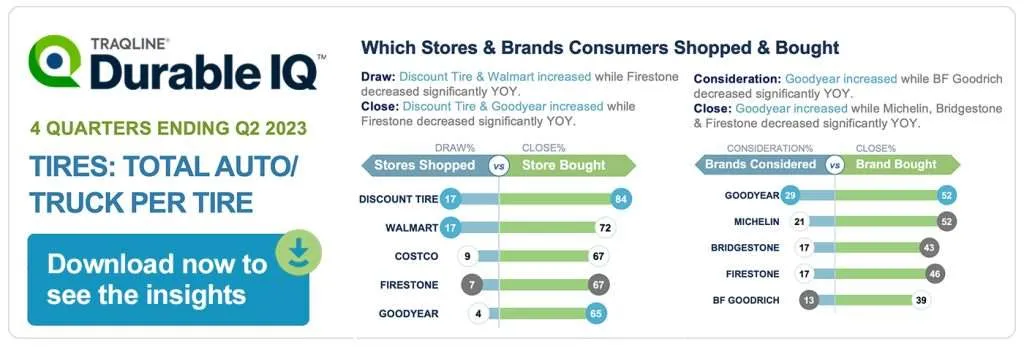
As of June 2023, the top tire retailer is Discount Tire, who leads the tire market in both unit share (14%) and dollar share (15%) — both significant leads.
Other market share insights for tire retailers include:
1. Following behind Discount Tire, the top tire retailers are (in order of share percent) Walmart, Costco, Firestone, and Goodyear. This order holds true for both units sold and dollar share YOY.
2. Firestone is the only major tire outlet to see a decrease in share YOY, down 0.7 points for dollar share and 0.5 points for unit share.
3. All other major tire outlets saw share increases for unit and dollar shares versus this time last year.
4. Notably Discount Tire, our leading retailer, saw the largest change in share compared to the prior year, enjoying increases of 0.6 points and 0.7 points, respectively.
Tire Market: Outlet Draw-Close Rates
As the top two retailers for the tire market, Discount Tire and Walmart also continue to lead other major outlets for outlet draw rate (both with 17%) and close rate, at 84% and 72% respectively.
This means these retailers drew in 17% of tire shoppers, and of that 17%, they closed their respective percent (and therefore did not lose them to another retailer).
Notably, the 17% draw rate enjoyed by these retailers was a significant increase compared to the prior year, likely a contributing factor to their significant dollar gains.
Canadian Tire Market: Top Outlets
For the Canadian tire market, the top outlet is Canadian Tire in both unit and dollar share (21% share and 20% share, respectively).
The next closest outlet is Costco, which came in 8.0 percentage points behind Canadian Tire for unit share (13%) and 4.2 points behind for dollar share (15%).

Which brands lead in tire market share?
U.S. Tire Market: Top Brands
The leading tire brand is Goodyear, winning 15% of the market based on both units and dollars. Goodyear’s market-winning unit share is up significantly YOY, at a growth of 0.8 percentage points. (Want to know the brand’s dollar share? Get the infographic now!)
Other notable top tire brand insights include:
1. Goodyear dollar share saw only a minor gain of 0.2 points versus last year.
2. After Goodyear, the top tire brands in order by dollar market share are Michelin, Bridgestone, Firestone, and BF Goodrich.
3. The order of the top tire brands is similar for unit share, with one exception: Firestone has slightly higher unit share than Bridgestone, putting the brand in third place for units sold.
4. Goodyear is the only top tire brand to gain unit share increase YOY; no brands saw significant increase in dollar share YOY.
[Download the infographic to see the share percentage breakdown by tire brand.]
Brand Consideration Rates
As the top two brands, Goodyear and Michelin lead for brand consideration with 29% and 21% respectively.
Goodyear and Michelin also lead for close rate (both are 52%), however Goodyear’s close rate increased 2.1 points and Michelin’s decreased 1.3 points YOY.
Canadian Tire Market: Top Brand
The best-selling tire brand in Canada is Michelin, winning 17% of the market in units sold and 19% for dollar share.
What is the average price paid in the U.S. tire market?
As of June 2023, the industry average price paid (APP) for tires was $220, which is similar to the $197 average price during the same period in the prior year.
However, the average amount spent at different outlets and by brand can vary. Let’s take a look at some of these variances below.
Average price paid by retailer – tire market insights
- Of all major tire outlets, Costco and Walmart are the outlets showing a notably different average price than the industry average.
- The average cost for tires at Costco comes in $21 higher than the industry APP at $241.
- The average cost for tires at Walmart was $184 – which is $36 lower than the industry average.
- Other major outlets saw an average price paid that was only slightly higher than the industry average (mostly within a $10 range). This includes our market share leader, Discount Tire, where consumers paid an average tire price of $228, which is only $8 higher than the industry average.
Average price paid by brand – tire market insights
Three of the leading tire brands saw an APP higher than the industry average: Michelin ($257), BFGoodrich ($251), and Bridgestone ($246).
Online vs. in-store sales trends for the U.S. and Canadian tire market?
Online vs. In-Store: U.S. Tire Trends
In-store remains the most common sales channel for tire purchases. In fact, 78% of tire sales are made at a physical retail location.

Here are some of the trends that OpenBrand uncovered:
- Only 12% of tire purchases are made online, with the remaining 10% coming from alternate channels such as catalogs.
- Of the 12% that purchase online, 58% ship directly to store.
- After an increase of 0.8 points in June 2022 (rolling 4Q), in-store sales comparatively significantly declined 1.0 point in June 2023.
- Online sales significantly increased 1.0 point in that same timeframe.
- Historically, consumers pay about the same price for tires when purchasing online as they do when purchasing in-store.
- This trend continues for 4Q ending June 2023 with an average price for online shoppers of $221, and an average price of $220 for retail purchasers.
- Among the leading retailers, Firestone shows the greatest gap in APP when comparing online to in-store sales. The average price paid online for tires at Firestone was $37 cheaper than when purchased at a retail location.
Online vs. In-Store: Canadian Tire Market
For the Canadian market, in-store sales are also the most common channel (66%). Online sales account for 15% of total purchases.
Unlike the U.S. market, purchases from other channels (such as catalog, mail order, TV shopping) are much higher in Canada. Interestingly:
- 19% of Canadian purchases are from these alternative channels.
- Canadian purchases from these other channels are up 0.8 points from this time last year.
Other key US tire market insights
Durable IQ is more than market share, delivering a complete understanding of the tire market. Here are a few other key insights as of June 2023!
Tire Shopper Demographics
What demographic makes up the average tire shopper? Here are a few insights from OpenBrand’s census-balanced consumer data:
- 72% of tires purchasers are homeowners
- 62% of purchasers are married
- 54% of tires are purchased with males alone involved in the decision; 16% involve males and females
- 59% of tire shoppers are over 55 years of age
Top Selling Tire Types
Has the recent increase in heavier EV vehicles changed consumer patterns for tire purchases as they look for more durable tires? Not necessarily. As of June 2023, “general everyday driving” continues to be the most popular tire type in both the U.S. (80%) and Candian (46%) markets. Other tire types include:
- Designed for higher performance
- Exclusively for winter conditions
- Designed for terrain such as unpaved surfaces/roads
Though similar to preferred tire type in previous years, purchases of the “general everyday driving” tire type did increase significantly in Canada (+2.9 points) from this time last year.
Tire Purchase Drivers
What moves a consumer to purchase new tires? Here are some insights into the why behind the buy.
Consistently year-over-year, “competitive price” remains the top reason for purchasing at a specific retailer.
- In fact, 53% of purchasers mention “competitive price” as a reason for retailer purchase.
- Both Costco and Walmart over-index in that regard with 80% and 77%, respectively, mentioning “competitive price” as a reason for purchasing at that retailer.
Brands & Outlets Shopped Before Purchase
When purchasing tires, most buyers shop only one outlet (76%) and the majority shop only one brand (57%) before making a purchase.
Get more insight into tire trends and market share
The tire market insights don’t stop here. For more retail sales data, market share, and insights on the tire market, download the OpenBrand-exclusive infographic below. To see insights for other industries or find out how we can help power growth for your business, contact us today.