




Our Televisions: 2025 Year-in-Review report recaps TV launches, placements, pricing and advertising and promotional activity captured throughout 2025. The report features data and insights from OpenBrand’s Television category, which feature products sold through the US ecommerce and brick-and-mortar channels.
Read through all the 2025 pricing and promotions insights below or email the report to read later.
You can also check out our 2025 Year-in-Review reports for other Consumer Electronics categories.
Television Market: 2025 Product Updates
For the US TV market, 2025 was a year of deliberate positioning, defined less by a single breakthrough and more by the steady layering of capability across hardware, software, and market execution. Brands refreshed OLED, Mini LED, and LED portfolios while pushing into ultra-large sizes, sharpening price-tier stratification, and elevating platform differentiation through AI features and ecosystem integrations. At the same time, next-generation display roadmaps gained clearer commercial shape, particularly around Micro RGB and advanced RGB backlighting, alongside continued OLED efficiency progress and new technologies that further separate premium from mass-tier TV experiences. Against a more promotion-aware backdrop, the year’s launch cadence, seasonal sales dynamics, and advertising patterns collectively show how TV manufacturers and retailers balanced demand generation with margin discipline, setting up the competitive priorities that will carry into 2026.

Televisions: 2025 Product Launches
2025 marked a year of broad but disciplined evolution in the US TV market, with leading brands balancing platform-level innovation, portfolio expansion, and increasingly granular tiering strategies amid the backdrop of uncertainty from tariffs and other macro-level factors. Across the year, manufacturers refreshed core OLED, Mini LED, and LED lineups while layering in AI-driven user experiences, extended size ranges toward the ultra-large end, and had more distinct segmentation between premium, mainstream, and value tiers. CES remained the primary stage for strategic direction-setting, followed by staggered pricing, availability, and channel expansion in the spring that reflected both competitive pressure and a more promotion-aware environment. Taken together, brands used 2025 to reinforce ecosystem lock-in, refine differentiation beyond panel technology alone, and position their portfolios for scale as display sizes, software platforms, and use-case expectations continue to grow.
Samsung
Samsung’s 2025 TV activity centered on an AI-led refresh across both premium and mainstream tiers, with announcements beginning at CES and moving into spring pricing/availability and late-summer ultra-large expansion. The company introduced Samsung Vision AI as a common platform across Neo QLED 8K/4K, OLED, QLED, and The Frame, adding features such as Click to Search, Live Translate, gesture controls, and expanded smart-home integrations, alongside a commitment to seven years of One UI Tizen OS updates. Samsung also broadened its design-focused portfolio by updating The Frame and launching The Frame Pro with Neo QLED performance and a Wireless One Connect Box, while expanding Art Store access beyond The Frame to Neo QLED and QLED models. Across hardware, the lineup spanned sizes from 43” up to 115” with updated Neo QLED and OLED series and new mainstream offerings like the Q7 QLED and U8000 LED appearing at US retail; later in the year, Samsung launched the 115” QN90F Neo QLED 4K as its largest Neo QLED 4K model, supported by promotional bundling at launch.
LG
LG’s 2025 TV activity combined a headline OLED refresh with continued expansion of its LCD portfolio and halo-category innovation. The year began at CES 2025 with the debut of the OLED evo M5, LG’s true wireless OLED using the Zero Connect Box, alongside updated G5, C5, and B5 series that emphasized higher brightness, AI-powered processing, and gaming features such as a VRR up to 165Hz. LG offers broad size coverage extending from the low-40” range up to 97” depending on series. In spring, LG opened US pre-orders for the G5 and C5 with launch incentives and maintained pricing close to prior generations, followed by early retail visibility as B5/C5/G5 models appeared on BestBuy.com. LG then moved into premium LCD upgrades with QNED evo launches (QNED85, QNED92, and the flagship QNED9M), extending QNED sizing up to 100” and bringing True Wireless capability to QNED9M, while also rolling out a mass-tier UA77 4K LED series across major online retailers. In the back half of the year, LG listed the wireless OLED evo M5 on its US site and closed the year by unveiling a 136” MAGNIT Active Micro LED positioned as an ultra-premium home cinema display ahead of a 2026 debut.
Hisense
Hisense’s 2025 TV activity paired a broad ULED portfolio refresh with continued emphasis on ultra-large, high-performance display formats. Early in the year, the brand used CES 2025 to spotlight two flagship technologies, the 136” 136MX Micro LED and the 116” TriChroma RGB Mini LED, before formally outlining its 2025 ULED lineup in spring across the U9, U8, U7, and U6 series, spanning 55” to 100” with Mini LED/QLED panels, Hi-View AI processing (by tier), and gaming-oriented refresh rates up to 165Hz, alongside an expanded CanvasTV range adding 75” and 85” sizes to the art-focused series. US market availability then rolled through major channels with the U8 and U7 Mini LED series landing on Amazon.com and BestBuy.com with notable introductory discounts, the QD7QF Mini LED line debuting from 50” to 100” with Fire TV integration, and value-tier A7 Fire TV models appearing on Amazon at aggressive opening prices. In the second half of 2025, Hisense advanced its ultra-premium presence by releasing the 116UX TriChroma RGB Mini LED at $29,999.99 (with early promotions) and placing the 136MX Micro LED on BestBuy.com at $129,999.99, signaling consumer channel movement for its first consumer Micro LED offering.
TCL
TCL’s 2025 TV activity was defined by a stepped rollout that expanded its Mini LED “Precise Dimming Series” from CES through retail launches, while also broadening its mid-range QLED offering. The year began with the CES debut of the QM6K Mini LED lineup (50”–98”) and continued into spring as TCL brought higher-tier Mini LED models into US online channel, including the QM7/QM7K series with sizes up to 115” and the flagship X11/X11K series in 85” and 98” configurations. By late May and early June, TCL’s premium QM8K series appeared on BestBuy.com (65”–98”), followed by the value-oriented QM5K Mini LED line positioned as a BestBuy.com exclusive with aggressive launch pricing across 50”–75”. In the latter half of the year, TCL introduced its flagship QM9K Mini LED series as the first Google TV models to ship with built-in Google Gemini AI (65”–98”), and subsequently confirmed US pricing and availability at BestBuy.com, while November brought a new T7 Series QLED lineup (55”–85”) aimed below the Mini LED tier and sold through Amazon.
Sony
Sony’s 2025 TV activity centered on a three-tier BRAVIA refresh that updated its premium OLED, midrange Mini LED, and entry LED offerings, alongside a coordinated rollout of pricing and expanded US distribution. In April, Sony unveiled the BRAVIA 8 II as its new flagship QD-OLED (55”, 65”, and 77”), the BRAVIA 5 as a Mini LED step-up model (55” through 98”, including Sony’s largest planned TV size), and the BRAVIA 2 II as its entry direct-lit LED series (43”–75”). All its models are powered by the XR Processor with AI and positioned around creator-focused picture modes and IMAX Enhanced/Dolby compatibility. Sony then published US MSRPs later in April, including $3,499.99–$3,999.99 pricing for BRAVIA 8 II and a $1,699.99–$6,499.99 range for BRAVIA 5 depending on size, before expanding online availability through specialty retailers (including Abt, B&H Photo, and RC Willey) in early June for the BRAVIA 8 II at $3,498–$3,998. By late July, Sony’s distribution broadened into mass retail as Walmart added BRAVIA 5 and BRAVIA 8 II listings online with below-MSRP pricing and instant savings, signaling earlier promotional activity as the lineup moved deeper into the second-half sales period.
Others
Panasonic, Amazon, Roku, Sharp, Philips, and Skyworth collectively broadened the 2025 US TV landscape through a mix of platform-led refreshes, re-entry expansion, and niche-category pushes. Panasonic continued building its US presence by previewing a Fire TV-based 2025 lineup at CES (flagship Z95B OLED, W95B Mini LED, and W70B LED), then moved into market with Z95B OLED availability on Amazon.com in 55”, 65”, and 77” sizes at $2,599.99 to $4,699.99, and later introduced a lower-priced 77” Z8BA OLED at $2,499 with broader retail availability beginning mid-November.
In smart-TV ecosystems, Roku rolled out its 2025 Select, Plus, and Pro series across major retailers, expanding coverage from 24” up to 85” and adding higher-end features (including Mini LED/QLED and Dolby Atmos) into more accessible tiers, while Amazon refreshed its Fire TV hardware portfolio with updated Omni QLED flagships and new 2-Series/4-Series models, adding features such as Omnisense presence detection and Alexa+ integration with pricing from $159.99 to $1,199.99. Meanwhile, Sharp launched a new AQUOS QLED 4K line as its first Xumo OS TVs (50”–85” at $350–$1,100), Philips entered Sam’s Club online with its first US-available OLED (65” OLED at $1,299, using Roku TV), and Skyworth expanded the art-TV segment with a Canvas Elite lineup headlined by a 100” model priced at $4,999 and additional Canvas sizes extending up to 100”.

Televisions: Events Changing the Market in 2025
Next-Generation LCD Backlighting and Micro RGB Progresses
In 2025, leading TV brands accelerated development of next-generation LCD backlighting systems built around independently driven RGB LEDs. Sony outlined plans to commercialize an RGB LED backlight architecture capable of exceeding 4,000 nits, delivering wide color coverage (approaching BT.2020), and scaling efficiently to large screen sizes, with mass production targeted for 2025. Samsung advanced this approach further by unveiling Micro RGB technology for ultra-premium TVs, using sub-100-micrometer RGB LEDs behind a 115” display to achieve per-color backlight control, 100% BT.2020 coverage, and AI-driven picture optimization, with U.S. availability planned following an initial South Korea launch. LG joined the Micro RGB category late in the year by announcing its Micro RGB evo flagship LCD TV ahead of CES 2026, confirming commercial intent for 75”–100” sizes and signaling that Micro RGB is emerging as a new flagship tier beyond Mini LED.
OLED Roadmap Progress and Panel-Level Breakthroughs
At the panel level, LG Display reached a major industry milestone by achieving commercialization readiness for blue phosphorescent OLED (PHOLED) panels, completing the technical foundation for a full phosphorescent “dream OLED.” The hybrid tandem blue PHOLED structure delivers approximately 15% power savings while maintaining stability, with initial demonstrations focused on small and mid-size IT displays and longer-term implications for TV panels. At the brand level, Samsung signaled continued OLED portfolio evolution by exploring a broader 2026 lineup that could span entry-level WOLED models through a new flagship tier above the S95 series, indicating a shift toward finer price-tier segmentation rather than a single premium focus.
HDR, AI Platforms, and Ecosystem-Level Differentiation
Beyond hardware, platform-level differentiation emerged as a key theme. Samsung introduced HDR10+ Advanced, a royalty-free next-generation HDR format designed for high-brightness Mini LED and Micro RGB displays, with enhanced metadata for brightness, color, motion, and gaming, and Prime Video confirmed as the first streaming partner ahead of a broader CES 2026 rollout. In parallel, Google began rolling out Gemini AI across premium Google TV hardware in the US, debuting first on TCL’s flagship QM9K TVs and expanding to select 2025 Hisense, TCL, and Onn models. Gemini replaces Google Assistant on TVs, enabling conversational content discovery, summaries, and learning use cases, while requiring higher-end hardware and Android 14, reinforcing a growing divide between premium and mass-tier smart TV experiences.

Televisions: 2025 Timeline of Seasonal Sale Events
Major promotional events in 2025 reflected a more disciplined promotional environment for televisions, marked by generally lower advertising intensity and selective discounting across the calendar. Advertising volumes declined year-over-year for key moments such as Super Bowl, Black Friday, and Cyber Week, while Prime Day and Prime Big Deal Days continued to serve as high-visibility mid-year tentpoles with concentrated deal activity. Discount levels remained competitive but uneven, with deeper savings often concentrated in large-screen and premium segments, and brands such as Samsung, TCL, Hisense, and LG maintaining prominent roles across events as retailers balanced demand generation with margin considerations.
Super Bowl
- Advertising volume leading into Super Bowl 2025 declined 11% YoY
- Best Buy remained top retailer for Super Bowl deals, although it had an ad count decrease of 29% YoY
- Samsung led a collection of 14 participating brands for third consecutive year
- Discounts during period averaged 27%, 4 points ahead of last year, and ranged up to 55% off
- 60” – 69” size class returns to be the most commonly advertised TV type, but 80”+ TVs took up a larger portion of this year’s advertising total
- 83 unique TV deals captured, more than doubling last Prime Day (35) and Big Deals Day (40)
- Overall average discount across brands was 23% off, down 6 pts YoY and down 3 pts from October
- Samsung led in deal count and average savings, Amazon led in discounting
- Amazon’s Prime Day 2025 spurred competing sale events from major online merchants intent to capitalize on increased deal awareness during the week
- 73 unique TV deals captured, nearly double last October’s event, but down 12% from July’s Prime Day
- Overall average discount across brands was 24% off, down two points YoY
- Samsung’s The Frame series was again a visible force, LG brought OLED segment deals, TCL and Hisense promoted Mini LED and QLED TVs
- Amazon’s Prime Big Deal Days 2025 spurred competing sale events from major online merchants intent to capitalize on increased deal awareness during the week
- Black Friday 2025 TV advertising down 15% YoY for event (238 vs. 280 ads)
- Overall average instant savings discount level of 30% off is two points ahead of last year’s 28% off average
- Samsung remains most active Black Friday TV advertiser for sixth consecutive year
- BJ’s Wholesale Club has the most active Black Friday TV ads for third consecutive year
- 50% of all TVs were on sale during Cyber Week 2025, 11 points lower saturation vs. 2024
- Overall average discount level of 26%, 2 points under last year
- Hisense and TCL have highest average discounts at 32% to 30% off, respectively
- Hisense and TCL top average savings landscape with $972 and $768, respectively
Quarterly Advertising Activities
Television advertising volumes in 2025 showed a muted year-over-year trend but clear seasonal and quarterly variation. Advertising activity declined year-over-year in each quarter, with softer levels in Q1 and Q2 followed by a sequential rebound in Q3. Samsung and LG consistently led advertising throughout the year, while activity peaks aligned with key retail and promotional moments, including the Super Bowl, early summer sales, Independence Day, and Prime Day, underscoring the continued role of major events in shaping advertising intensity.
Q1 2025: advertising total down 5% YoY, down 28% QoQ
- Samsung and LG maintain leadership of advertising; pair responsible for 58% of all Q1 2025 ads
- Peak advertising activity comes during lead up into Super Bowl, the again for March Madness
- Best Buy is dominant Q1 2025 advertiser with 60% share, down 6 points YoY, up 8 points QoQ
Q2 2025: advertising total down 9% YoY, down 7% QoQ
- Samsung and LG maintain leadership of advertising; pair responsible for 56% of all Q2 2025 ads
- Q2 2025 advertising activity peaked in early June for key brands to kick-off summertime
- Best Buy is dominant Q2 2025 advertiser with 67% share, down 7 points YoY
Q3 2025: advertising total down 11% YoY, up 16% QoQ
- Samsung and LG maintain respective 1 and 2 rankings QoQ and YoY; pair responsible for half of all Q3 2025 ads
- Samsung led most weeks, except for early September when LG surged to overtake it; TCL ramped up effort to close the quarter
- Best Buy is dominant Q3 2025 advertiser with 78% share, up 13 points YoY, up 11 points QoQ
Televisions: Market Outlook for 2026
The 2025 cycle suggests 2026 will lean further into platform- and processing-led differentiation, with “AI” moving beyond a feature to a main factor that separates premium experiences from mass-tier smart TVs. The expectation is for broader deployment of branded AI technologies and assistants (notably Gemini on higher-end Google TV hardware), alongside continued ecosystem lock-in via longer OS support promises, deeper smart-home integration, and content/discovery enhancements. On the hardware side, the frontier will expand beyond conventional Mini LED as Micro RGB and next-generation RGB backlighting architectures are poised to become a new flagship class (initially in 75”–100”+ sizes), while OLED competition should intensify through finer segmentation, including more price points, more panel variety (QD-OLED vs. WOLED), and clearer “good-better-best” ladders.
Commercially, 2026 is likely to remain promotion-aware and channel-dynamic. Brands will keep widening ultra-large coverage (100”+ becoming more routine), while relying on targeted launch incentives and event-driven discounting rather than uniformly higher ad intensity, especially if macro uncertainty persists. Retail visibility may continue to accelerate earlier in the year as lineups move from announcement to online and mass distribution more quickly, while seasonal tentpoles (Super Bowl and Prime events in particular) should remain the key demand-shaping moments. Successful 2026 strategies will be around pairing picture-performance advances with a clearly differentiated software promise, and systematic promotional timing.
Get more information
Visit our Consumer Electronics industry page to learn more about the data we deliver for the Television market – or reach out to our analyst below to ask questions about this report or get specific insights you need.
About the Author

Related blogs
Explore Our Data
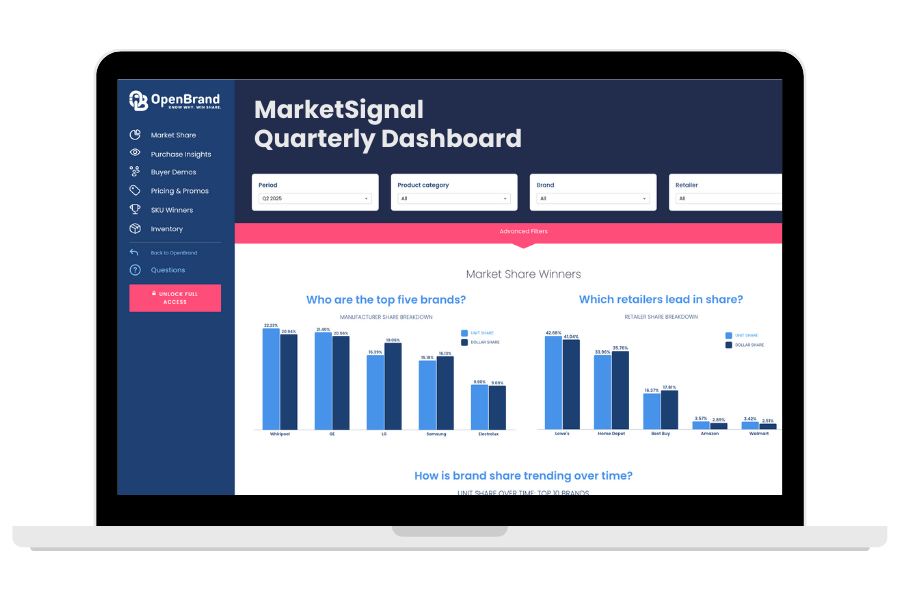
Free Quarterly Dashboards
Explore category-level data dashboards, built to help you track category leaders, pricing dynamics, and consumer demand – with no subscription or fee.
Related blogs

US Major Appliance Market Share: Q4 2025 Trends & Rankings
Q4 2025 closed out the year with the U.S. major appliance market still highly concentrated, as…

Consumer Price Index: Durable Goods | March 2026
This is the April 2026 release of the OpenBrand Consumer Price Index (CPI) – Durable Goods…
Lowe’s Earnings: Market Share Breakdown | Q4 2025
Inside the Q4 2025 Lowe’s Earnings Call Lowe’s closed 2025 with positive growth YoY in Q4, despite…
What Lowe’s Q4 2025 Earnings Say About Appliance Discounting
Discounting and Price Discipline Position Lowe's as Appliance Market Share LeaderAs inflationary…