





Your refrigerator starts making a noise. At first you ignore it, then it gets louder, and a few days later it sounds like a small airplane is preparing for takeoff somewhere behind the milk.
Now you have a decision to make. Buy a new refrigerator today, wait for a sale, buy a less expensive one, or just hope the compressor has enough torque to get airborne and turn up the TV.
That is where tariffs stop being something politicians and economists argue about and start becoming something real people actually have to deal with while standing in the appliance aisle.
Washington can impose tariffs, economists can model them, and politicians can explain exactly what is going to happen next with a level of confidence I have always thought exceeded their historical batting average. Eventually, though, somebody still has to buy the refrigerator.
We wanted to know what those people were actually doing.
So instead of asking 1,000 people how worried they were about tariffs or what they thought they might do if prices went up, we looked at more than 1.2 million durable goods purchase reports during the first halves of 2025 and 2026 and asked what I think are much more useful questions: What did they buy, when did they buy it, and, separately, how did they say tariffs were affecting their purchase behavior?
What we found is more complicated than either side of the tariff debate would probably prefer. Tariffs are changing consumer behavior, but not in one neat, predictable direction.
Consumers Are Moving From “Buy Now” to “Maybe Later”
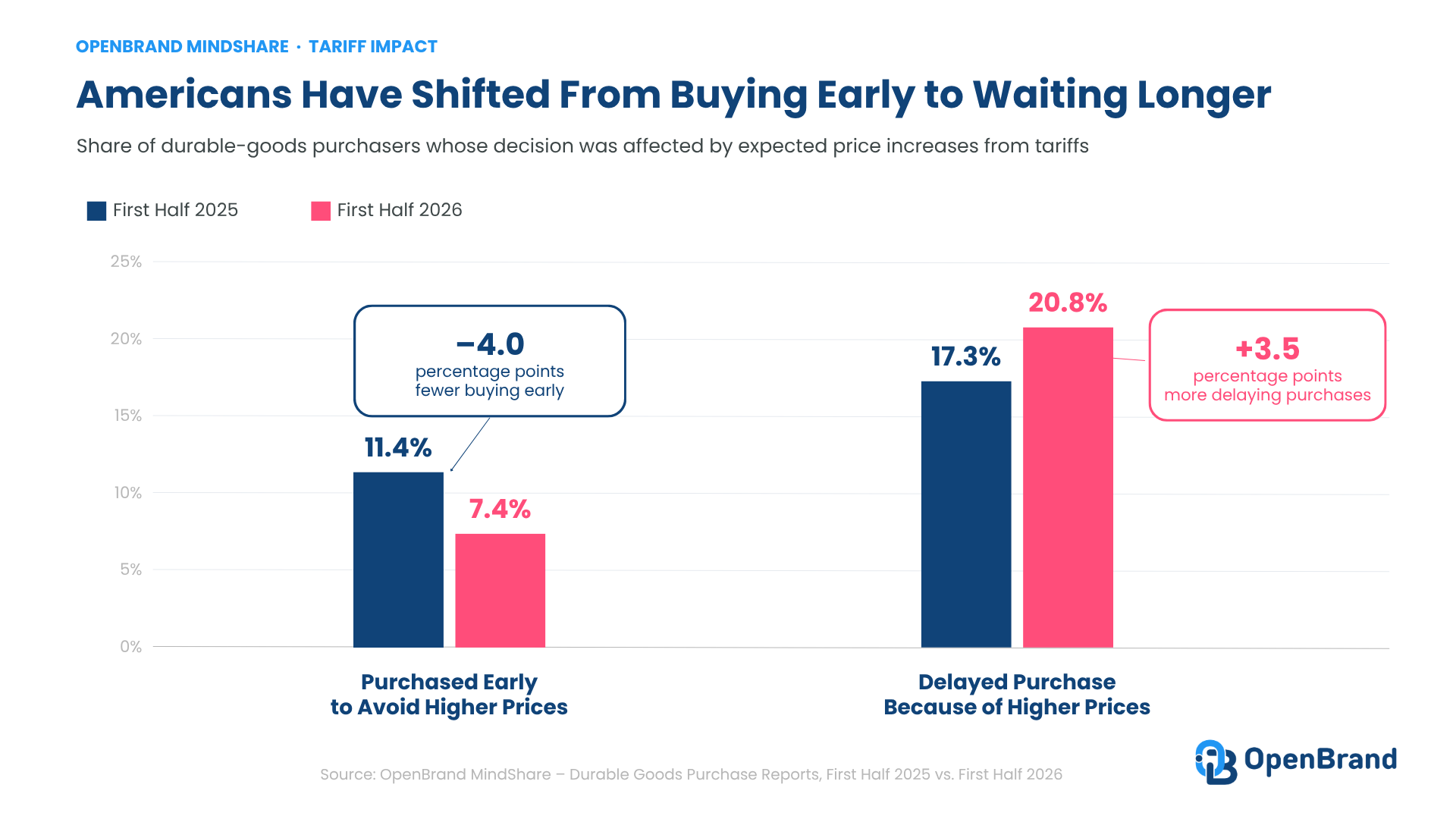
In the first half of 2025, roughly 11% of durable goods purchasers said they bought earlier because they expected prices to rise. By the first half of 2026, that had fallen to about 7%. At the same time, the share saying they delayed a purchase because of higher prices climbed from around 17% to 21%.
That shift lines up with how the tariffs actually arrived… not as one dramatic announcement, but in waves. New tariffs, higher rates and changes in coverage kept the issue in front of consumers through 2025 and into 2026. Consumers weren’t reacting to a single shock. They were adjusting to a series of reminders that prices might not be done moving.
Basically, consumers went from being Captain Kirk “Scotty, we MUST buy one before the price goes up” to Mr. Spock “The refrigerator continues to perform its primary function. Replacing it now would be… illogical.”
That matters because durable goods demand does not necessarily disappear when prices rise. Some of it just moves. The TV waits until Christmas, the lawn mower gets one more summer, and the washing machine keeps limping along until either a promotion shows up or it converts the laundry room into a waterfront property.
Some of that demand will eventually come back and some of it may not, but either way the timing of the market has changed. Do that across millions of households and inventory starts building, forecasts start missing, promotions get more aggressive, and suddenly everybody on the earnings call has discovered the phrase “temporary headwinds.”
A tariff does not just move a number in somebody’s economic model. It changes millions of small purchase decisions, and when enough of those decisions change, the market changes with them.
“A tariff does not just move a number in somebody’s economic model. It changes millions of small purchase decisions, and when enough of those decisions change, the market changes with them.”
American-Made Is Getting More Attention
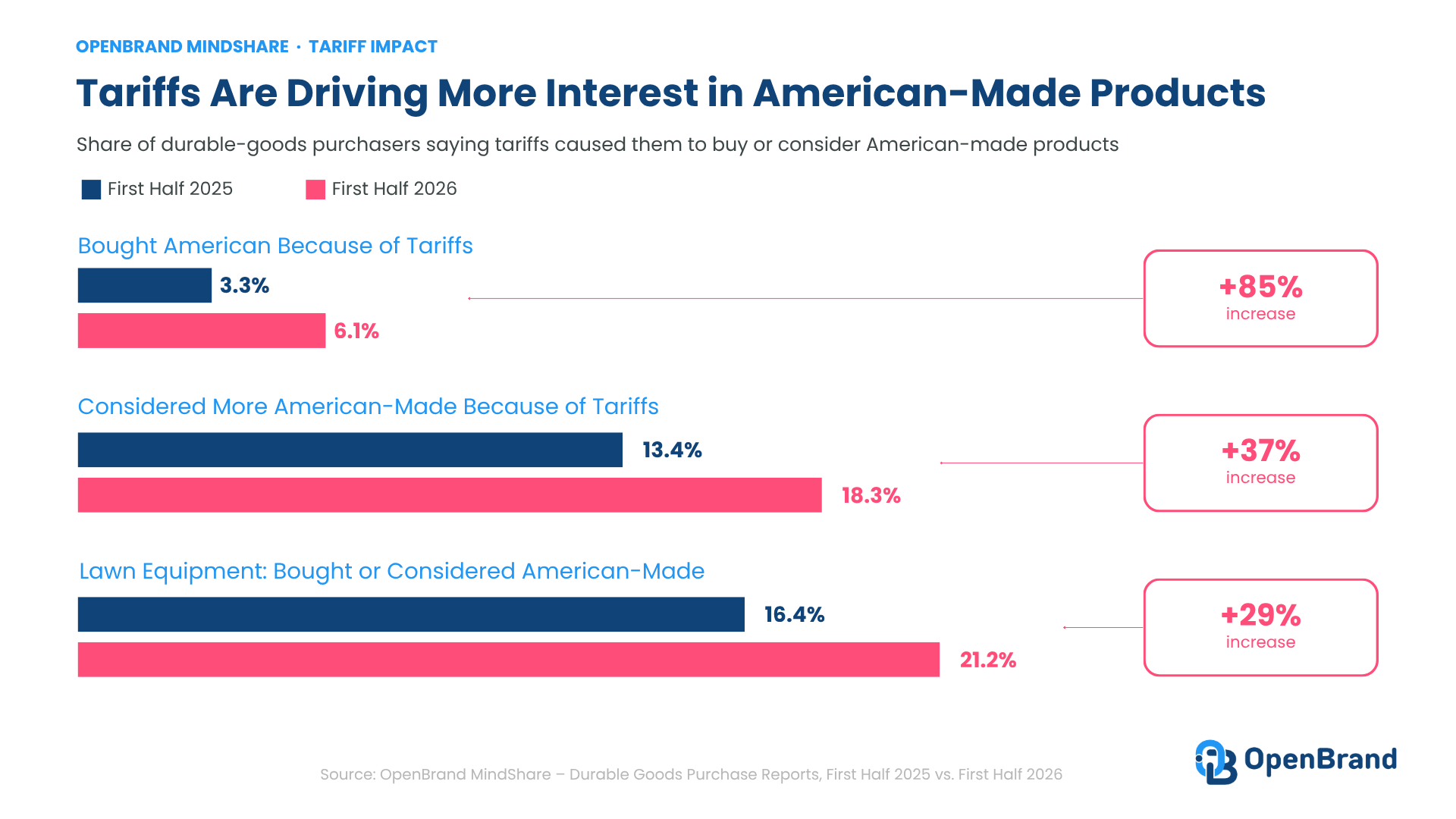
Tariffs are also clearly making consumers think harder about where products are made. Across durable goods, the share saying tariffs caused them to actually buy an American-made product roughly doubled, moving from a little over 3% to more than 6%. Another 12% said tariffs caused them to consider more American-made products.
Put those together and nearly one in five durable goods purchasers either bought American because of tariffs or started looking harder at American-made alternatives. Among lawn equipment buyers, the share who said tariffs pushed them toward American-made products rose from about 16% to more than 21%.
That is a real opening for American manufacturers, but I would keep the champagne corked for now. “Made in America” may get you onto the shopping list, but it does not win the sale by itself. The mower still has to start, the refrigerator still has to keep the yogurt cold, and the product still has to have the right features, be sitting somewhere the customer can actually buy it, and be priced somewhere in the same zip code as what they are willing to spend.
Tariffs can open the door, but they cannot build the factory, design the product, stock the shelf or close the sale.
Brand Patterns Shifted Among Tariff-Influenced Consumers
This is where the data gets particularly interesting.
Among consumers who reported that tariffs caused them to make a purchase earlier than planned to avoid potential price increases, appliance brand purchasing patterns shifted significantly between the first half of 2025 and the first half of 2026. One major manufacturer gained substantial ground among this group, while another saw a near-parallel decline.
The interesting part is not really which two brands they were. It is that the movement was that large inside a group of consumers who specifically told us tariffs influenced when they bought.
Before anybody turns that into a headline, that does not mean tariffs caused one brand to gain eight points and another to lose seven. Promotions, pricing, inventory, retail placement, new products and product mix are all moving at the same time, along with probably ten other things I am forgetting.
But it does make one thing pretty clear: consumers who say tariffs affected their purchase timing do not all move toward the same brands. Consumers still do what consumers usually do. They look at price, quality, features and what is actually available, then buy whatever looks like the best deal. Funny how that works.
Country of origin is clearly entering the purchase decision more often. It just is not making the decision by itself, and that may be one of the most important things in the data.
“But it does make one thing pretty clear: tariffs may influence the purchase, but they do not dictate the outcome.”
So, Are Tariffs Working?
Depends what you mean by working.
If the goal is to make people think harder about where products are manufactured, there is evidence that is happening. If the goal is to create an opening for American manufacturers, the opening is clearly there. If the claim is that tariffs will create no price pressure, delayed purchases or disruption, this data makes that a pretty difficult case to defend.
Like most things involving millions of consumers and trillions of dollars, the answer is not disaster or miracle. It is messier than that.
More consumers are delaying purchases, more are considering American-made products, some brands are gaining, others are losing, and some of the winners are probably not the ones anybody would have guessed when this started.
Somewhere in America, that refrigerator is still sitting on the runway waiting for clearance. The tariff debate keeps asking whether that family is going to pay more to replace it. I think the more interesting question is what they are going to do because they expect to.
Looking for more tariff insights?
OpenBrand's proprietary tariff impact survey monitors how sentiment around purchasing is shifting in light of tariff movement. Our data shows how US consumers are reacting, capturing shifting perception and the impact of tariffs on purchase decisions.
For a deeper look into tariff data across durables categories, contact us today!
About the Author
