




Outdoor Power Shift Webinar: Analyst Insights on OPE Share, Pricing & Promotions
The outdoor power equipment (OPE) market is experiencing its biggest transformation in decades.
From the rapid rise of cordless tools to shifting consumer demographics and tariff-driven price pressures, the industry is entering a new era of innovation and competition.
In our OPE-focused insights webinar, our category analyst, Adrienne Spear, shared deep insight into outdoor power equipment market trends, market share shifts, and what’s ahead for 2025 and beyond.
Watch the webinar now or read the blog below for the highlights.
Check out our OPE market trends blog post for all the latest data in the market.
How much unit share does cordless OPE capture?
Cordless outdoor power equipment has officially surpassed gas and corded products combined, now making up more than 60% of units sold at major retailers.
Growth is strongest in handheld categories like trimmers and blowers, where customer adoption has accelerated due to convenience, quieter operation, and better performance.

What does the shift to cordless mean for OPE brands?
Battery ecosystems are now central to brand loyalty. Once a customer invests in a brand’s cordless platform, they tend to stick with that ecosystem, creating long-term share advantages.
This widespread shift to cordless OPE products signals a structural change in the outdoor power equipment market, and retailers need to stock the right cordless products and cordless brand ecosystems accordingly.
How are tariffs putting pressure on pricing in the outdoor power equipment market?
Tariffs are reshaping the OPE industry, driving higher input costs that manufacturers can’t fully absorb.
Brands like Troy-Bilt, DeWalt, and EGO have raised average prices significantly across categories. Here are some highlights of the price increases over the last 6 months:
- Troy-Bilt handhelds: +12%
- DeWalt handhelds: +10%
- Black+Decker handhelds: +9%
- EGO pressure washers: +12%
- Black+Decker pressure washers: +10%

Consumers are feeling the impact: OpenBrand survey data shows nearly 38% of OPE buyers delayed purchases, bought earlier, or shifted to American-made products due to tariffs in Q2 2025.
This economic pressure is redefining how brands and retailers balance pricing, promotions, and market share. Retailers should be thinking: American-made, compelling promotions, and an awareness that consumers are concerned about tariff-pricing.
How are OPE retailers shifting in 2025?
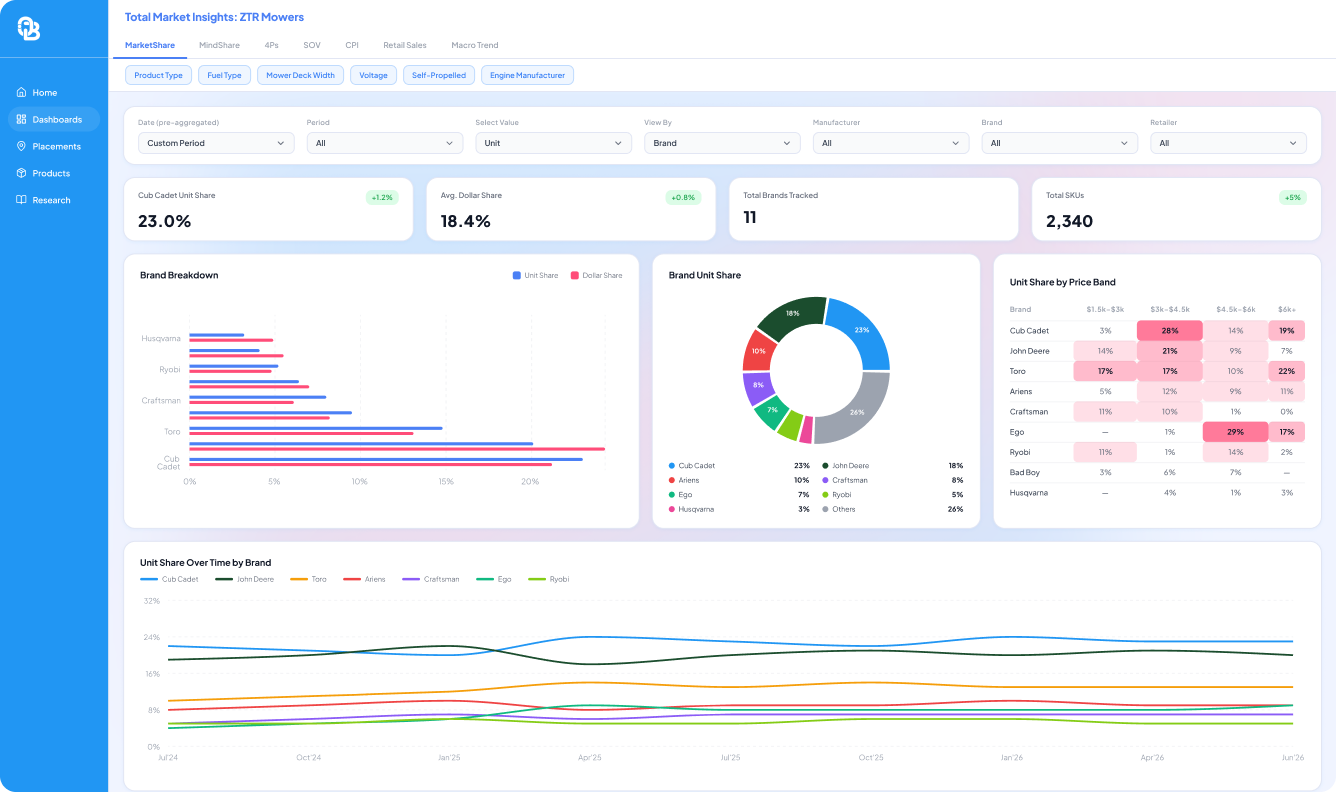
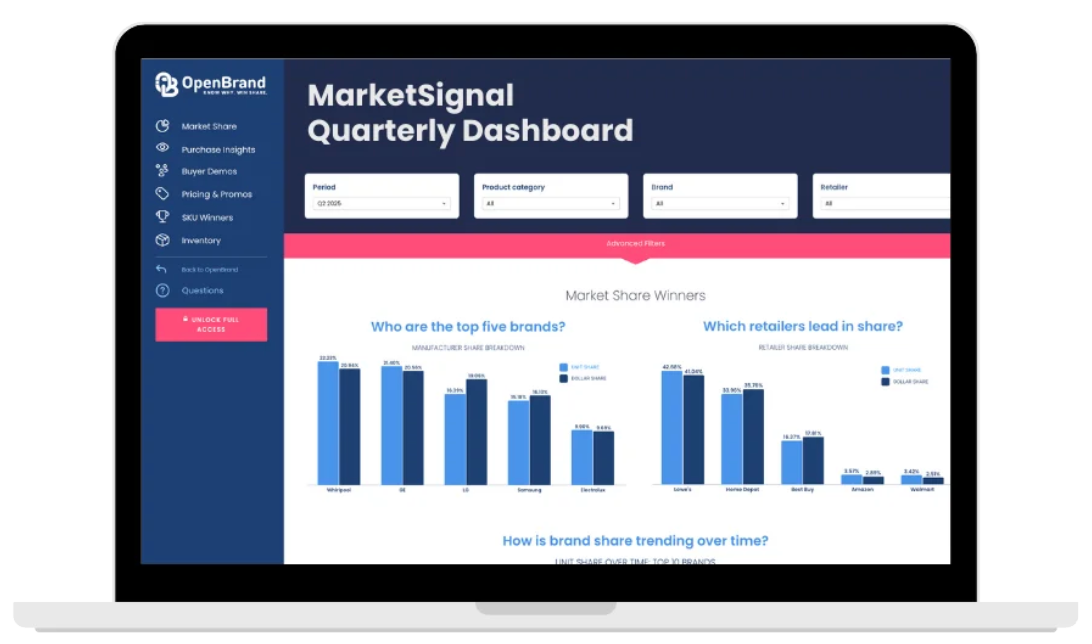
Competition across outdoor power equipment retailers is intensifying. Home Depot continues to lead in unit share, while Lowe’s holds the edge in dollar share. Yet mass merchants, specialty stores, and online platforms are making gains, with Walmart winning on affordability and private-label growth, Amazon leveraging convenience and premium assortments, and Ace Hardware and Tractor Supply Co. carving out space for themselves against these bigger players.
Let’s dive into all these trends in more detail.
Home Depot vs. Lowe’s: OPE Market Trends

Home Depot relies heavily on Ryobi as its anchor brand, which accounts for more than half of its OPE unit share. Cordless dominates the mix with 64% of unit sales, while line trimmers deliver the highest volumes. Walk-behind mowers are the biggest dollar driver at 19%. This strategy positions Home Depot to lock in customers through Ryobi’s battery ecosystem and expand revenue through higher-ticket categories.
- Ryobi = 56%+ of OPE unit share
- Cordless = 64% of unit sales
- Line trimmers = highest unit mover
- Walk-behind mowers = 19% of OPE dollar share
Lowe’s, by contrast, takes a more diversified approach. Craftsman remains its leader, but EGO is the true growth engine, jumping to nearly 40% cordless unit share, up more than 5 points in a year. Zero-turn mowers (ZTRs) drive the largest share of dollars at 27%. Toro has also gained traction quickly, capturing about 24% of gas unit share since entering the retailer in 2024.
- Craftsman = lead brand
- EGO = 39%+ cordless unit share, growing fast
- ZTRs = 27% of OPE dollar share
- Toro = ~24% gas unit share since 2024
Customer spending patterns reinforce these differences. Shoppers spend more per product at Home Depot across most categories, except riding mowers, where Lowe’s leads.
Lowe’s also carries 43% more riders and ZTRs than Home Depot, a clear reflection of its more rural customer base. Meanwhile, Home Depot emphasizes cordless variety, balancing both DIY and pro-level offerings.
Openbrand’s Takeaway: Home Depot is maximizing cordless ecosystems and mid-ticket sales, while Lowe’s leans into premium gas and high-ticket riding equipment.
Walmart vs. Amazon: OPE Market Trends

The rivalry between Walmart and Amazon highlights two very different strategies in the outdoor power equipment market. Walmart prioritizes affordability and volume, while Amazon positions itself around convenience and choice, appealing to both budget-conscious and premium buyers.
Walmart OPE Trends in 2025
- Average spend is nearly 18% lower than Amazon’s, showing its value-driven strategy
- More than half of OPE unit sales are cordless, with almost half of SKUs priced under $100
- Hyper Tough, its private label, grew 7% year-over-year in unit share
- 67% of Hyper Tough buyers cite price as the top purchase driver
Amazon OPE Trends in 2025
- Cordless accounts for 65% of unit sales, with line trimmers leading both units and revenue
- Most units sold are under $100, but premium buyers find EGO and DeWalt in the mix
- Average OPE assortment is priced about 12% higher than Walmart’s, especially in chainsaws, snow throwers, and pressure washers
- Dual positioning allows Amazon to capture value buyers and high-end customers alike
OpenBrand’s Takeaways
- Walmart dominates the entry-level, traffic-driving segment through affordability and private-label strength
- Amazon balances mass-market accessibility with premium appeal, capturing unit share across the value spectrum
Ace Hardware vs. Tractor Supply Company: OPE Market Trends

Specialty retailers are carving out their own roles in the OPE market, targeting distinct customer bases with tailored strategies.
Ace Hardware OPE Trends
- Premium assortment anchored by STIHL and EGO
Chainsaws average over $1,000, reflecting STIHL’s professional-grade presence - Overall pricing is about 16% higher than Tractor Supply’s
- Targets higher-income suburban homeowners who prioritize brand reputation and durability
Tractor Supply OPE Trends
- Broad assortment that appeals to rural and farm-focused buyers
- Mix includes accessible cordless brands like Worx and Greenworks alongside premium riders and ZTRs
- Carries a more premium riding assortment than Ace, positioning itself as a destination for big-ticket equipment
Complements equipment sales with consumables under its “Life Out Here” lifestyle positioning
OpenBrand’s Takeaways
- Ace attracts suburban homeowners with a premium, pro-grade lineup
- Tractor Supply caters to rural customers with breadth in riders and consumables, strengthening its appeal to lifestyle-driven buyers
Together, Ace and Tractor Supply showcase how specialty retailers are thriving by targeting distinct customer segments. Ace appeals to suburban homeowners seeking premium, pro-grade solutions, while Tractor Supply attracts rural customers with breadth in riding equipment and a mix of consumables that complement equipment purchases.
Both strategies expand the competitive landscape beyond the big-box and online leaders, reinforcing the diversity of the outdoor power equipment market.
How are OPE buyers changing?
The OPE buyer base is shifting, with younger generations taking more unit share — but older buyers still dominate in volume. Here’s what our MindShare consumer durables survey data shows.
Generational Shifts
- Millennials & Gen Z: steadily increasing share of items sold
- Boomers & Matures: unit share is declining
- Younger priorities: cordless equipment, sustainability, online shopping convenience
Age Breakdown of Purchases (Q2 2025)
| Age Group | Share of Purchases | Notes |
| Under 25 | Smallest group | Most likely to prefer American-made, due to tariffs |
| 25–34 | Growing | Strong cordless adoption, eco-minded |
| 35–44 | Largest spending segment overall | Value and performance balance |
| 45–64 | Strong presence | Significant unit share of mainstream OPE demand |
| 65+ | Declining | Least likely to change behavior due to tariffs |
OpenBrand’s Takeaway
Younger buyers are shaping the future with cordless and sustainability preferences, while older buyers still account for the majority of purchases. Brands must balance digital-forward strategies for younger consumers with proven performance value for established customer segments.
Sustainability and Innovation Drive the Future of OPE
Regulatory pressure and consumer demand are pushing the industry toward sustainability. California’s statewide SORE emissions ban is just the start, with more restrictions expected across states and municipalities. Looking forward, the next wave of outdoor power equipment market trends will center on:
- Higher-capacity batteries and faster charging
- Robotics and AI innovation, particularly in mowing
- Smart technology integration with apps and connectivity
- Sustainability and recyclability as differentiators
These forces will determine which brands win long-term market share.
OPE Market Changes: Key Takeaways for 2025 and Beyond
Four themes will shape the outdoor power equipment market:
- Cordless dominance — handhelds lead growth, with consumers willing to pay more for performance improvements.
- Tariffs and pricing — costs are rising, forcing shifts in pricing and promotional strategies.
- Retail competition — Home Depot and Lowe’s still lead, but Walmart, Amazon, and specialty retailers are capturing more unit share.
- Sustainability and innovation — regulations, AI, and battery technology will shape the next decade.
Stay Ahead of Market Changes With OpenBrand’s OPE Intelligence
The outdoor power equipment market is evolving quickly, and brands that adapt to cordless growth, price pressures, new consumer behaviors, and sustainability trends will be best positioned for the future.
For a deeper dive into outdoor power equipment market trends and market share insights, watch the full webinar replay or connect with OpenBrand for a personalized demo.
