




Prime Day 2026 still drove strong shopper participation, but OpenBrand’s latest survey shows a more disciplined, value-focused consumer taking shape beneath the headline sales numbers.
 Prime Day 2026 landed as a major mid-year checkpoint for retail, but it didn’t behave like a simple deal frenzy. The event stretched across four days in late June, overlapped with other summer promotions, and still drove strong ecommerce volume, yet the more interesting story is how unevenly that momentum showed up across categories, retailers, and shopper behavior.
OpenBrand’s Prime Day 2026 Shopper Survey Report digs into that behavior, focusing on how durable goods shoppers discovered, evaluated, and purchased during the event. Rather than rehashing headline sales numbers, the report shows where engagement softened, where intent stayed strong, and how those patterns point to a more disciplined, value-focused consumer heading into the back half of the year.
Fast facts
| Prime Day 2026 shopper signal | What the survey suggests |
| Awareness | Shopper awareness declined versus 2025 |
| Cross-shopping | Spillover beyond Amazon remained meaningful, but softened year over year |
| Conversion | Shoppers who visited rival retailers often arrived with stronger intent to buy |
| Spend mix | Spending skewed toward lower price bands and practical categories |
| Strategic takeaway | Prime Day ended up being a more deliberate shopping event than years past |
Inside the shopper read
At a high level, the survey shows that Prime Day 2026 still worked, but it worked differently than in 2025. Awareness slipped, cross-shopping at rival retailers was less intense, and spending clustered in lower price bands.
At the same time, shoppers who did engage often arrived with clear purchase plans and followed through at high rates.
Here are a few themes that stood out in our report:
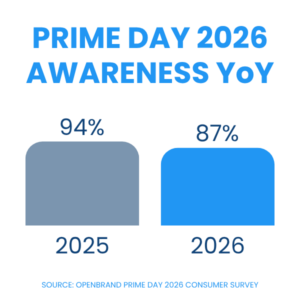 Engagement was broad but less explosive. Most Prime Day shoppers (87%) recall seeing advertising. However, this number is down 7 percentage points (ppts) from 2025, pointing to an event that reached the market with a bit less built-in momentum.
- Spillover was more selective. Prime Day continued to drive traffic to Walmart, Target, Costco, and others, but cross-shopping rates were lower year over year, suggesting that fewer shoppers were casually browsing across multiple retailers. Walmart saw the highest spillover, drawing in 27% of shoppers.
 Intent was high once shoppers engaged. Among those who did visit competing retailers, conversion rates remained notably strong – Costco saw a 100% cross-shopping conversion rate – indicating that cross-shopping was often tied to specific missions rather than window shopping.
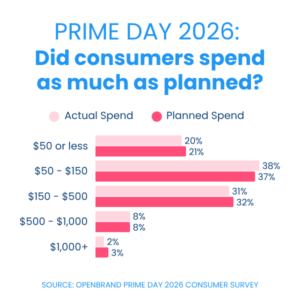
 - Spend skewed toward disciplined baskets. The distribution of spend leaned into lower price bands (with 58% spending $150 or less) and practical categories, reinforcing a more budgeted, value-driven mindset.
The full report provides even more insights into how Prime Day shifted this year, including where shoppers over-delivered versus their pre-event intentions, and where interest failed to convert.
Download the full Prime Day 2026 shopper report to see the detailed charts on awareness, retailer cross-shopping, spend distribution, and category mix, along with OpenBrand’s forward-looking takeaways for Q3 and holiday planning.
What this means for brands and retailers
Prime Day 2026 did not fail to drive demand, but it did reveal a more disciplined shopper. Awareness fell to 87% from 94% in 2025, cross‑shopping softened across rival retailers, and spend concentrated in lower bands, with 58% of shoppers spending $150 or less. Even so, shoppers who engaged converted with purpose, suggesting that demand was still there, just more selective and less event-driven.
For brands and retailers, that raises the bar for Q3 and holiday planning. Broad promotional volume is less likely to break through when only 29% of shoppers said deals exceeded expectations, while 62% said deals simply met them. The better strategy is sharper execution around high-intent moments: stronger category positioning, more relevant offers, and value that feels practical, timely, and easy to act on.
In durables especially, Prime Day points to a market where winning means capturing planned demand, not just generating noise. In electronics, 58% of buyers said they planned their purchase before seeing Prime Day deals, versus 35% who decided after the promotion, while cross‑shopping conversions remained high at Costco, Target, Walmart, and Home Depot. In a more deliberate consumer environment, the advantage goes to brands and retailers that make the path to purchase feel more credible and more relevant, not simply more promotional.
Download the full Prime Day 2026 Shopper Report
Want the full picture behind Prime Day 2026? Get the complete report for deeper insight into shopper awareness, cross-shopping behavior, conversion patterns, spend mix, and category-level trends, plus forward-looking implications for brands and retailers planning for Q3 and holiday.
Complete the form below to access the report.
More Prime Day analysis from OpenBrand
This shopper report is one part of a broader Prime Day 2026 coverage set. For a fuller view of the event, from pricing mechanics to retailer strategy, explore these related pieces:
- Prime Day 2026: Pricing and Promotions Insights — A category-by-category look at how retailers approached discount depth, assortment visibility, and promotional intensity across the event.
- What Prime Day Data Reveals About Consumer Behavior and Retailer Strategy — A broader strategic read on what Prime Day signals about shopper behavior, retail timing, and the evolving role of large promotional events.
Taken together, these pieces offer complementary views of Prime Day 2026: shopper-level insight into behavior and intent, plus market-level visibility into pricing, promotions, and retailer execution.
Conclusion
Prime Day 2026 showed that strong event volume and cautious consumer behavior can exist at the same time. Shoppers stayed engaged, but they behaved more deliberately, with lower awareness, tighter budgets, and clearer purchase intent.
For brands and retailers, that is the clearest signal heading into Q3 and holiday: winning the next promotional moment will depend less on participating loudly and more on showing up with focused value, relevant assortments, and offers built for consumers who are planning carefully before they buy.
If you’re looking to get ahead of the next big promotional window with real-time consumer and pricing insights, contact us today to see how we can help.
Want to prepare for the next key promotional window?
OpenBrand tracks pricing, promotions, and market share across durable goods categories in real time, so you head into each promo window knowing which brands discount deepest, how retailers sequence their deals, and where assortment gaps open up. The same data behind these eleven Prime Day reports feeds line review prep, competitive intelligence, and promotional planning for brands and retailers.
Contact us today to see what OpenBrand’s data can tell you about your categories before the next promo window.