


As consumers close out another treatment season, the lawn care market continues to evolve around three major forces:
- Habit-driven repeat purchasing
- A tightening two-retailer race for share
- A widening split between premium and volume brand strategies
Using data from OpenBrand’s latest Lawn Care Total Market Insights report [download now], we analyzed how consumers are shopping the lawn care category, where retailers are winning and losing share, and which top lawn care brands are gaining traction.
While the data reflects Q4 2025, the trends highlighted below represent the current direction of the lawn care market heading into 2026. The report includes data across our Market Measurement and Competitive Inteligence insights solutions.
SOURCE: All data insights in this article covers Q4 2025 data within the OpenBrand Total Market Insights Lawn Products category. This includes fertilizer, grass seed, pesticides, and weed killer.
Summary: Lawn Care Market Key Stats
- Home Depot leads lawn care retailer unit share at 36%
- Scotts ranks as the top lawn care brand by dollar share at 31%, more than double its unit share
- Products priced between $10 and $19 account for the largest share of units
- 76% of purchases are tied to routine maintenance rather than a one-time problem
- Brand familiarity is the leading purchase driver at 50%, ahead of quality and price
- Baby Boomers represent the largest lawn care buyer segment at 49%
- One in three shoppers leaves without purchasing, with a category walk rate of 33%
Who are the top retailers in the lawn care market?
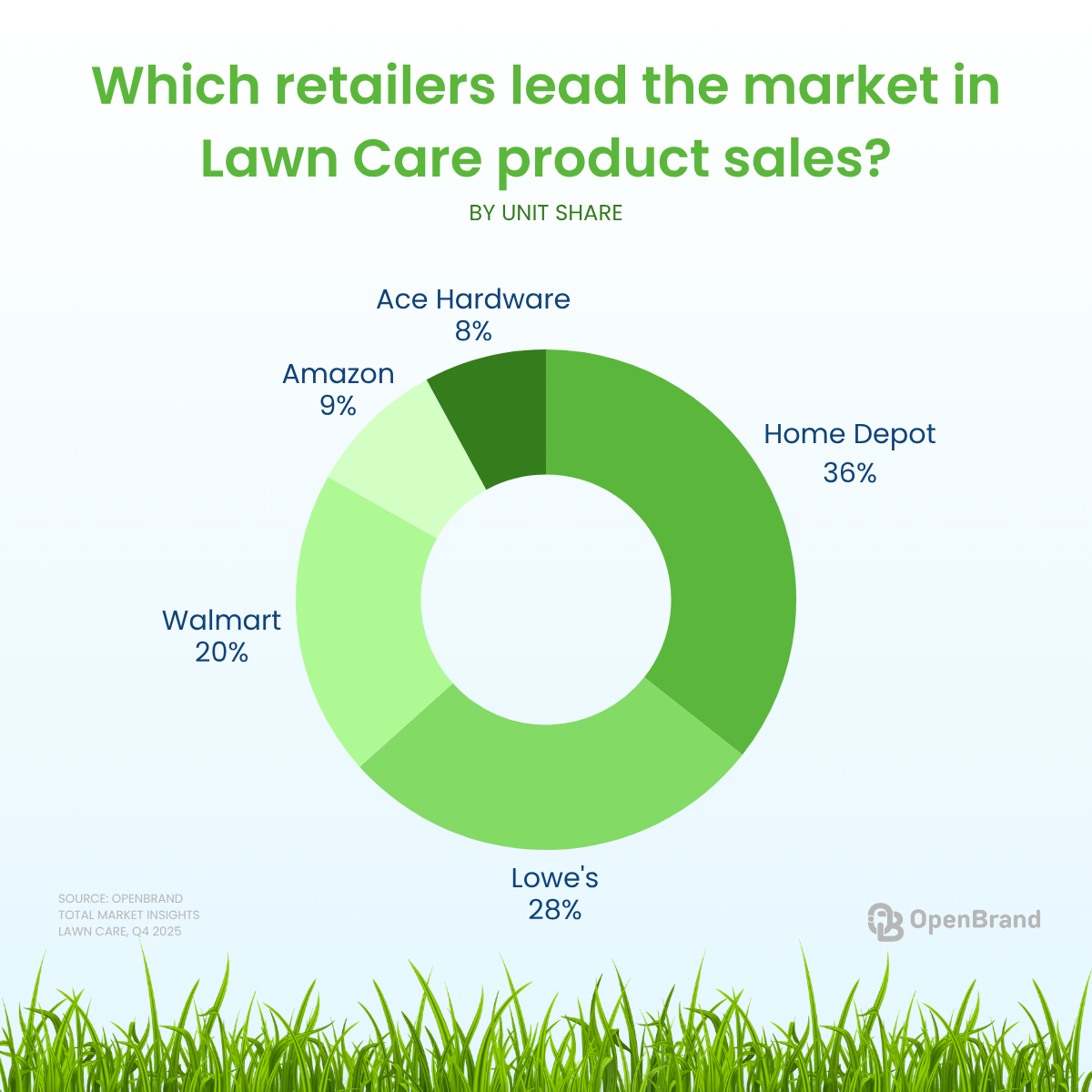
According to OpenBrand’s Q4 2025 market data, retail leadership in the lawn care market is more concentrated than in most durable categories. Among the major retail players, Home Depot and Lowe’s together account for 64% of unit share.
Top Retailers in the Lawn Care Market (Unit Share)
| Rank | Lawn Care Retailer | Unit Share (%) |
| 1 | Home Depot | 36% |
| 2 | Lowe's | 28% |
| 3 | Walmart | 20% |
| 4 | Amazon | 9% |
| 5 | Ace Hardware | 8% |
Source: OpenBrand Lawn Care Market Insights, Q4 2025
OpenBrand’s Lawn Care Trend Insights
Concentration at the top changes what growth looks like in this category. With two home improvement retailers controlling nearly two thirds of units, share movement depends less on national availability and more on assortment depth, seasonal reset execution, and shelf position within those two accounts.
For brands, that raises the stakes of every line review at Home Depot and Lowe’s, because losing a single facing in a category this concentrated is difficult to replace through other channels.
For more lawn care retailer insights, including retailer leakage, conversion trends, and shopper behavior data, download the full infographic.
Lawn care retailers are competing more aggressively for shopper conversion
Because lawn care shoppers buy on a seasonal schedule rather than waiting for a product to fail, the retailer that captures a shopper early in the season often captures the repeat trips that follow.
Q4 2025 Lawn Care Retailer Draw Rates
| Lawn Care Retailer | Draw Rate | Close Rate |
| Home Depot | 39% | 75% |
| Lowe's | 32% | 68% |
| Walmart | 21% | 71% |
| Amazon | 9% | 74% |
| Ace Hardware | 8% | 69% |
Source: OpenBrand Lawn Care Market Insights, Q4 2025
Home Depot leads on both measures, drawing 39% of shoppers and closing 75% of them. Amazon presents the sharpest contrast in the category, drawing just 9% of lawn care shoppers while closing 74% of the ones it does attract.
Want deeper insights into retailer conversion and shopper leakage trends? Download the infographic for the full breakdown.
OpenBrand’s Lawn Care Trend Insights
Amazon’s profile is the most instructive number in the draw and close data. A 9% draw rate paired with a 74% close rate describes a channel that few shoppers browse for lawn care, but one that converts efficiently when a shopper arrives with intent already formed.
That pattern separates two very different retailer problems. Home Depot and Lowe’s compete for undecided seasonal traffic. Amazon competes for the shopper who already knows the product and is replenishing it.
Shopper leakage reveals how directly retailers compete
Retail competition becomes clearer when looking at what happens when a retailer loses a sale, and who gains those lost shoppers. This is uncovered through OpenBrand’s proprietary retail leakage analysis data.
Where Home Depot’s Lost Lawn Care Shoppers Go
| Retailer | Share of Home Depot's Lost Shoppers |
| Lowe's | 41% |
| Walmart | 20% |
| Amazon | 7% |
| Ace Hardware | 6% |
Source: OpenBrand Lawn Care Market Insights, Q4 2025
When Home Depot does not close a shopper, Lowe’s captures 41% of that lost traffic, twice the share Walmart captures and roughly six times Amazon’s.
OpenBrand’s Lawn Care Trend Insights
Leakage confirms what the share data implies. The lawn care market functions as a direct two-retailer contest, and the primary beneficiary of a missed Home Depot conversion is the retailer most likely to sit across the street from it.
With a category walk rate of 33%, one in three lawn care shoppers leaves without buying anything at all. In a seasonal category, that shopper does not simply delay the purchase. They often complete it elsewhere within the same weekend.
How much do consumers spend in the lawn care market?
According to OpenBrand’s market data, lawn care carries a low ticket relative to most home improvement categories. Units concentrate heavily below $30, which shapes how both pricing and promotion work in the category.
Lawn Care Market by Price Range (Unit Share)
| Price Range | Share of Units |
| $0 to $9 | 15% |
| $10 to $19 | 28% |
| $20 to $29 | 24% |
| $30 to $39 | 14% |
| $40+ | 19% |
Source: OpenBrand Lawn Care Market Insights, Q4 2025
OpenBrand’s Lawn Care Trend Insights
Units priced under $30 account for 67% of the lawn care market. At that ticket, a single promotion rarely justifies a dedicated shopping trip, which is why lawn care volume tends to attach to a broader basket rather than drive traffic on its own.
The $40 and above tier still holds 19% of units, so the category is not uniformly low priced. That tier is where dollar share is won, and it explains how a brand can hold a modest unit position while commanding a much larger share of category revenue.
What are the top brands in the lawn care market?
Who leads lawn care market share by brand in Q4 2025?
As replenishment behavior compounds, the gap between brands that win volume and brands that win revenue continues widening.
Leading brands in the lawn care market include:
- Scotts
- Spectracide
- Ortho
- Pennington
- Roundup
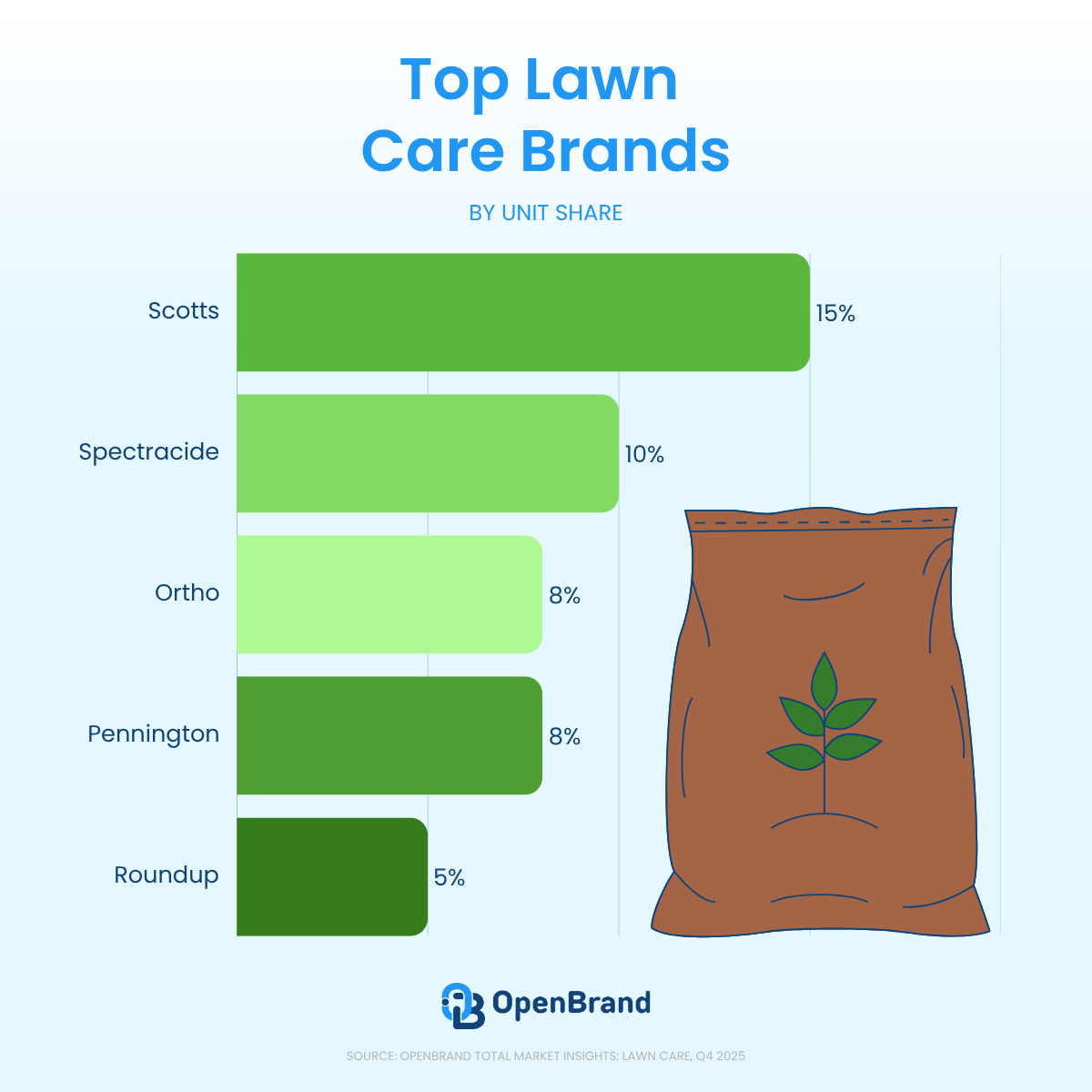
Top Lawn Care Brands Ranked by Market Share
| Rank | Lawn Care Brand | Unit Share | Dollar Share |
| 1 | Scotts | 15% | 31% |
| 2 | Spectracide | 10% | 5% |
| 3 | Ortho | 8% | 6% |
| 4 | Pennington | 8% | 12% |
| 5 | Roundup | 5% | 5% |
Source: OpenBrand Lawn Care Market Insights, Q4 2025
At the same time, the category remains highly fragmented. Brands outside the tracked leaders account for 23.8% of total shelf placements, with more than a dozen brands holding roughly 1% each.
For more insights into top lawn care brands, share trends, product launches, and competitive positioning, download the full infographic.
OpenBrand’s Lawn Care Trend Insights
Scotts converts 15% of category units into 31% of category dollars, the widest unit to dollar gap among the top five lawn care brands. Its two Turf Builder items are also the top two SKUs in the category by unit share, at 1.6% and 1.5%, with average selling prices of $28 and $33.
Spectracide runs the inverse profile, holding 10% of units against 5% of dollars. Pennington sits closer to Scotts, turning 8% of units into 12% of dollars. Three of the top five brands are therefore competing on entirely different terms, and a unit share ranking on its own would misread who leads the lawn care market.
Purchase Drivers: Why are consumers making lawn care purchases?
Lawn care purchase behavior looks different from most categories OpenBrand tracks. Demand is driven by maintenance routine rather than product failure, and brand selection is driven by familiarity rather than price.
Top Purchase Drivers for Lawn Care Brands
| Driver | Share |
| Familiarity | 50% |
| Quality | 38% |
| Price | 36% |
| Features | 31% |
Source: OpenBrand Lawn Care Market Insights, Q4 2025
In addition, 76% of lawn care purchases are tied to routine maintenance, making this a replenishment category rather than a replacement category.
OpenBrand’s Lawn Care Trend Insights
Familiarity leading at 50%, ahead of both quality at 38% and price at 36%, is the defining behavioral fact of the lawn care market. Shoppers are reaching for the product they used last season, and they are doing so on a predictable seasonal cycle rather than in response to a problem.
That combination rewards incumbency and raises the cost of switching a shopper. For challenger brands, the implication is direct:
- price promotion alone is unlikely to break a familiar repeat purchase
- shelf adjacency to the familiar brand matters more than a lower price point
- packaging that communicates application and timing competes on the shopper’s actual decision
- trial has to be won during the seasonal reset, not mid season
Product strategy is diverging across lawn care brands
Across 5,687 total category placements tracked at retail, brands are taking measurably different approaches to growth. The latest data shows:
- variation in discount depth across brands
- differences in shelf presence relative to share
- an uneven pace of product introductions
Lawn Care Brand Discount Depth and Product Debuts
| Brand | Discount Depth | Product Debuts | Share of Shelf |
| Scotts | 20% | 27% | 11.4% |
| Spectracide | 26% | 17% | 4.8% |
| Ortho | 20% | 28% | 5.7% |
| Pennington | 19% | 18% | 6.7% |
| Roundup | 23% | 10% | 4.8% |
Source: OpenBrand Lawn Care Market Insights, Q4 2025
OpenBrand’s Lawn Care Trend Insights
Brands are following one of two strategies, and the shelf data separates them cleanly:
- Ortho and Scotts are pursuing growth through newness, at 28% and 27% of product debuts
- Spectracide and Roundup are pursuing growth through price, at 26% and 23% discount depth
- Pennington is doing neither aggressively, running the shallowest discount depth at 19% while holding the second largest share of shelf at 6.7%
Scotts is the only top brand pairing the largest shelf presence at 11.4% with a high rate of new introductions, which is a difficult position for a challenger to attack on price alone in a category where familiarity is the leading purchase driver.
Online vs. in-store lawn care sales trends
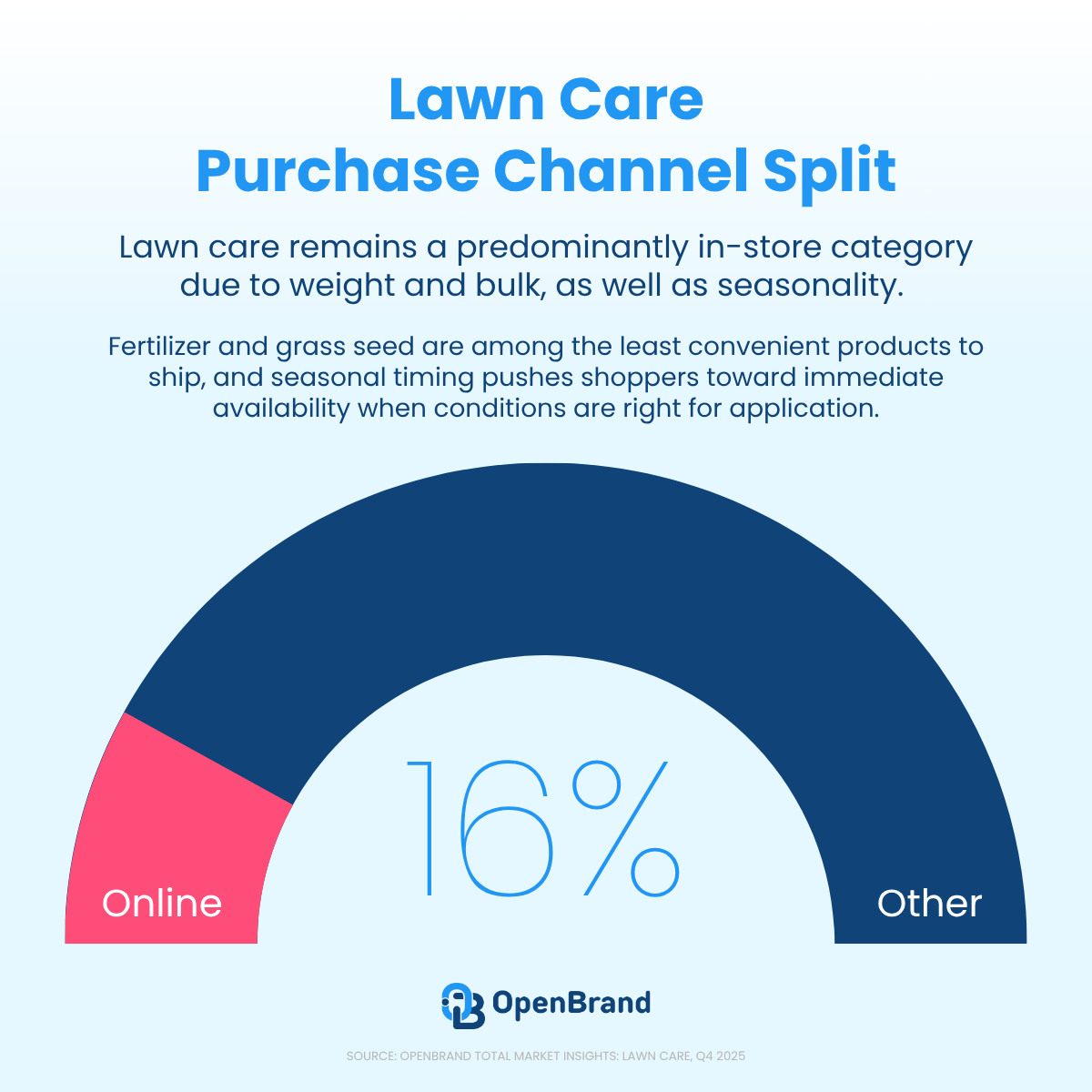
Lawn care remains a predominantly in-store category. Online accounts for 16% of lawn care purchases, with the remaining 84% completed through other channels.
OpenBrand’s Lawn Care Trend Insights
A 16% online rate is low for a category this repetitive, and weight and bulk only partly explain it. Fertilizer and grass seed are among the least convenient products to ship, and seasonal timing pushes shoppers toward immediate availability when conditions are right for application.
That keeps physical shelf position central to lawn care share, and it explains why Amazon converts efficiently on thin traffic rather than building broad category presence.
Lawn Care Shopper Demographics
Older homeowners continue anchoring the lawn care market
OpenBrand’s census-balanced data provides a snapshot of today’s lawn care buyer. Unlike most categories OpenBrand tracks, purchases here skew decisively toward older generations, with Baby Boomers alone accounting for nearly half the market.
Lawn Care Purchases by Generation
| Generation | Share of Purchases |
| Baby Boomers | 49% |
| Gen X | 26% |
| Gen Y | 16% |
| Matures | 5% |
| Gen Z | 3% |
Source: OpenBrand Lawn Care Market Insights, Q4 2025
OpenBrand’s Lawn Care Trend Insights
Baby Boomers and Gen X together account for 75% of lawn care purchases, while Gen Z holds 3%. That age profile reinforces the familiarity finding, since older buyers have had more seasons to establish a brand routine and a preferred retailer.
It also frames the category’s medium term risk. Lawn care demand is tied to homeownership and yard responsibility, so the pace at which younger generations take on both will shape category volume more than any pricing or promotional decision made in the near term.
What this means for the lawn care market
Lawn Care in 2026
The latest lawn care market data points to a category with unusually stable demand and unusually entrenched buying behavior.
Several trends are shaping the market simultaneously:
- Two retailers control 64% of units, making Home Depot and Lowe’s line reviews decisive for brand growth
- Familiarity outranks price and quality, rewarding incumbent brands and raising the cost of winning a switch
- Brands are splitting between newness-led and discount-led strategies, with Scotts holding both scale and innovation pace
- An older buyer base concentrates near-term demand while framing the category’s longer-term volume question
Together, these forces define the current direction of the lawn care market and where the greatest opportunities for growth may exist moving forward.
Want the Full Lawn Care Market Report?
The trends highlighted here represent only a portion of the latest lawn care market data available through OpenBrand.
Download the full infographic to explore deeper insights into:
- lawn care market share by unit and dollar
- retailer performance, draw, close, and leakage
- pricing, discount depth, and average net price trends
- product debuts and SKU-level share winners
- consumer shopping behavior and demographics
Data is also available by individual category, including fertilizer, grass seed, pesticides, and weed killer. To learn how OpenBrand can help your business stay ahead of market shifts, get in touch with our team.
FAQ: Lawn Care Market Trends
Which retailer has the largest lawn care market share?
According to OpenBrand’s modeled MarketShare data, Home Depot leads lawn care retailer unit share at 36%, followed by Lowe’s at 28%. The two retailers together account for 64% of category units.
What are the top lawn care brands right now?
Scotts, Spectracide, Ortho, Pennington, and Roundup are the leading brands in the lawn care market based on OpenBrand’s Q4 2025 data. Scotts leads on both unit share at 15% and dollar share at 31%.
What price range dominates the lawn care market?
According to OpenBrand’s Q4 2025 data, products priced between $10 and $19 account for the largest share of units at 28%, and units under $30 represent 67% of the category.
What is driving lawn care purchases?
According to OpenBrand’s MindShare consumer survey data, 76% of lawn care purchases are tied to routine maintenance, and brand familiarity is the leading purchase driver at 50%, ahead of quality and price.