




Prime Big Deal Days, Amazon’s October Prime Day event, ran October 6-7 with a healthy headline: $9.86 billion in U.S. online spend, up 8.5% year over year, according to Adobe Analytics. The shoppers behind that number were more deliberate, rewarding preparation over impulse.
OpenBrand surveyed shoppers before, during, and after the event and compared the results with June’s Prime Day and 2025 to track how durables shopper behavior is shifting into the holidays. Three forces stood out:
- Planned demand did the heavy lifting. Most shoppers arrived with a purchase already in mind
- Spend split toward the extremes. Small, practical buys and considered $500+ purchases both grew while the middle tier shrank
- Rival retailers converted with precision. Shoppers who left Amazon usually went somewhere specific to buy something specific
This post shares a sample of the findings. Access the full Prime Big Deal Days 2026 Shopper Insights Report now to see every chart, the full category breakdown, and OpenBrand’s recommendations for brands and retailers.
SOURCE: Unless otherwise noted, all data in this article comes from OpenBrand’s 2026 Prime Big Deal Days survey, a subset of the MindShare consumer survey. Results draw on more than 5,100 consumer responses collected October 1-12, 2026, and analyze durables shoppers specifically.
Prime Big Deal Days 2026 Key Stats
- 60% of shoppers came to Prime Big Deal Days with a planned purchase in mind
- 84% saw event advertising, down from 87% at June’s Prime Day and 94% in 2025
- 76% expected Amazon to have the best deals before the event started
- 92% of Home Depot’s cross-shoppers bought there, the highest conversion of any rival retailer
- 60% spent under $150, while 14% spent $500 or more, up from 10% who planned to
- 35% bought consumer electronics, the leading category
- 36% said Prime Big Deal Days deals beat what they expect from Black Friday, while 28% expect Black Friday to be better
Did Prime Big Deal Days shoppers come to buy or to browse?
They came to buy. According to OpenBrand’s 2026 Prime Big Deal Days survey, 60% of shoppers arrived with a planned purchase in mind, either a deal on something already on their list or a plan to stock up on essentials. Browsing still mattered, but it was secondary to the list.
Shoppers could select more than one reason for shopping, and the mix shows how mission-driven the event has become:
| Shopping reason (multi-select) | Share of shoppers |
| Find a deal on something already on my list | 46% |
| Browse discounts or find new products | 40% |
| Stock up on essentials | 30% |
Source: OpenBrand 2026 Prime Big Deal Days survey, durables shoppers
More than one in four shoppers also used the event for holiday shopping, a clear sign that seasonal demand is arriving in early October rather than waiting for November.
OpenBrand’s Shopper Behavior Insights
When 60% of shoppers walk into a two-day sale with a purchase already planned, the deal is not what creates demand. It confirms a decision made earlier. For durables brands, the real competition for Prime Big Deal Days happens in the weeks before the event, when shoppers are building the list.
Prime Big Deal Days ad awareness slipped, but intent held
Fewer shoppers noticed the event this time. According to OpenBrand, 84% of shoppers saw advertising for Prime Big Deal Days 2026, down three points from June’s Prime Day and ten points from the October 2025 event. Softer reach did not translate into softer intent, because the shoppers who knew the sale was coming arrived ready to buy.
| Event | Saw event advertising |
| Prime Big Deal Days 2025 | 94% |
| Prime Day 2026 (June) | 87% |
| Prime Big Deal Days 2026 | 84% |
Source: OpenBrand 2026 Prime Big Deal Days survey; OpenBrand Prime Day 2026 survey
Where shoppers look for deals matters as much as whether they see an ad. Amazon’s own channels led, with Amazon.com at 55%, but 23% of shoppers looked on social media, 22% used Google, and 12% turned to AI tools. The full report ranks all twelve deal-discovery channels.
OpenBrand’s Deal Discovery Insights
Declining ad recall alongside strong purchase intent says awareness is no longer the bottleneck. With one in eight shoppers already using AI tools to find deals, brands need to show up where people search, scroll, and ask questions, not only on the Amazon product page.
How did rival retailers perform during Prime Big Deal Days?
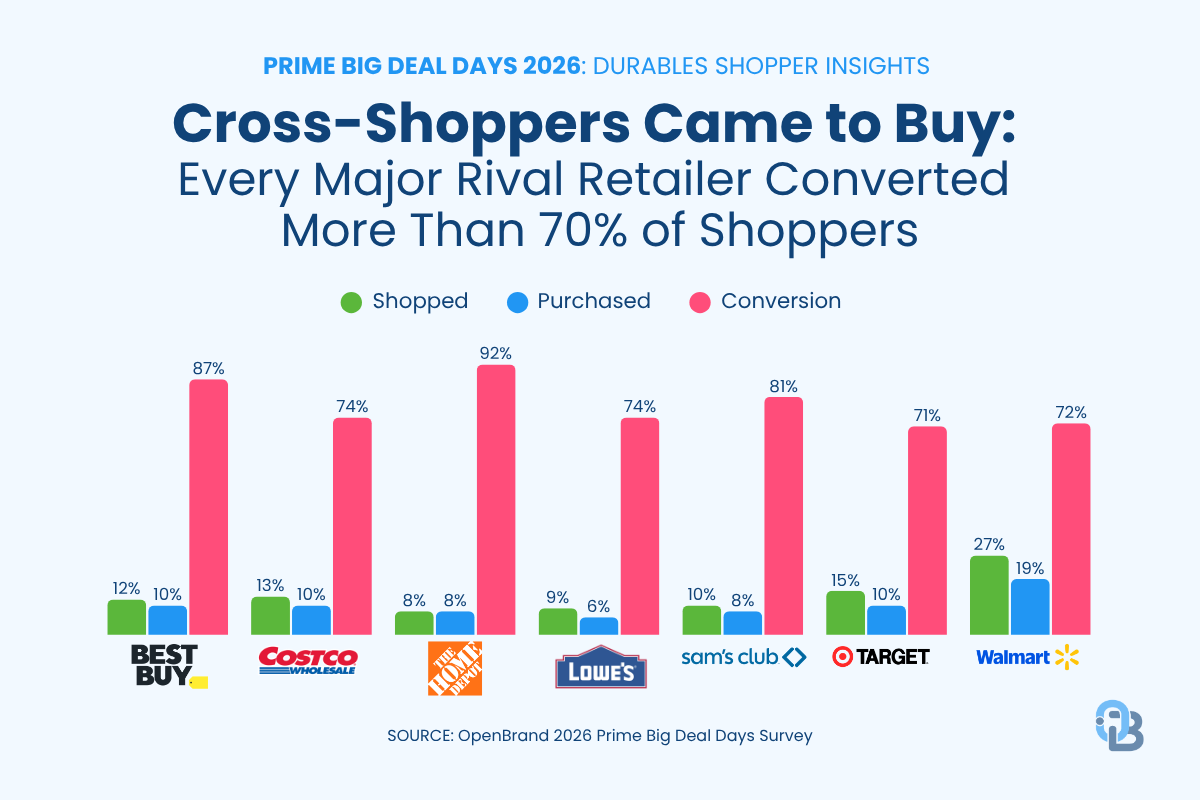
Rival retailers drew fewer shoppers but converted the ones they drew. According to OpenBrand, every major competitor converted more than 70% of the Amazon shoppers who also visited them, led by Home Depot at 92%. Cross-shopping softened from June, yet the shoppers who left Amazon usually had a specific purchase in mind.
Before the event, 76% of shoppers expected Amazon to have the best deals, with Walmart (5%), Best Buy, and Costco (3% each) leading the alternatives. Walmart still drew the most cross-shopping purchases, with 19% of Amazon shoppers also buying there, down from 22% in June.
| Rival retailer | Cross-shopper conversion |
| Home Depot | 92% |
| Best Buy | 87% |
| Walmart | 72% |
Source: OpenBrand 2026 Prime Big Deal Days survey. Conversion calculated on unrounded values. Full retailer results for Costco, Lowe’s, Sam’s Club, and Target are in the report.
OpenBrand’s Retailer Insights
For retailers competing with Amazon’s window, traffic is the battle, not conversion. Conversion rates above 70% at every major rival mean the shoppers who show up are ready to buy. The harder job is getting onto a shopper’s route before they settle on Amazon by default.
Get the full retailer cross-shopping and conversion breakdown in the complete report.
Prime Big Deal Days spending split toward the extremes
Prime Big Deal Days did not push shoppers up a spending tier. It pushed them out of the middle. According to OpenBrand, 60% of shoppers spent under $150 and 14% spent $500 or more, while the $150 to $500 tier fell well short of what shoppers planned before the event.
| Spend tier | Planned before event | Actual spend |
| Under $150 | 54% | 60% |
| $150 to $500 | 36% | 26% |
| $500 or more | 10% | 14% |
Source: OpenBrand 2026 Prime Big Deal Days survey, durables shoppers
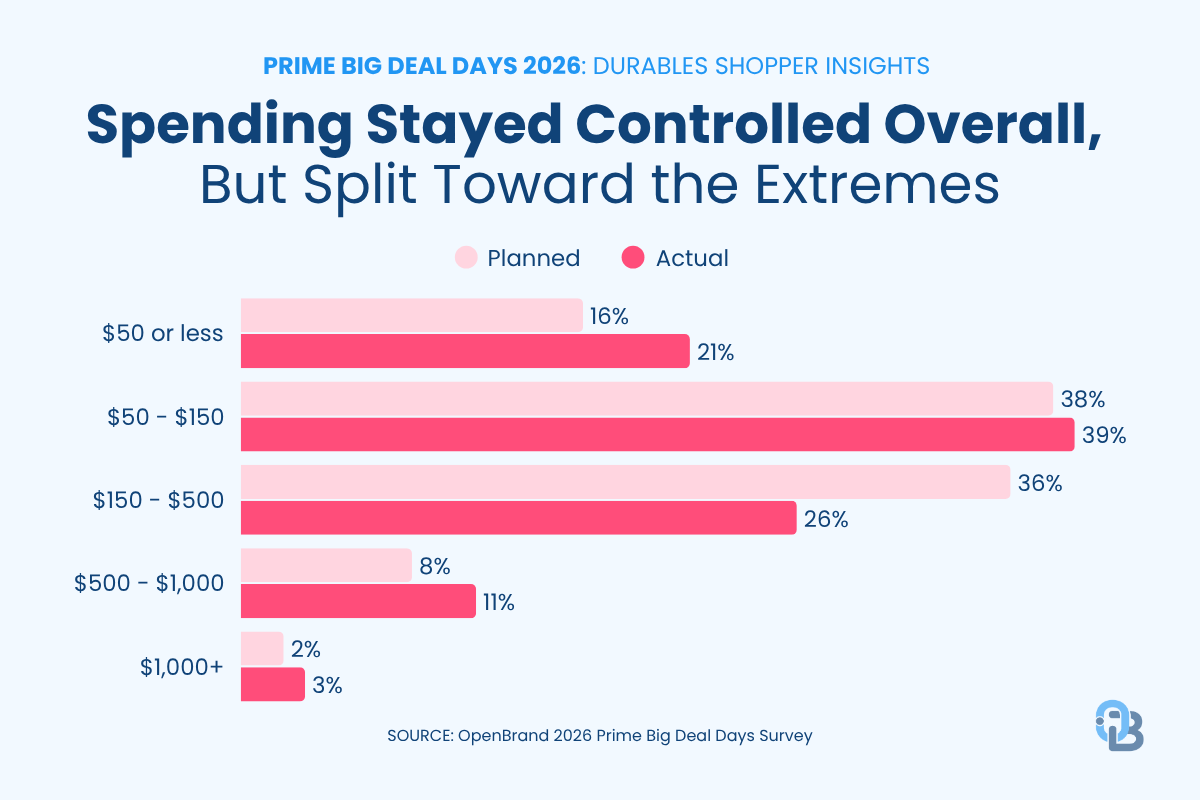
The $500+ group is where the event did its most persuasive work. Those big spenders bought from an average of three categories, compared with fewer than two for shoppers who spent under $150. Sixty-eight percent of them bought consumer electronics, and 60% said these deals beat what they expect from Black Friday.
OpenBrand’s Spending Insights
The middle of the basket is where Prime Big Deal Days lost ground. Shoppers either kept purchases small and practical or committed to a considered major buy. Brands built around mid-tier price points should plan holiday offers that either sharpen everyday value or make a stronger case for trading up.
Which product categories led Prime Big Deal Days 2026?
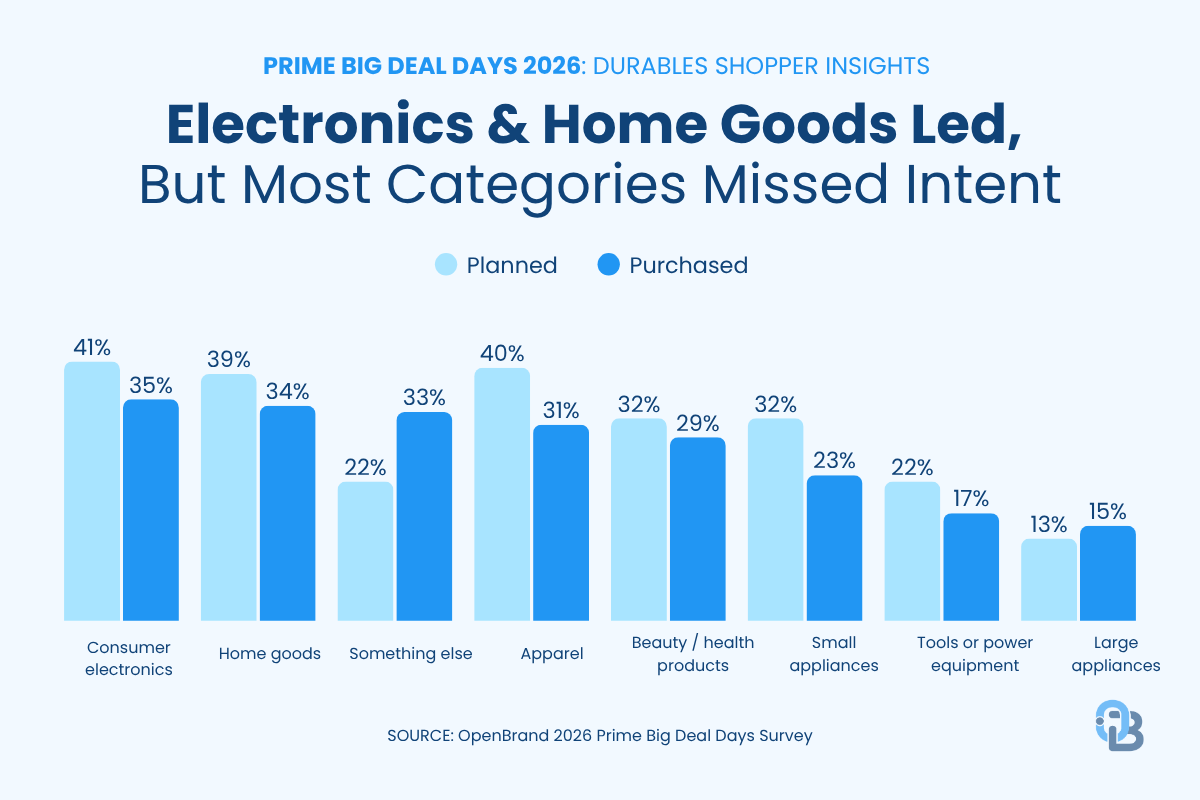
Consumer electronics and home goods led. According to OpenBrand, 35% of durables shoppers bought consumer electronics and 34% bought home goods, both up year over year. Large appliances more than doubled from 7% in 2025, yet most categories still fell short of what shoppers said they planned to buy.
Electronics also stood out as a category where the event itself still changes minds. Most electronics buyers (65%) planned their purchase before seeing the deal, but 31% decided after. For brands, that gap is the opportunity: being on the list earns consideration, but the offer still has to close the sale.
The full report breaks down planned versus actual purchases across eight categories, the electronics product mix from headphones to TVs, and a seasonal shift in tools and outdoor power equipment purchases compared with June.
OpenBrand’s Category Insights
Most categories at Prime Big Deal Days 2026 converted less demand than shoppers planned, with apparel and small appliances each finishing nine points short of intent. Large appliances were one of the few to beat it. For category managers and retail buyers, the gap between planned and actual purchases is a sharper read on event performance than deal counts alone, and a useful input for upcoming line review conversations.
For analyst reads on discount depth, brand participation, and pricing by category, see What Prime Big Deal Days 2026 Told Retailers and Brands: Category Reads.
Did shoppers think the deals were worth it?
Mostly yes, though few were wowed. According to OpenBrand, 27% of Amazon shoppers said Prime Big Deal Days discounts exceeded expectations, down from 29% in June, while 60% said deals met expectations. Planned buying paid off after checkout too: 71% said they do not plan to return anything, up from 68% in June.
That steady-but-unspectacular read lines up with OpenBrand’s pricing data. During the event, 66% of Amazon.com products hit their deepest discount of the prior 30 days, yet only 2% reached their lowest net price. OpenBrand Chief Economist Ralph McLaughlin explains why in Prime Big Deal Days: Bigger Discounts, Not Necessarily Lower Prices.
OpenBrand’s Holiday Outlook Insights
Prime Big Deal Days may have pulled some holiday confidence forward. In OpenBrand’s survey, 36% of shoppers said the October deals beat what they expect from Black Friday, and only 28% expect Black Friday to be better. Brands and retailers heading into November should assume a meaningful share of shoppers already feel they got the deal.
What Prime Big Deal Days 2026 means for brands and retailers
Prime Big Deal Days worked, but on the shopper’s terms. Most decisions were made before the sale began, discounts turned planned purchases into sales rather than growing baskets, and rival retailers converted the shoppers they drew. Four priorities follow for holiday and 2027 event planning:
- Get on the list early. Most buyers decided before the sale, so holiday visibility has to start before the deal goes live
- Plan for both ends of the basket. Spend shifted toward small, practical buys and considered $500+ purchases, not the middle tier, so holiday assortment and offers should be built for both
- Plan beyond Amazon. Rival retailers converted 71% to 92% of the shoppers they drew, so event plans should cover every retailer where your shoppers buy
- Make deals easy to find. Mission-driven shoppers do not dig, so event pricing needs to be visible on the first visit
The full report adds OpenBrand’s retailer-specific recommendations, including how often Amazon shoppers visited during the event and how many always price compare.
Get the Full Prime Big Deal Days 2026 Shopper Insights Report
This post covers a portion of the findings. The complete Prime Big Deal Days 2026 Shopper Insights Report, prepared by OpenBrand Senior Analyst Scott Peterson and Analyst Bryce Tecson, gives brands and retailers the full shopper read on awareness, cross-shopping, spend, and category demand from the October event. It includes:
- All twelve deal-discovery channels shoppers used, from Amazon.com to AI tools and voice assistants
- Planned versus actual cross-shopping and conversion for seven rival retailers
- The full planned versus actual spend distribution, including June versus October comparisons
- Category purchases for $500+ spenders versus shoppers who spent under $150
- Planned versus purchased results across eight durables categories and the consumer electronics product mix
- OpenBrand’s recommendations for brands and retailers heading into the holidays and 2027
Click to view the full report, or contact OpenBrand to see how MindShare shopper insights, paired with OpenBrand market share and pricing data, can inform your next promotional window, assortment plan, or line review.
More Prime Big Deal Days and Prime Day analysis from OpenBrand
- What Prime Big Deal Days 2026 Told Retailers and Brands: Category Reads: analyst reads on discount depth, price floors, and retailer competition by category
- Prime Big Deal Days: Bigger Discounts, Not Necessarily Lower Prices: why record discounts did not mean record-low prices
- Prime Day 2026 Shopper Survey: Key Signals for Durables Brands and Retailers: the June baseline for awareness, cross-shopping, and spend
FAQ: Prime Big Deal Days 2026 Shopper Behavior
How long was Prime Big Deal Days 2026?
Prime Big Deal Days 2026 ran two days, October 6-7. OpenBrand fielded its MindShare event survey from October 1-12 to capture shopper plans before the event, behavior during it, and results afterward.
How much did shoppers spend during Prime Big Deal Days 2026?
According to OpenBrand’s MindShare survey data, 60% of durables shoppers spent under $150 and 14% spent $500 or more. The $500+ share beat pre-event plans of 10%, while the $150 to $500 tier fell to 26% from 36% planned.
Did Prime Big Deal Days deals beat Black Friday?
According to OpenBrand’s 2026 Prime Big Deal Days survey, 36% of shoppers said the October deals beat what they expect from Black Friday, while 28% expect Black Friday to be better. Among shoppers who spent $500 or more, 60% said Prime Big Deal Days deals were better.
Did shoppers buy from retailers other than Amazon during Prime Big Deal Days?
Yes. According to OpenBrand’s MindShare survey data, 19% of Amazon shoppers also bought from Walmart during the event. Every major rival retailer converted more than 70% of the cross-shoppers it drew, led by Home Depot at 92% and Best Buy at 87%.
How does OpenBrand survey shoppers during Prime events?
OpenBrand’s Prime Big Deal Days survey is a subset of the MindShare consumer survey, which tracks durable goods purchase behavior with more than 20 years of category history. For this event, OpenBrand collected more than 5,100 responses before, during, and after the sale and compared results with June’s Prime Day and 2025.
